
0345–0406
Gu Kaizhi
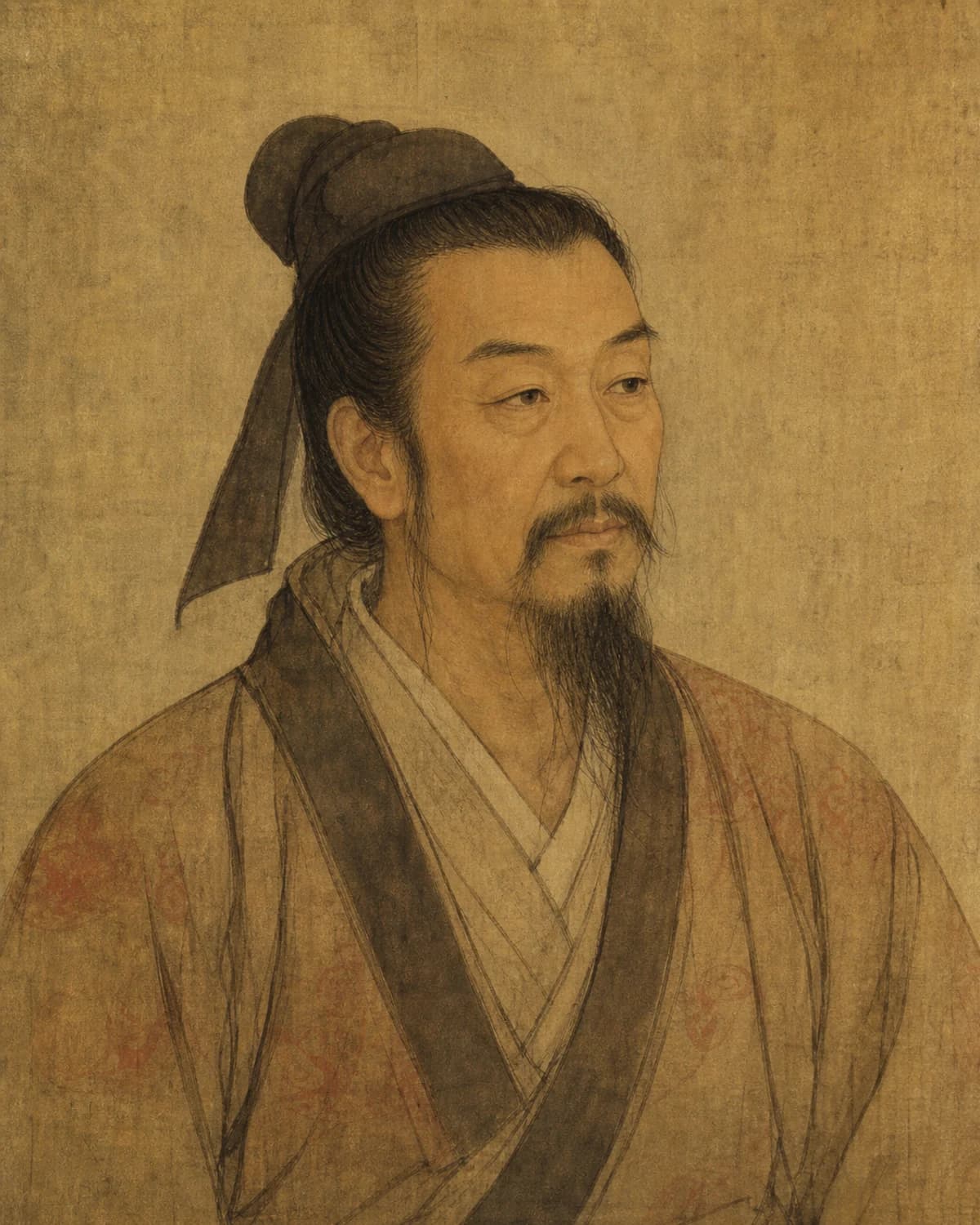
Gu Kaizhi lived in the southern Chinese state of the Eastern Jin, served as secretary to generals and high officials, and wrote poems and treatises on painting. Chinese tradition regards him as the founder of its painting. Three scrolls are linked to his name, the “Admonitions of the Instructress to the Court Ladies”, the “Nymph of the Luo River” and “Wise and Benevolent Women”, but all survive only in later anonymous copies.
Biography
Gu Kaizhi once left a sealed chest of his best paintings with Huan Xuan. Huan carefully opened the chest, took out the scrolls and restored the seals. When the chest came back, the painter saw the unbroken seals and the empty bottom and, if the story is to be believed, explained the loss this way: perfect painting is able to become incorporeal and vanish, like the immortals.
His biography holds far more stories of this kind than dates.
The first anecdotes about him were written down by Liu Yiqing in “A New Account of the Tales of the World” around 430, a quarter of a century after the painter’s death, and the official biography in the “Book of Jin” was compiled in 644–646, when the legends had had time to grow. What emerges from these texts is a man boastful, credulous and witty. Huan Xuan gave him a willow leaf under which cicadas were supposed to hide and assured him that it could make a person invisible; Gu believed him and treasured the leaf. Young people made fun of his bragging. His patron Huan Wen used to say that Kaizhi was odd in every single act and could only be judged as a whole, and from then on Gu was reputed to be first in three things: in wit, in painting and in eccentricity.
He was born around 344 in Wuxi, in what is now Jiangsu province, into a noble family; his father, Gu Yuezhi, served in the imperial secretariat. The painter’s courtesy name was Changkang. In 364, the sources report, he painted for the first time in the capital, Jiankang, today’s Nanjing, and at about nineteen he entered the service of the commander-in-chief Huan Wen. Huan Wen died in 373, Gu Kaizhi responded to his death with poems, and the next twenty years of his life are almost undocumented. At around fifty he became secretary to the high official Yin Zhongkan, and the three of them, with Huan Xuan, liked to compete in eloquence. Later he received a court title. The statesman Xie An ranked his paintings above everything painted before him.
Not a single undisputed work by Gu Kaizhi survives. The three scrolls linked with him were painted by unknown artists and are copies, and their titles do not appear in the Tang lists of his works. I think it is more honest to speak of them as monuments of the Gu Kaizhi tradition than as his paintings.
The best known is the “Admonitions of the Instructress to the Court Ladies”, a scroll measuring 24.8 by 348.2 centimetres, apparently an early Tang copy. It illustrates a moralising text by Zhang Hua, whose lines are written right there between the scenes. Nine scenes survive; the first three are lost. In one, Lady Feng steps between Emperor Yuan and a bear that has broken loose from its chain. In another, Lady Ban refuses to ride in the same palanquin as the emperor so as not to distract him from affairs of state. The calmest scene almost argues with the text: the text bids us adorn not the face but the character, while on the scroll a court lady looks at herself in a mirror as a maid dresses another lady’s hair. The figures are drawn with a thin, even line that has been compared to the silk thread spun by spring silkworms. The earliest seal on the scroll dates from the eighth century; later it passed through the collection of the Qianlong Emperor, in 1900, during the Boxer Uprising, it fell into British hands, and since 1903 it has been in the British Museum. A later Song version, complete with all twelve scenes, is in the Palace Museum in Beijing.
The “Nymph of the Luo River”, a scroll about five metres long, illustrates Cao Zhi’s poem about meeting a river goddess and parting from her. It is known in several copies, the best known of them from the Song period, in the Palace Museum in Beijing, the Freer Gallery in Washington and the Liaoning Provincial Museum. The Liaoning copy is considered the most faithful: in it the text of the poem alternates with the images. The last emperor, Puyi, took it to Manchuria; in 1945 the scroll disappeared and was found ten years later. In the “Nymph of the Luo River” the same hero appears several times, while the mountains, trees and streams form a connected space and serve as visual metaphors for the poem.
“Wise and Benevolent Women” survives in a thirteenth-century Song copy: a five-metre scroll of ten scenes based on Liu Xiang’s “Biographies of Exemplary Women”.
There were also works known only from descriptions. The ninth-century art historian Zhang Yanyuan could still see his wall painting of Vimalakirti in a temple in Jiankang and could admire it for hours. Gu Kaizhi himself described a landscape he had planned, with Daoist immortals at Mount Yuntai. Of his treatises, “On Painting”, “Painting Yuntai Mountain” and “In Praise of Famous Paintings of the Wei and Jin”, fragments survive. He held that the main thing was to convey the spirit of what is depicted: in a portrait, clothes and appearance count for little, the eyes decide everything. He was also a poet and calligrapher, but the collection of his writings is lost, and few of his poems remain.
Gu Kaizhi died in 406. Where and in what circumstances is not known.
Related context
Associations
Works connected through artistic movements, cultural context and period. Priced works available in this market appear first.
Profile notes
Profile and sources
Image
Artist image
На основе открытого изображения: Gu Kaizhi; Wikimedia Commons; Public domain.
