
21.10.1945–present
Grisha Bruskin
Grisha Bruskin (born 1945) works with signs and myths: “Fundamental Lexicon” (1986) sets out figures bearing emblems of Soviet life across large tables, and “Alefbet” builds the world as a book on the basis of the Kabbalah. Since 1988 he has lived in New York and Moscow. He made a triptych for the Reichstag (1999), represented Russia at the 2017 Venice Biennale and has published several books of memoirs and essays.
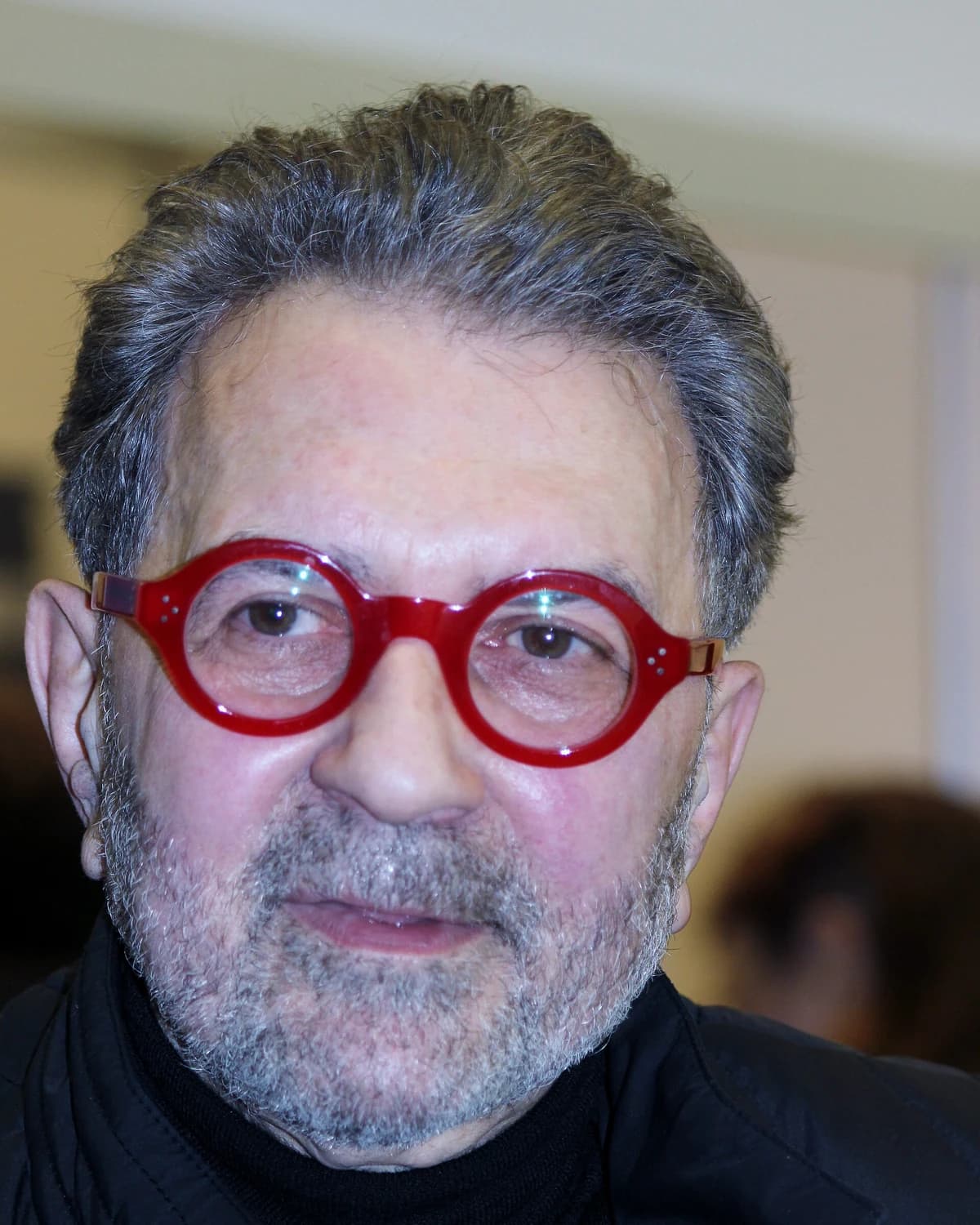
Biography
In 1999 a monumental triptych, “Life Above All”, appeared in the rebuilt Reichstag in Berlin. The German government had invited Grisha Bruskin to make it as an artist representing Russia. By then he had been working in New York for ten years.
Until 1988 his work was barely known even to the Moscow public.
Grigory Bruskin was born on 21 October 1945 in Moscow. From 1963 to 1968 he studied in the art department of the Moscow Textile Institute, and in 1969 he joined the Union of Artists of the USSR. His solo exhibitions were banned more than once, although a few did take place: in 1976 at the House of the Artist in Moscow, in 1983 in Vilnius, and in 1984 at the Central House of Art Workers.
Already in the early series “Alefbet” and “Fundamental Lexicon” he arrived at the structure he still uses: the world is arranged as one vast, all-embracing book. “Alefbet” draws on the ideas of the Kabbalah, but it also contains symbols from other religions and mystical teachings, from the ancient East to medieval Christianity. In “Fundamental Lexicon” (1986) little figures carrying the emblems of official Soviet culture are set out across large tables like dictionary entries. Bruskin’s second constant theme is this very social mythology of the Soviet period. The critic Anna Tolstova observed that whatever he takes up, whether a painting, a tapestry, a porcelain service or a performance with the percussionist Vladimir Tarasov, the result is always a dictionary. I think this is an accurate observation: his characters always look like museum exhibits or illustrations to definitions.
In 1988 “Fundamental Lexicon” made Bruskin’s name known abroad, and that same year he went to America on a cultural exchange. Offers to carry out long-planned projects came at once. Since then he has lived and worked in New York and Moscow. From 1990 the Marlborough Gallery in New York has shown his work regularly. In the early 1990s his painting became more laconic: single figures replaced crowded compositions, and the colour became local, as in the series “Metamorphoses”. At the same time he began to transfer the images he had created into other techniques. In the 1990s his exhibitions were held in New York, San Francisco, Cologne, Chicago, Buenos Aires and Zurich, and in 1992 he had an exhibition at the Russian Museum and a joint project with the poet Lev Rubinstein at the Pushkin Museum of Fine Arts.
In 2001 his first book came out, the memoir “Past Imperfect”; it was later published in English, French and Italian. It was followed by “Yours Truly” (2003), “Letter Follows” (2005), “Direct and Indirect Objects” (2008), a collection of studies of artists, “All That Is Beautiful Is Terrible, All That Is Terrible Is Beautiful” (2016), and a book on revolution and counter-revolution in art, “Seething Rage” (2021). The exhibition “Life Is Everywhere” was shown that same year, 2001, at the Pushkin Museum and the Russian Museum; in 2006 the Pushkin Museum showed “Alefbet” as a tapestry, and in 2010 “Alefbet” was exhibited at the Museum of Jewish Art and History in Paris.
The project “H-Hour” was shown in 2012 at the Multimedia Art Museum in Moscow and won the Kandinsky Prize as project of the year. Next came “An Archaeologist’s Collection”: in 2015 this installation was shown in the former church of Santa Caterina during the 56th Venice Biennale. Two years later, at the 57th Biennale, Bruskin made the project “Change of Scenery” for the Russian pavilion, and in 2017–2018 his exhibition “Soviet Icons” was held at the Palazzo Leoni Montanari in Vicenza. Bruskin’s work is in the Tretyakov Gallery, the Russian Museum, the Pushkin Museum, the Museum of Modern Art and the Jewish Museum in New York, the Art Institute of Chicago, the Israel Museum and the Museum Ludwig in Cologne.
In 2022 the exhibition “Change of Scenery” at the Tretyakov Gallery was closed ahead of schedule. In December 2025 a new solo exhibition of the artist opened in Moscow, at the ZILART museum and exhibition centre.
Profile notes
Profile and sources
Image
Artist image
Rodrigo Fernández; Wikimedia Commons; CC BY-SA 4.0.
