
12.01.1870–11.10.1937
Grigory Gurkin
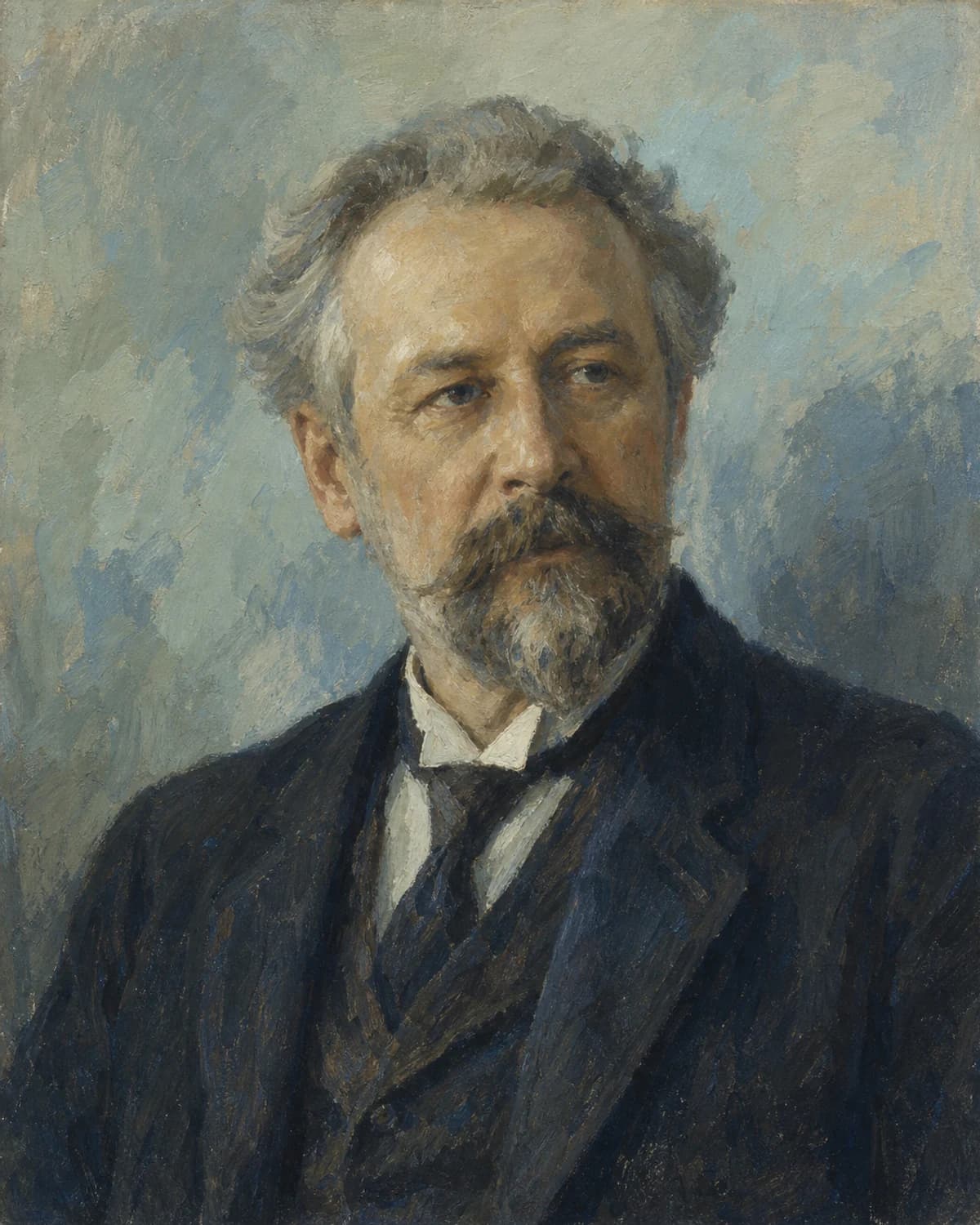
Grigory Gurkin (1870–1937), an Altaian of the Choros clan, began as an icon painter at the mission school in Ulala, studied under Shishkin and Kiselyov at the Academy of Arts and became the first professional Altaian artist. His mountain landscapes, “Khan Altai” and “Lake of the Mountain Spirits”, toured all of Siberia. In 1918 he headed the Karakorum district administration; in 1937 he was arrested.
Biography
In 1942–1943 Ivan Yefremov wrote the story “Lake of the Mountain Spirits”. Its hero, the painter Chorosov, lives not far from Chemal, and the story names his paintings “The Crown of the Katun”, “Khan Altai” and “Deny-Der”, that is, “Lake of the Mountain Spirits”; the mysterious properties of the lake in that picture drive the plot. In the preface to a collection of his stories Yefremov named the painter outright: Grigory Ivanovich Gurkin.
By then Gurkin had been dead for five years.
He was born on 12 (24) January 1870 in the village of Ulala, on the site of today’s Gorno-Altaysk, into a baptised Altaian family of the Choros clan; hence his other name, Choros-Gurkin. In 1878 the boy was placed in the icon-painting class of the school run by the Altai Ecclesiastical Mission. After finishing it he taught for a short while, then went back to icon painting and worked in Ulala and Biysk. In 1896 he met A. V. Anokhin, a collector of Altai folklore, who opened up modern painting to him.
With his first picture, “Night of the Sacrifice”, Gurkin tried without success to gain admission to the Academy of Arts in Saint Petersburg. Orthodox by birth and upbringing, he then had only a vague idea of the everyday life and faith of the Altaians; he began to study them seriously later and left thousands of drawings. His work caught the eye of Ivan Shishkin, who took him in to live and study with him and helped him enter the Academy as an auditor. Gurkin studied with him for only half a year: Shishkin died suddenly at work, before his pupil’s eyes. Gurkin went back to the Altai, returned a few months later and studied under A. A. Kiselyov, again as an auditor. Landscape became his field, and after a brief period of imitating Shishkin he found a manner of his own.
In 1903 he returned to the Altai, settled in the village of Anos, taught, married, and every summer went off into remote parts of the mountains. Mature work came quickly: “The Katun in Spring” (1903), “Lake at Lazha”, “The Yadygem River”, “Karakol”, “Ice Drift”, “Altai. Mountain Valley” (the last four from 1909), “The Crown of the Katun” and “Lake of the Mountain Spirits” (both 1910). One motif runs through a whole series of pictures: rivers and lakes that have just thrown off their ice. The series leads to “Lake of the Mountain Spirits”, now in the Surikov Art Museum in Krasnoyarsk. To my mind, water barely freed from ice is the most personal thing in Gurkin. Over the years he moved from single places to large compositions in which the Altai is shown as a whole. He painted “Khan Altai” almost all his life: the first version dates from 1903, later ones from 1907 and 1912, and the last was made shortly before his death. In other genres he worked less, and with less success.
The nearest city with a real art scene was Tomsk, the provincial capital, to which the Altai Mountains then belonged. In 1906–1907 an exhibition of his work was held there. The intelligentsia of almost all Western Siberia had gathered around the educator G. N. Potanin, and in that circle Gurkin quickly won recognition; from 1909 he was a member of the Tomsk Society of Art Lovers, and the Tomsk merchants the Gadalovs valued and bought his paintings. Between 1906 and 1915 he toured the whole of Siberia with exhibitions.
On 12 May 1917, at the first session of the Tomsk Provincial People’s Assembly, Gurkin gave a report, “On the Altai and Its Needs”, and proposed that the native inhabitants of the Altai be made a separate district. By then he sympathised with Burkhanism, an Altaian religious and political movement. In February 1918 the Karakorum (Karakorum-Altai) District Administration was set up in Ulala, and Gurkin, as the best-known Altaian, was persuaded to head it. In April 1919 the authorities loyal to Kolchak arrested him on charges of separatism and treason and sent him to prison in Biysk. Released on bail, he hid his paintings and left with his family for Mongolia, and from there moved to Tuva, where he drew the everyday life and customs of the local people, including shamanic rituals.
In 1925 he was persuaded to return. At first the reception was enthusiastic: two exhibitions in Novosibirsk, an exhibition in Moscow in 1926 and an approving word from Lunacharsky. Then came routine work: posters, decorations for festivals in the Altai Mountains and Novosibirsk, drawings for an Altai primer, illustrations to the folk epic. He did not give up painting, and his pictures gained in colour, calm and decorativeness.
In 1937 Gurkin was arrested on charges of organising an underground nationalist group and spying for Japan. He was shot on 11 October 1937. In 1956 he was posthumously rehabilitated.
In 1992 the Altai Republic established a prize in his name, awarded on the artist’s birthday, and in 1995 one of the central streets of Gorno-Altaysk was named after him. On 12 January 2006 a museum opened in Anos, in the house where he lived with his family and had his studio, and on 5 July of the same year a monument by V. Chukuev was put up in Gorno-Altaysk. His paintings are kept and shown by the A. V. Anokhin National Museum.
Related context
Associations
Works connected through artistic movements, cultural context and period. Priced works available in this market appear first.








Profile notes
Profile and sources
Image
Artist image
На основе открытого изображения: Гуркин (1870 — 1937, реабилитирован в 1956); Wikimedia Commons; Public domain.
