
29.04.1810–18.01.1893
Grigory Gagarin
As a boy in Rome, Prince Grigory Gagarin (1810–1893) drew alongside Karl Bryullov; he illustrated Pushkin and Sollogub and served in the Caucasus, where he painted the Sioni Cathedral in Tiflis and published the album “Le Caucase pittoresque”. From 1859 to 1872 he was Vice-President of the Academy of Arts and tried to turn Russian church painting towards Byzantine models.
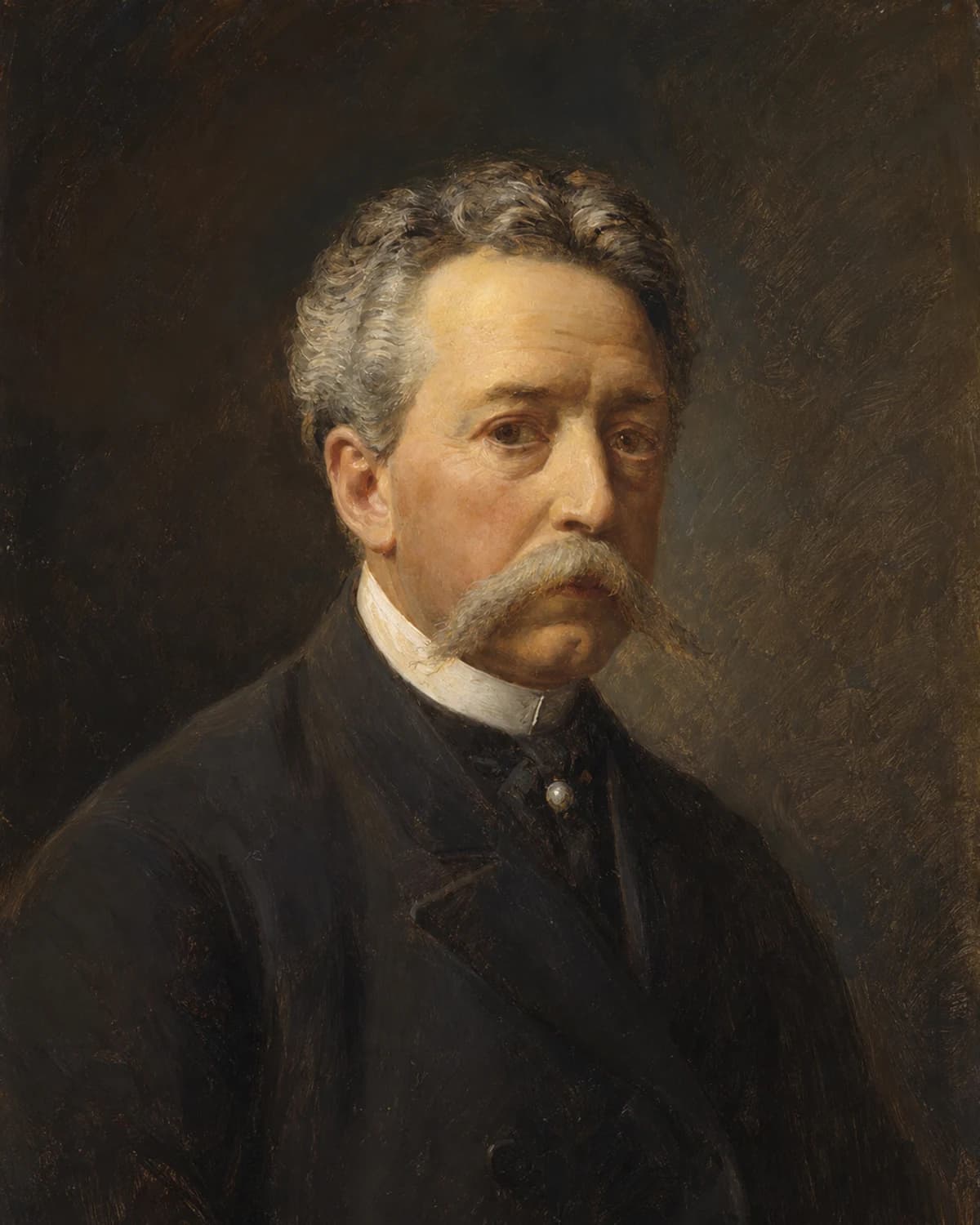
Biography
For the edition of “Tales of A. P.” that Pushkin was planning, the cover, or perhaps the title page, was to be drawn by the young Prince Grigory Gagarin. The subject came from “The Queen of Spades”: Hermann before the Countess. Gagarin had already made vignettes for “Ruslan and Lyudmila” (1832) and “The Tale of Tsar Saltan” (1833). The poet liked the drawings and entrusted him with illustrating three more of his unpublished poems.
Gagarin never had a systematic training in art.
He was born in Saint Petersburg on 29 April (11 May) 1810, or, by other accounts, on 15 (27) May; he was baptised on 20 May in the Church of the Vladimir Icon of the Mother of God in the Court Settlements. His father, Prince Grigory Ivanovich Gagarin, was a diplomat; his mother, Yekaterina Petrovna, came from the Soimonov family. When the boy was six, the family left for Europe and settled in Italy, where his father served as envoy. The Gagarins’ house in Rome was constantly visited by pensioners of the Academy of Arts: Alexander and Karl Bryullov, Bruni, Silvestr Shchedrin, Basin, Halberg. The boy’s first drawings and watercolours, family portraits and landscape sketches, are dated 1815. For a home performance of “The Minor” he painted scenery together with Karl Bryullov and went out sketching with him; later he took lessons from him. At fourteen he was sent to the Collegio Tolomei in Siena, where he spent two years.
In 1829 he was attached to Pozzo di Borgo’s embassy in Paris as an actuary. The post took up almost none of his time, and at the Sorbonne he attended a course in architecture and building, as well as lectures in mathematics, law, philology and philosophy. Then came two years of travel in Europe with a sketchbook. In 1832 Gagarin arrived in Saint Petersburg, entered the Asiatic Department and quickly gained a reputation in society as a skilful draughtsman; among his acquaintances were Zhukovsky, Odoevsky and Pushkin. In the winter of 1833, after a trip to Moscow with his father and brother, he made watercolours of Moscow’s old architectural monuments, very attentive to detail.
In Saint Petersburg he grew close to the “Circle of Sixteen” and to Lermontov. In 1839 Gagarin travelled with Vladimir Sollogub from Saint Petersburg to Kazan; Sollogub’s “Tarantas” grew out of that journey, and Gagarin illustrated it (the engravings by E. E. Bernardsky came out in 1845). In 1840 he followed the exiled Lermontov to the Caucasus, to the Tenginsky Regiment; according to D. A. Stolypin, they shared a tent. Sheets survive with a Latin inscription meaning “Lermontov drew, Gagarin painted”. After the poet’s death in 1841 Gagarin stayed in the army, took part in the Chirkei campaign and received the Order of St Stanislaus, 3rd class, and in 1842 he was on Prince A. Chernyshev’s expedition to Daghestan.
He had become absorbed in Byzantine painting and ornament during his journeys to the East in 1832 and 1837. In 1848 he was attached in Tiflis to the Viceroy of the Caucasus, Prince M. S. Vorontsov, “to be employed in a scholarly and artistic capacity”, and he lived in Tiflis until 1855. A theatre was built there to his design; he painted the Sioni Cathedral in the Byzantine manner and restored the frescoes of old Georgian monasteries, among them Betania. From 1847 his album “Le Caucase pittoresque”, with a text by Ernest Stackelberg, was coming out in Paris, and among his portraits of these years are those of M. K. Orbeliani and D. A. Chavchavadze (Russian Museum). The house of Gagarin and his second wife, Sofia Andreevna, née Dashkova, was then the centre of cultural life in Tiflis.
In 1855 he was appointed to serve under Grand Duchess Maria Nikolayevna, President of the Academy of Arts. In 1858 Gagarin became a major general of the Imperial suite, in 1859 Vice-President of the Academy, a post he held until 1872, and in 1864 he returned to the civil service as a privy councillor. He wanted to rebuild the Academy on the lines of the École des Beaux-Arts in Paris, with separate professors’ studios and pupils attached to them, and he commissioned F. F. Lvov, secretary of the Society for the Encouragement of Artists, to draft a new charter. The charter was approved in 1860. Lectures were introduced at the Academy, attendance at classes was made compulsory, and notes of the lectures were printed and handed out free. The old professors, as Lvov recalled, received the changes with hostility and feared for their official apartments, while Gagarin was not by nature able to act harshly. Under him the repair of the building began, paid exhibitions of young artists were held, with the takings going to grants for students, and the museum was put in order, with the Russian school separated from the foreign and copies from originals. He founded a museum of Christian antiquities at the Academy and strove to bring Russian church painting back to Byzantine models, but these efforts had no lasting result. It seems to me that the story of the charter shows him better than the list of his ranks: a design for the whole Academy and an unwillingness to insist on getting his way.
From 1872 he remained an honorary member of the Academy, and in 1880 he was made Ober-Hofmeister of the court. He wrote on early art: the booklet “The Origin of Five-Domed Churches” appeared in 1881, and “A Collection of Byzantine and Old Russian Ornaments”, in fifty plates, was published in 1887 by Baron Stieglitz’s Central School of Technical Drawing. His collections of Byzantine, Georgian and Old Russian ornaments and architectural monuments came out after his death, in 1897 and 1900.
Gagarin died on 18 (30) January 1893 at Châtellerault in France. He was buried on his own estate of Karacharovo on the bank of the Volga, near the former village of Nikolskoye-na-Suchke, now in the Konakovo district of the Tver region. The Gagarin collection in the Russian Museum numbers about four thousand items, and half of them are drawings and sketches on oriental subjects.
Related context
Associations
Works connected through artistic movements, cultural context and period. Priced works available in this market appear first.








Profile notes
Profile and sources
Image
Artist image
На основе открытого изображения: Viktor Bobrov; Wikimedia Commons; Public domain.
