
13.02.1891–12.02.1942
Grant Wood
Grant Wood (1891–1942) painted the farmers, hills and cornfields of Iowa and, with Thomas Hart Benton and John Steuart Curry, became the leading figure of American Regionalism. His “American Gothic” (1930) is in the Art Institute of Chicago. He helped found an art colony at Stone City and from 1934 to 1941 taught painting at the University of Iowa.
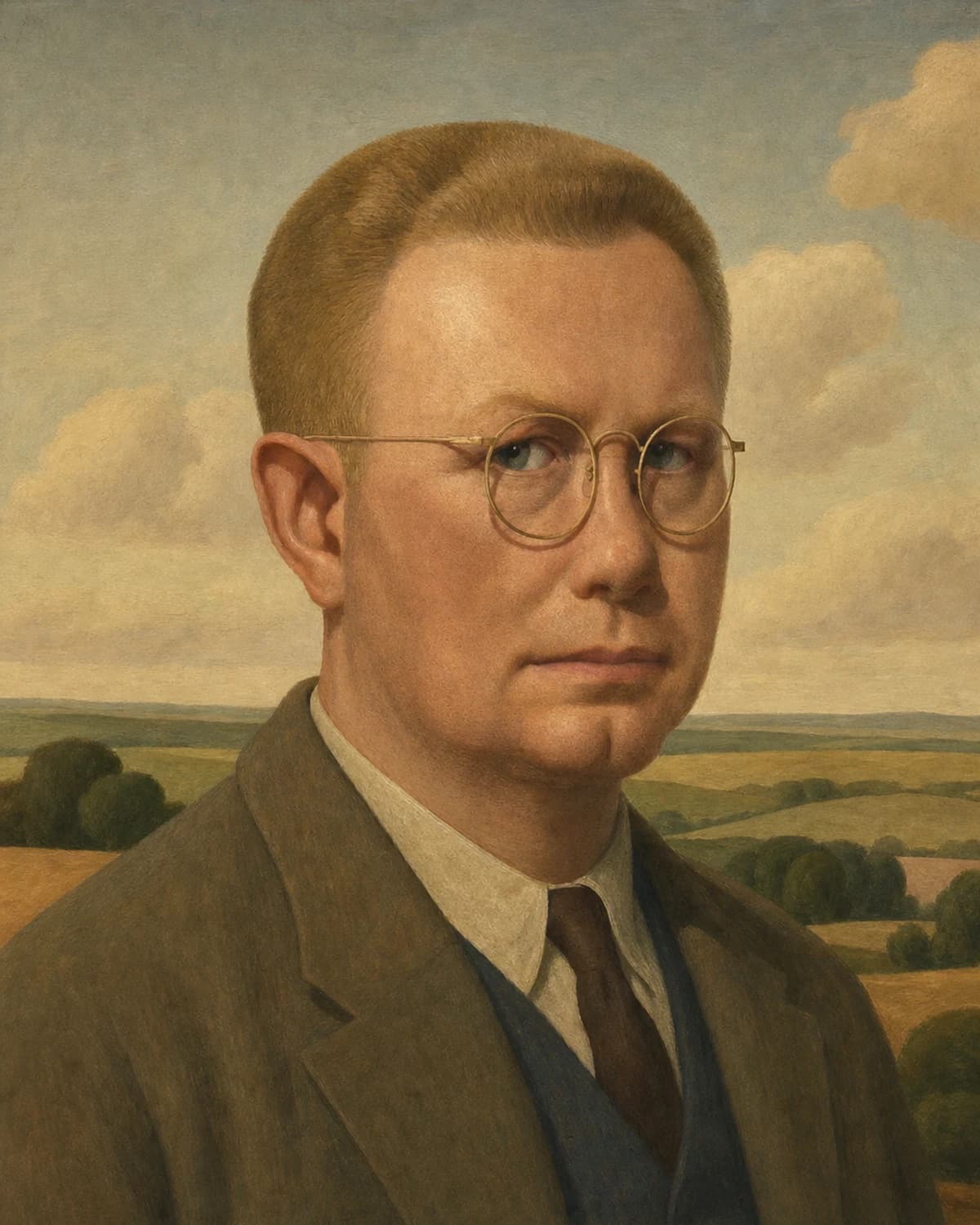
Biography
From 1924 to 1935 Grant Wood lived in Cedar Rapids in the hayloft of a carriage house, which he had converted into a studio. The building had no address, so Wood invented one: “5 Turner Alley”.
By then he had tried his hand at many things. He was born on 13 February 1891 on a farm in Iowa, six and a half kilometres east of Anamosa, the son of Francis Maryville Wood and Hattie DeEtte Wood, née Weaver. His father died in 1901, and his mother moved the children to Cedar Rapids, where the boy was soon apprenticed in a metal shop. After high school, in 1910, he enrolled at the Handicraft Guild in Minneapolis, an art school run entirely by women, and in 1913–1916 he studied at the School of the Art Institute of Chicago and worked as a silversmith. At the end of the First World War he served in the army, designing camouflage. From 1919 to 1925 he taught art to schoolchildren in Cedar Rapids; for pupils who had misbehaved he built a bench on which they waited for the principal, and called it “Mourner’s Bench”, a joke at the expense of Methodist church customs. The summer holidays allowed him to travel to Europe, and he spent the entire 1923–1924 school year there.
Between 1922 and 1928 Wood went to Europe four times and studied Impressionism and Post-Impressionism. The strongest influence on him, however, was Jan van Eyck: from the fifteenth-century Fleming he took the clarity and precision that became the basis of his new manner. In 1928 he went to Munich to oversee the making of the stained-glass windows he had designed for the Veterans Memorial Building in Cedar Rapids.
“American Gothic” was first shown in 1930 at the Art Institute of Chicago, where it still hangs. The painting won a prize, newspapers across the country wrote about it, and Wood became famous overnight. The starting point was a small house in Eldon, in southern Iowa, built in the Gothic Revival style with a pointed-arch window upstairs; Wood decided to paint it together with the people who, as he imagined, ought to live in it. The models were the artist’s sister Nan and his dentist, Byron McKeeby of Cedar Rapids. Beside the farmer, as intended, stands his unmarried daughter, and Nan insisted on exactly this: she did not want to look older than she felt. The severity of the composition and the meticulous handling come from the Northern Renaissance, which Wood had seen in Europe. Gertrude Stein and Christopher Morley took the picture for a satire on the narrowness and insularity of small-town life, Iowans were offended, Wood himself rejected that reading, and with the onset of the Great Depression people began to see in it the steadfastness of the pioneers. I am closer to the third interpretation, in which reverence and mockery are mixed and cannot be separated.
A year earlier he had painted his mother, Hattie, holding a sansevieria (“Woman with Plants”, 1929); the sharp leaves, he later explained, recalled her straightforward character. Then came “Stone City, Iowa” (1930), “Young Corn” and “Fall Plowing” (1931), “Daughters of Revolution” (1932), “Dinner for Threshers” (1934), “Parson Weems’ Fable” (1939) and “Spring in the Country” (1941). He also worked in lithography, ink and charcoal, in ceramics, metal and wood, and to earn a living he drew advertisements and once designed corn-themed décor for a hotel dining room, down to the chandelier.
In 1932 Wood helped found an art colony at Stone City, not far from his birthplace, to help artists get through the Great Depression. He travelled the country lecturing on Regionalism, a movement that set figurative scenes of the American heartland against European abstraction, and helped Curry and Benton return to the Midwest by finding them teaching posts. In 1935 he published the pamphlet “Revolt against the City”. His bohemian youth in Paris was gradually dropped from his public image. In 1934 he headed a New Deal art programme in Iowa City and supervised murals for Iowa State University in Ames, then became an associate professor at the University of Iowa, where he taught painting until 1941; among his students was Elizabeth Catlett. In 1940 he was one of nine artists invited to make drawings during the filming of “The Long Voyage Home”, based on plays by Eugene O’Neill.
Grant Wood died in Iowa City on 12 February 1942, the day before his fifty-first birthday, and was buried in Riverside Cemetery in Anamosa.
His estate passed to his sister, Nan Wood Graham. After her death in 1990 his personal effects and many of his works went to the Figge Art Museum in Davenport.
Related context
Associations
Works connected through artistic movements, cultural context and period. Priced works available in this market appear first.








Profile notes
Profile and sources
Image
Artist image
На основе открытого изображения: Grant Wood; Wikimedia Commons; Public domain.
