
27.06.1926–28.05.2020
Gracia Barrios
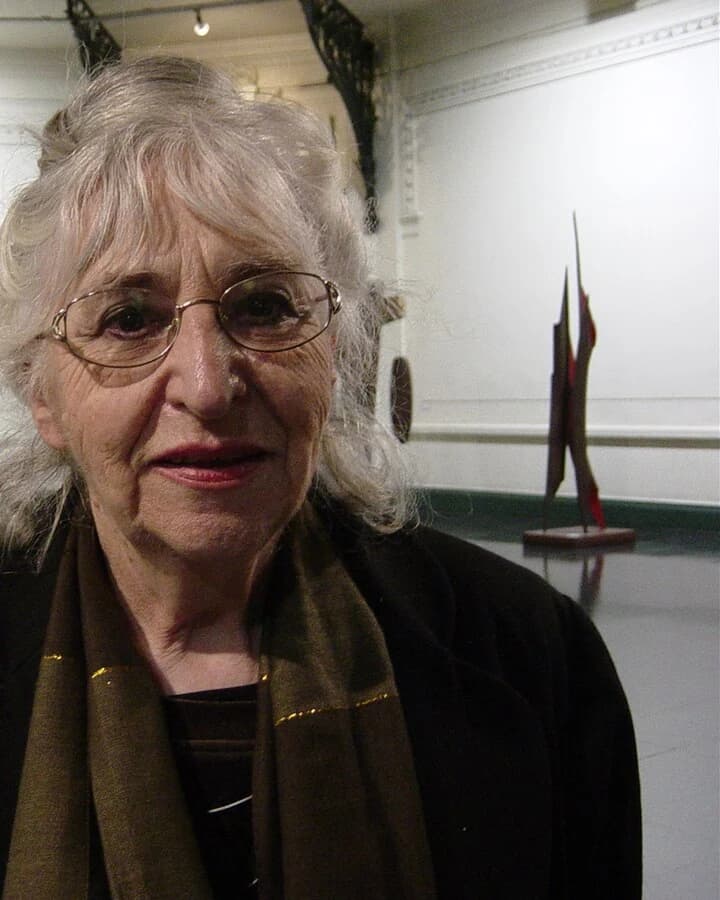
The Chilean painter Gracia Barrios studied at the School of Fine Arts of the University of Chile, belonged to Grupo Signo in the 1960s and moved from figurative painting to an informal style, with earth and clay in the paint layer. After the 1973 coup she spent about ten years in France. In 2011 she received the National Prize for Plastic Arts.
Biography
In 1972, for the building constructed for the third UNCTAD conference in Santiago, Gracia Barrios made a woven wall hanging, “Multitud III”, eight metres wide and three metres high. Her piece was one of the works by about thirty artists. After the military coup of 1973 these works vanished from the building, and decades later the hanging was found and donated to the Museo de la Solidaridad Salvador Allende.
She was born in Santiago, the daughter of the writer Eduardo Barrios and the pianist Carmen Rivadeneira. The date of her birth varies: most often given as 27 June 1926, sometimes 1927. She took lessons from the painter Carlos Isamitt, attended evening classes at the School of Fine Arts of the University of Chile while still at school, and studied there from 1944 to 1949. Her teachers included Augusto Eguiluz, Carlos Pedraza and Pablo Burchard; Burchard influenced her manner most. In 1943, at the university’s open courses, she was introduced to the painter José Balmes, of Catalan origin, and they married in 1952. From 1954 to 1956 they travelled together through Europe, exhibiting and studying contemporary art.
She began teaching in 1953 at the same university, as an assistant in Carlos Pedraza’s drawing workshop, and held other posts until 1973.
In the early 1960s Barrios, Balmes, Alberto Pérez and Eduardo Martínez Bonati formed Grupo Signo. The group broke with Post-Impressionism, argued for abandoning easel painting and drew on European Art Informel. In 1962 its exhibitions were held in Spain and France. In those years Barrios painted in a manner she herself called “informal realism”: torsos, heads and maternities seen on a monumental scale, with a direct approach to the American continent and its people. She used oil and acrylic but mixed earth and clay into the paint to give it density, and obtained dark tones with earth pigments. In the early 1970s she returned to more figurative painting, producing large canvases of an anonymous crowd. Among the themes of her pictures were war, indigence and exile.
Prizes came from the late 1950s. She won first prize for drawing at the 68th Official Salon in Santiago (1957), second prize for painting at the next salon, first prize for painting at the 76th Official Salon (1966) and second prize at the American Biennial of Quito (1968). In 1988 she received an award for her mural at the Workers’ Hospital in Santiago, and in 1996 the Municipal Art Prize of Santiago.
After the 1973 coup Barrios left for France with her husband and daughter, by some accounts on 17 November 1973. They returned to Chile about ten years later, by some accounts in October 1982. In exile she took part in the Luis Corvalán Brigade, later the Pablo Neruda Brigade, and with Balmes and other artists painted murals in the Netherlands, Germany, Italy and France. In 1974, with Balmes and Marés González, she worked on a Neruda play in Nanterre, a suburb of Paris. Her paintings have been shown in Spain, France, Germany, Brazil and Japan, and are in the Barcelona Museum of Contemporary Art and the André Malraux Museum of Le Havre.
Back home she taught again: in 1983–1986 as a visiting professor at the Catholic University, and from 1994 at Finis Terrae University. Of her reasons for leaving teaching she said that art used to revolve around the University of Chile and was therefore more democratic, whereas now creation goes with money and “a good surname”. To my mind, this is one of the few public remarks of hers about art in which personal bitterness can be heard.
In 2011 she was awarded the National Prize for Plastic Arts. The jury noted her “incessant search for the human condition” and the relation of the human being to its existential and historical contexts. Around 2013 she gave up painting. Her daughter Concepción Balmes and granddaughter Elisa Triviño compiled a catalogue of the couple’s works, and in 2019 produced a catalogue raisonné of the legacy of Barrios and Balmes. Barrios died on 28 May 2020 in Santiago and is buried in the El Totoral cemetery, beside Balmes.
Profile notes
Profile and sources
Image
Artist image
Paloma Baytelman; Wikimedia Commons; CC BY-SA 2.0.
