
1527–11.07.1593
Giuseppe Arcimboldo
Giuseppe Arcimboldo (c. 1527 – 1593), a Milanese, began with stained glass for the cathedral alongside his father, and from 1562 served the Habsburgs in Vienna and Prague for a quarter of a century: he painted portraits, staged tournaments and festivities, and bought curiosities for the Kunstkammer. His “composite heads” of flowers, fruit, fish and books, the cycles “The Four Seasons” and “The Four Elements”, forgotten for three centuries, were brought back in the twentieth by the Surrealists.
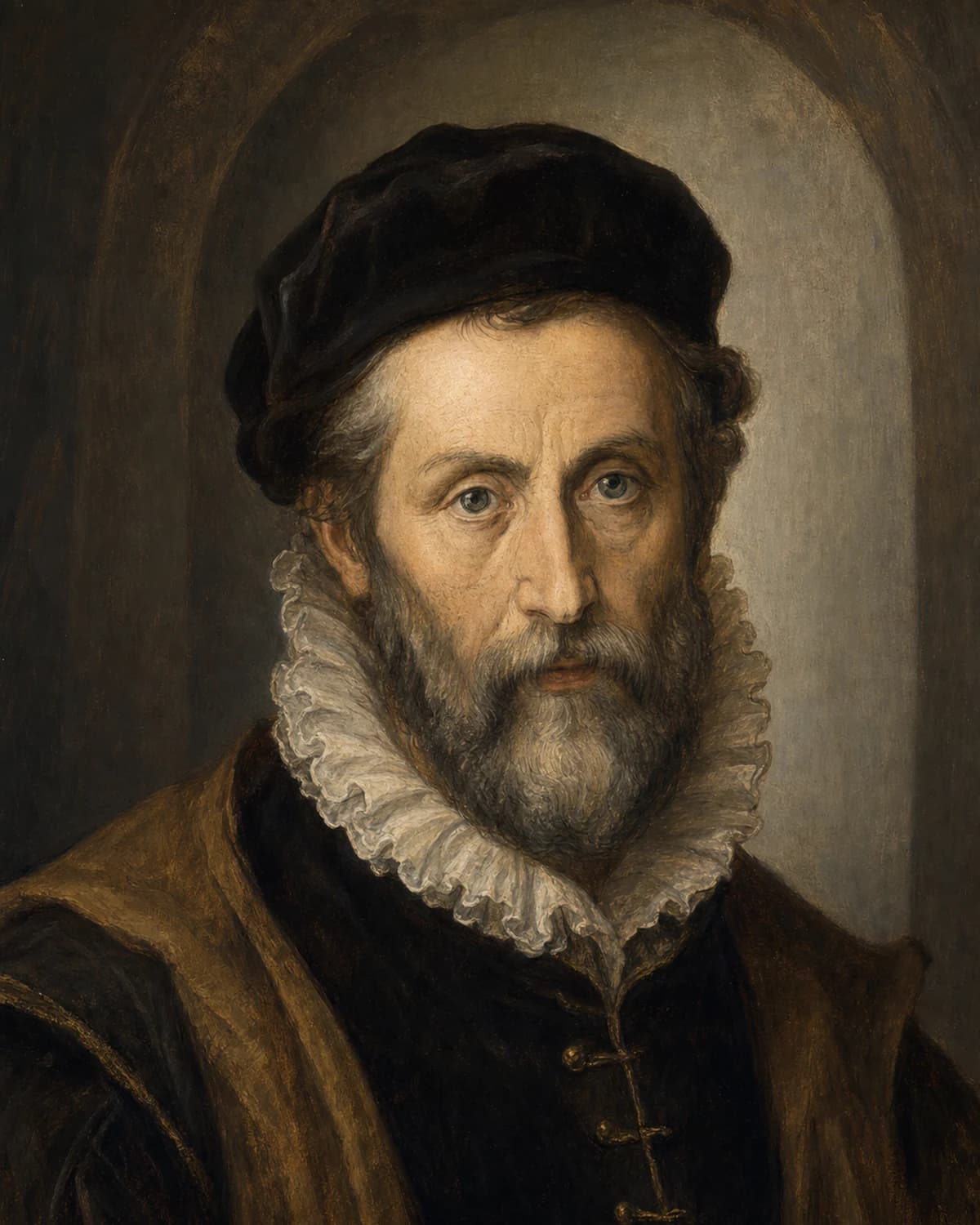
Biography
In 1582 Emperor Rudolf II sent his painter to Germany with instructions to buy antiquities and “animals and wondrous birds of the New World”. By then Arcimboldo had served the Habsburgs for twenty years, and his duties had long since outgrown the easel.
He was born in Milan, in 1526 or 1527; there is no record of birth or baptism, and the date is inferred from the number “61” on a drawn self-portrait of 1587. His father, Biagio Arcimboldo, was a Milanese painter; the family, according to the biographer Paolo Morigia, had South German roots, and two archbishops of Milan were among its forebears. His father was a friend of Bernardino Luini, Leonardo’s pupil, and Luini’s son showed the young Giuseppe the albums and notebooks of Leonardo that remained in the family. The documents first name him in 1549: with his father he made designs for stained-glass windows of the life of St Catherine for Milan Cathedral, and more than a hundred and fifty invoices for this commission survive up to 1557. After 1551 Biagio’s name disappears from the papers. In that same year Giuseppe painted five coats of arms for Ferdinand of Habsburg, not yet emperor, and in 1558 he received 119 lire from Como Cathedral for a tapestry design: riotous plant ornament, flowers and fruit, spirals that leave no empty space.
In 1562 he left for Vienna and, as Morigia wrote, was away from Milan for twenty-five years. How he earned the invitation is unknown. Ferdinand I is usually named, but the archival accounts and the later biographers connect his arrival with Maximilian, the future emperor. The salary of a court painter was twenty gulden a month, works that particularly pleased were paid for on top, and in 1566 he was given a hundred gulden for a journey to Italy, after which he vanishes from the papers for two years and reappears only in March 1569. The accounts record payments but almost never name the paintings.
The first “Four Seasons” were painted in these Viennese years: the back of “Winter” bears the date 1563, though Thomas DaCosta Kaufmann doubts it and thinks the cycle was presented to the emperor around 1569. “Spring”, in profile, is assembled from hundreds of flowers, each of which a botanist can identify by species; “Summer” from ripe fruit and ears of grain; “Winter” from roots, with fir twigs for hair and a straw mat for a cloak. For Maximilian there followed “The Four Elements” and a new “Four Seasons”. Both emperors ordered autograph replicas of the cycles to give to allies and adversaries; Augustus, Elector of Saxony, having visited Vienna in 1570 and 1573, received his own “Four Seasons” with the Saxon arms on the cloak of “Winter”. In “Air” sit the peacock and the eagle of the Habsburgs, “Fire” wears the chain of the Golden Fleece made of flints and steels, in “Earth” a lion’s skin recalls Bohemia. In an unpublished poem Giovanni Fonteo read these cycles as the harmony of the empire under Habsburg rule, and at the festive procession of 1571 the emperor himself appeared in the costume of Winter, “head of the year” by the Roman reckoning. To my mind, without this court context the heads of vegetables read too easily, as pure joke.
There were jokes too, of course: contemporaries, Lomazzo, Comanini and Morigia, called these pictures scherzi, grilli and capricci. In “The Librarian” the curtain with which reading carrels were screened off in libraries became clothing, and the animal tails used to dust the books became a beard; there are reversible pictures as well, such as a basket of fruit that can be looked at upside down.
His other work at court was the festivities. Morigia writes of carved wooden pieces for tournaments, contests, weddings and coronations and of theatrical machines for performances; according to the documents Arcimboldo staged and decorated two tournaments, at the wedding celebrations of 1571 and at Rudolf’s Hungarian coronation in 1572. In 1570 Maximilian sent the artist to Prague, to the heir, with whom he got on well; in 1586 Rudolf gave him 1,500 florins, four years’ pay. In 1580 the emperor granted Arcimboldo and his son Benedetto nobility with the right to a coat of arms. At the same time, as Gregorio Comanini relates, the painter was matching sounds to colours, drew a sequence of chords as coloured patches and asked the court musician Mauro Cremonese to play it on the harpsichord.
He returned to Milan around 1587: Rudolf’s order for the 1,500 florins “for long service to the reigning house” is dated 12 August 1587, while Morigia gives 1588. He settled with his son in the house of a friend, the mathematician and poet Giovanni Filippo Gherardini, renewed old acquaintances, among them Lomazzo and Morigia, and went on working for Prague. In Milan he painted “Flora” and the “Portrait of Rudolf II as Vertumnus”, where the fruits of all four seasons make up the face of the emperor, likened to the god of change and fertility; Comanini wrote verses on them. In 1592 Rudolf gave the artist the honorary title of Count Palatine, with which, among artists of the sixteenth-century empire, only Sodoma and Titian had been distinguished.
Arcimboldo died on 11 July 1593 in Milan, at about sixty-six; the entry is in the register of the city magistrate. After his death and Rudolf’s, the paintings were scattered and forgotten: in 1648 the Swedes carried off much of the Prague collection, and the first monograph was published only in 1885, by Carlo Casati. The Surrealists found him again; his allegories hung in the exhibition “Fantastic Art, Dada, Surrealism” in New York in 1937 and at the Palazzo Grassi in Venice in 1987, and in Vienna in 2008 about a hundred and fifty of his works were gathered together with the drawings. Some twenty reliable paintings survive, and Kaufmann regards only the four signed ones as beyond dispute.
Related context
Associations
Works connected through artistic movements, cultural context and period. Priced works available in this market appear first.
Profile notes
Profile and sources
Image
Artist image
На основе открытого изображения: Giuseppe Arcimboldo; Wikimedia Commons; Public domain.
