
1267–08.01.1337
Giotto
In 1303–1305 the Florentine Giotto di Bondone (c. 1267–1337) painted the Scrovegni Chapel in Padua, where figures acquired weight, volume and recognisable feelings. He worked in Rome, Assisi, Florence and Naples, and in 1334 he was appointed chief architect of Florence and designed the cathedral bell tower now known as Giotto’s Campanile.
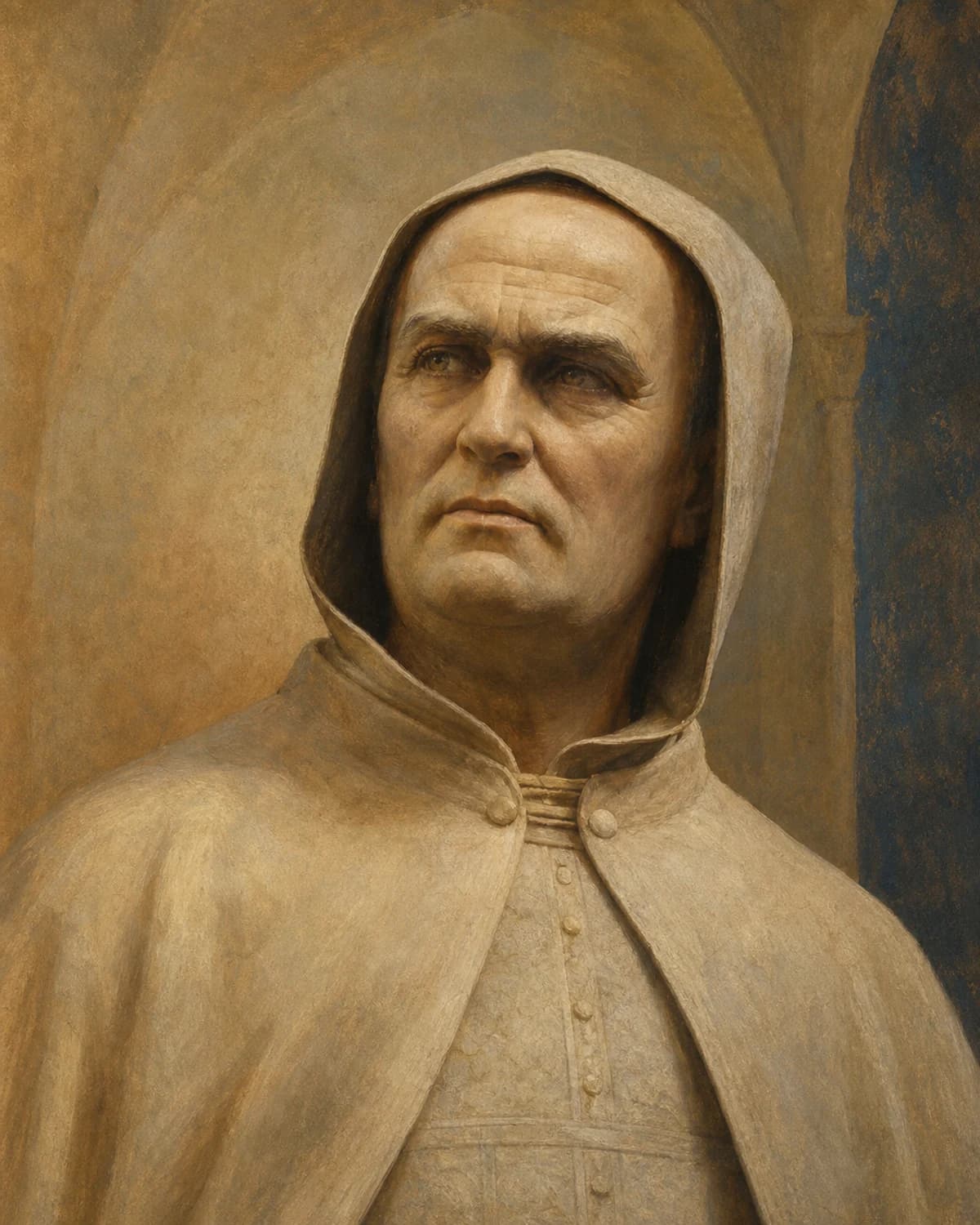
Biography
Vasari tells how Pope Benedict XI sent a messenger to Giotto for a sample of his art. The painter took a sheet and, with a single movement of his hand and no compasses, drew a circle in red paint. The messenger thought he was being mocked, but in Rome, once they learned how the circle had been made, they understood that Giotto surpassed all his contemporaries.
Little about him is certain: that he painted the chapel in Padua, and that in 1334 the city commissioned him to build the cathedral bell tower. Almost everything else, from the year of his birth to the place of his burial, is disputed.
He was probably born in 1266 or 1267; Vasari gave 1276, but the dating of the early works rules that out. Tradition makes his birthplace the village of Vespignano near Vicchio, east of Florence, and his father a blacksmith named Bondone; according to another version, he was born in Florence itself. The name Giotto may have been short for Ambrogiotto or Angelotto. In Vasari the boy is herding sheep and drawing one of them in charcoal on a flat stone when Cimabue, passing by, takes him on as a pupil; the old bridge over the Sieve near Vespignano is still called the Ponte Cimabue. Many historians regard this story as a legend, like the tale of the fly the pupil supposedly painted on a face in his master’s picture so convincingly that Cimabue tried to brush it away: it is too close to the ancient anecdote about Zeuxis.
Around 1290 he married Ciuta di Lapo del Pela; they had eight children, and one of the sons also became a painter. By 1301 he already owned a house in Florence. Among the early works are the huge suspended Crucifix for Santa Maria Novella, with the heavily sagging body of Christ, the Madonna from San Giorgio alla Costa, the signed “Stigmatization of St Francis” in the Louvre and the polyptych from the Badia. In Rome, perhaps for the Jubilee year of 1300, he made the design for the “Navicella” mosaic in the atrium of Old St Peter’s, commissioned by Cardinal Jacopo Stefaneschi; only fragments of it survive.
The hardest question of his biography is the cycle of St Francis in the Upper Church at Assisi. The Franciscans’ documents perished when Napoleon’s soldiers stabled their horses in the church. Some scholars recognise the hand of the young Giotto as early as the Isaac scenes of around 1290; others, relying on technical studies of 2002, believe that the cycle was painted by four masters who had come from Rome. I would leave the question open.
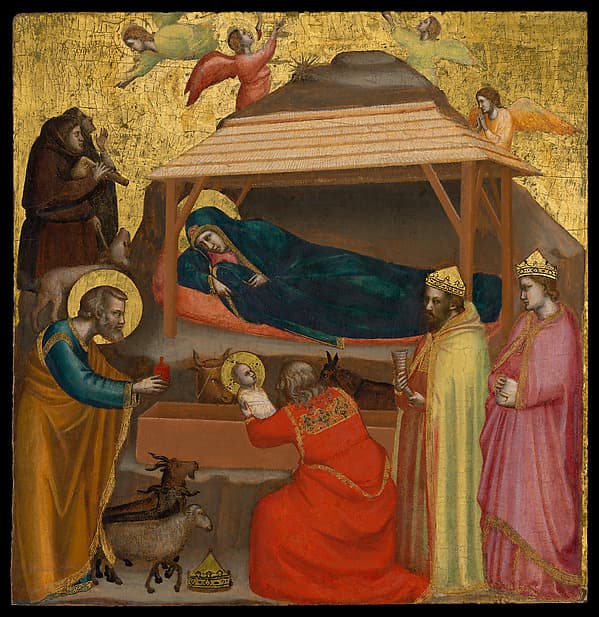
The chapel in Padua was commissioned by Enrico Scrovegni as a family place of worship and burial; a mystery play was also performed there every year. Around 1303–1305 Giotto covered its walls with thirty-seven scenes in three tiers: at the top the story of Joachim and Anne and the youth of Mary, below that the childhood and miracles of Christ, at the bottom the Passion, and on the west wall the “Last Judgement”. Beneath the coloured scenes he painted, in grey grisaille, as if they were marble statues, the seven virtues and the seven vices. His figures are not elongated in the Byzantine manner; they have volume and weight, the folds of their clothes hang under their own heaviness, and some characters sit with their backs to us. Two shepherds exchange sidelong glances as the disgraced Joachim returns to them; a soldier in the “Massacre of the Innocents” hunches his head into his shoulders, and there is shame on his face. The star over the “Adoration of the Magi” looks like a comet: it may reflect the appearance of Halley’s Comet in 1301, and in 1986 the space probe Giotto was named after him. The ultramarine blue, too expensive to lay on wet plaster, was applied to dry plaster and has flaked away faster than the other colours; this is clearest on Mary’s cloak in the “Nativity”. John Ruskin said that Giotto painted the Madonna, St Joseph and the Christ, but essentially Mamma, Papa and Baby.
Dante remarked in the Purgatorio that Cimabue had thought to hold the field in painting, and now it is Giotto who has the cry.
Fame called him to Rimini, where his Crucifix survives, to Assisi, where his workshop painted the Lower Church, and back to Rome. From 1311 he was living in Florence again; in 1312–1315 his name turns up in notarial records of loans. Of his altarpieces, only the “Ognissanti Madonna” (325 by 204 centimetres) in the Uffizi is accepted without dispute. The cardinal’s will named the Stefaneschi Triptych, for the high altar of Old St Peter’s, as Giotto’s work. In the church of Santa Croce he painted the Bardi Chapel, with seven scenes from the life of Francis, and the Peruzzi Chapel, with stories of the two Johns; the Peruzzi paintings, done on dry plaster, have suffered badly, but Masaccio and Michelangelo studied them.
In 1328–1333 Giotto worked for King Robert of Anjou in Naples and received the title of court painter; almost nothing of his Neapolitan work remains. In the spring of 1334 he was appointed chief architect of Florence: his duties included the city wall, repairs to the bridges after a flood, and the cathedral bell tower, whose foundation stone was laid on 18 July 1334. After his death Andrea Pisano and Francesco Talenti completed it, not entirely according to his design, finishing in 1359. He was then sent to Milan to Azzone Visconti, and his last work, done with the help of pupils, was the decoration of a chapel in the Bargello.
Giotto died in Florence on 8 January 1337. According to Vasari he was buried in the cathedral, to the left of the entrance; according to other sources, in the church of Santa Reparata, whose remains lie directly beneath the cathedral. In the 1970s bones of a short man, about 120 centimetres tall, were found under its floor, and an analysis in 2000 detected arsenic and lead in them, both common in paints. Italian researchers judged them to be Giotto’s remains and reburied them with honour next to the tomb of Brunelleschi; the American art historian Franklin Toker, who was present at the excavation, considers them most likely the bones of some fat butcher.
Artist works
Works by the artist
Works by Giotto available in this edition of NEOARCA.
Related context
Associations
Works connected through artistic movements, cultural context and period. Priced works available in this market appear first.
Profile notes
Profile and sources
Image
Artist image
На основе открытого изображения: Original uploader was Frieda at it.wikipedia; Wikimedia Commons; CC BY-SA 3.0.
