
20.07.1890–18.06.1964
Giorgio Morandi
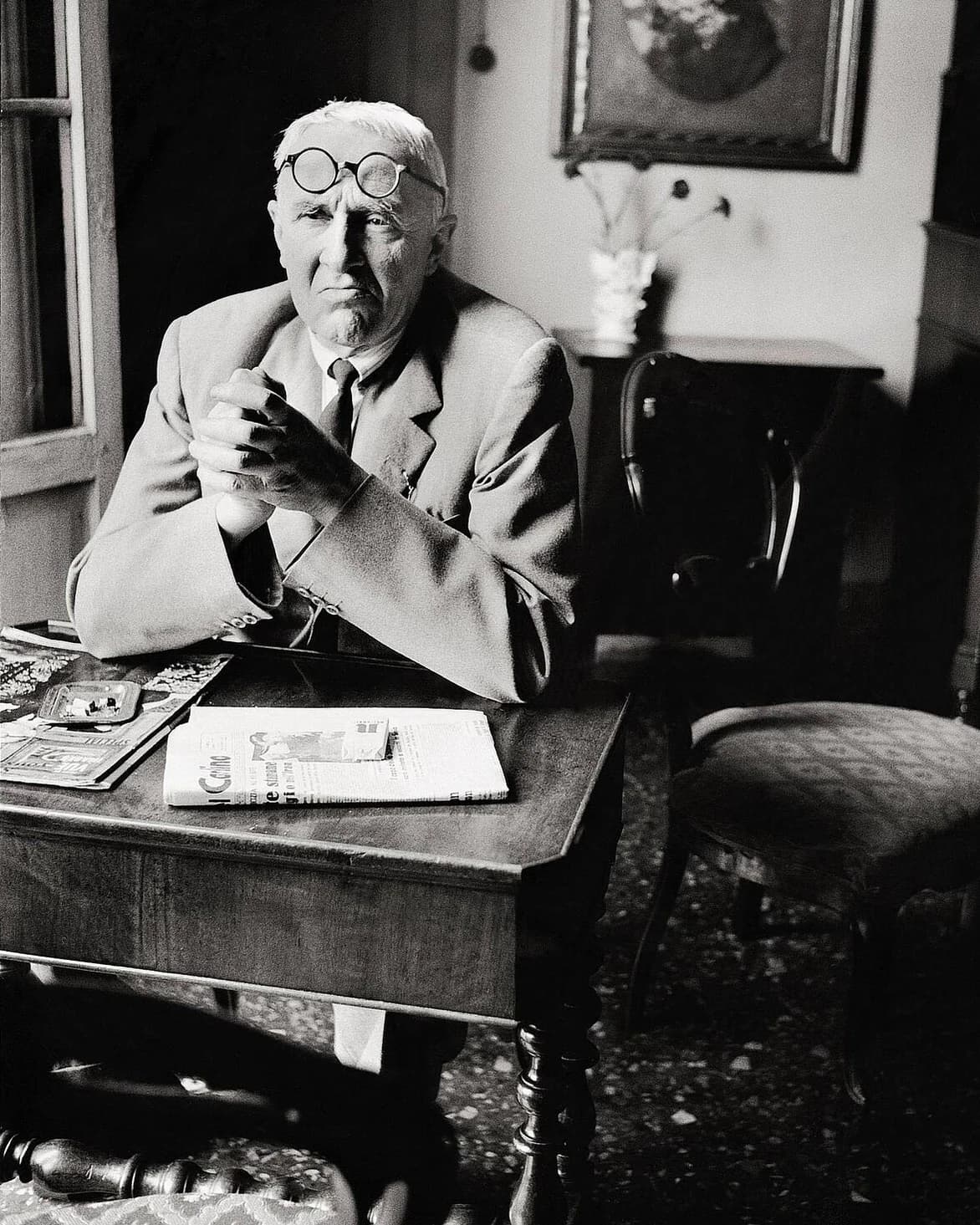
Giorgio Morandi (1890–1964) spent almost his whole life in Bologna, in an apartment shared with his sisters, where one of the rooms served as both bedroom and studio. He painted bottles, pitchers and boxes that he coloured and rearranged himself, and about 1,340 of his oil paintings are recorded in Vitali’s catalogue, mostly such still lifes and landscapes. In 1948 he won the prize for painting at the Venice Biennale.
Biography
In 1943, in the middle of the war, Morandi found himself in a Bologna prison. His release was secured with the help of the art historian Roberto Longhi. His friendships with anti-Fascists were, by one account, the reason for the arrest; the sources give no details.
He was born on 20 July 1890 in Bologna, the eldest of five children. His father, Andrea Morandi, was a co-owner of the Bologna branch of a French firm trading in hemp, and at first Giorgio worked for him. But the pull of painting won out, and in 1907 he entered the Academy of Fine Arts in Bologna. His father died in 1909, and the eldest son had to become head of the family; he graduated from the academy in 1913. According to some accounts, he taught himself etching by working through books on Rembrandt. He did well in his studies, but the academy did not give him the training he was looking for. He dreamed of Paris in the early 1910s, but there was no money for the trip, and he did not get there until 1956.
At first he knew new French painting only from black-and-white reproductions. He saw Renoir at the Venice Biennale of 1910, while Cézanne he studied for a long time only from photographs. That same year he went to Florence to look at Giotto, Masaccio, Uccello and Piero della Francesca; Padua and Assisi followed. His earliest known works, a landscape and a portrait of his sister Dina, are dated 1911 and 1912.
In 1913–1914 he exhibited with the Futurists in Bologna and Rome, met Umberto Boccioni and Carlo Carrà, and was praised by Filippo Tommaso Marinetti, the leader of the Futurist movement. The attraction did not last: the Cubists and Henri Rousseau were closer to him. From 1914 to 1929 he taught drawing in Bologna’s elementary schools. In 1915, when Italy entered the First World War, he was called up and, because of his great height, assigned to a grenadier regiment. After two months he suffered a nervous breakdown and was discharged. In 1917 he again fell seriously ill and hardly worked.
From 1918 to 1922 he was close to metaphysical painting: Giorgio de Chirico, Arturo Martini, Carrà, and Mario Broglio’s magazine Valori Plastici (“Plastic Values”). Broglio was the first to sign an exclusive contract with him. But already at the Spring Exhibition in Florence in 1922, where he showed alongside de Chirico and Carrà, it was clear that this phase was behind him. What follows is what we now call “Morandi”: shades, tonal transitions, objects in softened air.
Recognition came in the 1930s, first for his prints. In 1930 he became head of the chair of etching technique at the Bologna academy and held it until 1956. In 1932 he took part in the First Exhibition of Modern Italian Engraving in Florence, and the magazine L’italiano devoted an issue to him, with an article by Ardengo Soffici. From 1931 his works were shown at the Rome Quadriennale, and in 1939 he was given a separate room at the third Quadriennale: forty-two paintings. Longhi and the collector Lamberto Vitali admired his painting in the mid-1930s, and the friendship lasted for years. Vitali compiled a catalogue of his prints, published in his lifetime (1957), and the complete catalogue of his works (1977). A solo exhibition at the Il Fiore gallery in Florence opened on 25 April 1945, the day Bologna was liberated by the Allies.
His objects rarely stayed what they had been. Those who visited the studio remembered bottles and small vases painted with gouache or covered with a careless layer of plaster, so that glass stopped being glass. Longhi called them “useless objects”. Morandi himself said in a rare interview that still life gave him calm and intimacy, and that he avoided the danger of repeating himself by building his pictures as variations on a few themes. I think this is the most accurate description of his method. Landscapes make up a little under a fifth of his output, portraits are almost absent, and seven self-portraits are known. There are also flowers and shells. The catalogue lists 137 etchings: the same soft tone, crossing strokes without contour, objects dissolving into the background.
The prizes came after the war. He won the prize for painting at the Venice Biennale in 1948, the Grand Prize for a series of etchings at the São Paulo Biennial in 1953, the Grand Prize for painting there in 1957, the Rubens Prize of the city of Siegen in 1962, and the gold “Archiginnasio” medal from the city of Bologna in 1963. He still lived modestly, with his unmarried sisters. In 1959 he built a house at Grizzana, thirty kilometres from Bologna, where the family had gone for the summer for many years and had waited out the war. In 1985 his name was added to that of the commune: Grizzana Morandi.
Morandi died in Bologna on 18 June 1964. He is buried in the Certosa cemetery in the family tomb with his three sisters; on the tomb is his portrait by Giacomo Manzù.
Related context
Associations
Works connected through artistic movements, cultural context and period. Priced works available in this market appear first.








Profile notes
Profile and sources
Image
Artist image
Anonymous Unknown author / Imagno; Wikimedia Commons; Public domain.
