
24.09.1931–20.10.2019
Gilberto Aceves Navarro
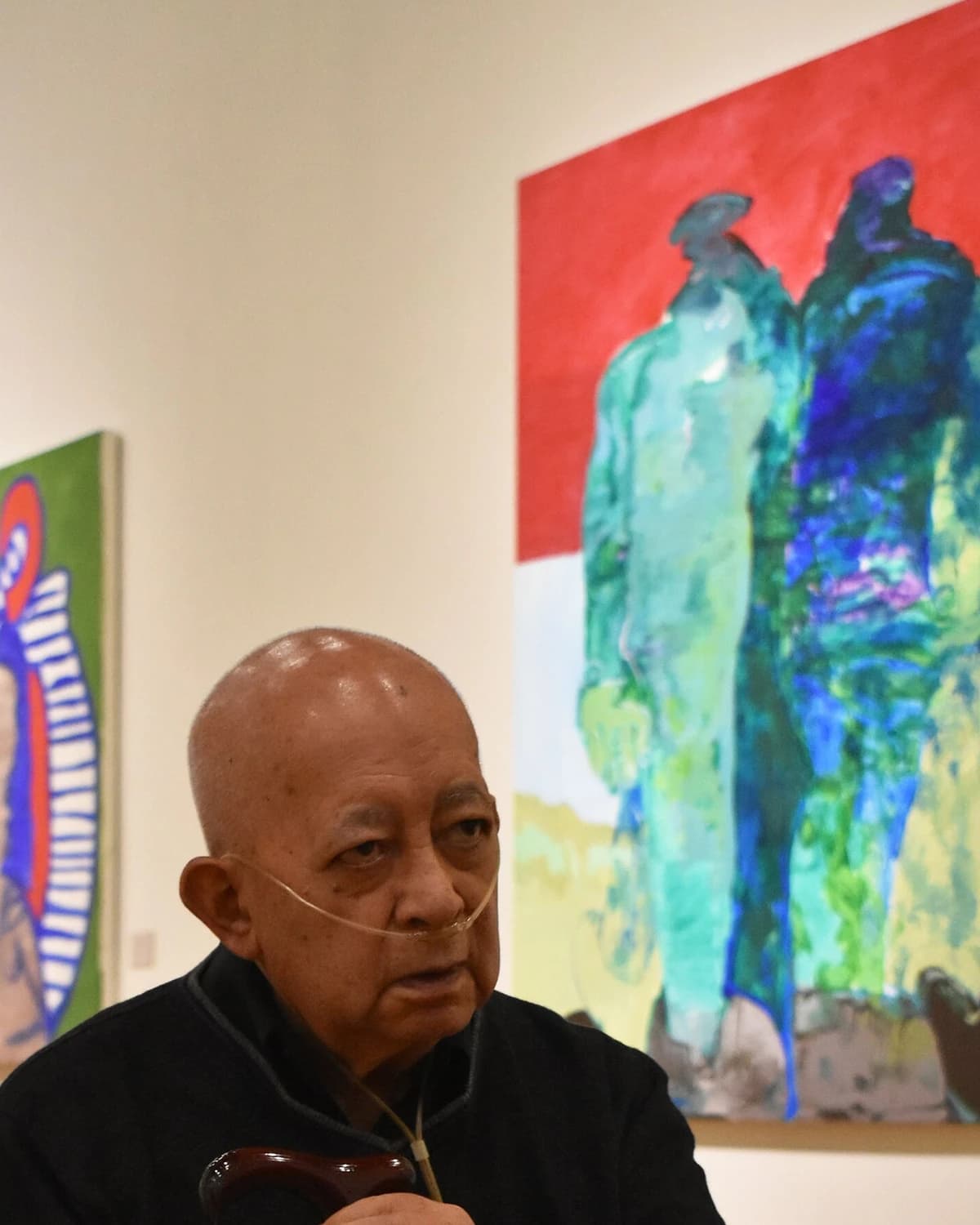
Gilberto Aceves Navarro (1931–2019) went to work as an assistant to Siqueiros at nineteen, and afterwards spent years drawing in the streets of Mexico City. He painted murals for the Mexican pavilion at the Osaka World’s Fair, taught at the National School of Plastic Arts at UNAM, and in 2003 received the National Prize for Sciences and Arts. In 2008 the Palacio de Bellas Artes showed a retrospective of more than four hundred of his works.
Biography
In 1951 or 1952, Gilberto Aceves, a student at the art school La Esmeralda, stood on the scaffolding of the University’s Rectorate Tower and helped David Alfaro Siqueiros with his murals. The date varies between sources, and I have not managed to pin it down.
He was born on 24 September 1931 in Mexico City, the youngest of three children. He began drawing at four, started school only at seven, and taught himself to read. His relatives wanted him to study medicine, but a teacher at his school intervened and sent him to La Esmeralda. He entered it in 1950 and studied under Enrique Assad, Ignacio Aguirre and Carlos Orozco Romero.
He did not like studying there. He argued with his teachers, above all with Orozco Romero, and objected to the copying of old paintings in place of working from life, and to the lack of places where young artists could exhibit. With friends he organised unauthorised shows in the Alameda Central park and near factories. The school responded by opening the Nuevas Generaciones gallery, where he exhibited twice, but he kept his reputation as a troublemaker. In 1952 he went with Luis Arenal to paint the state government palace of Guerrero in Chilpancingo; when he came back three months later, he was not allowed to re-enrol. By one account he nevertheless came secretly and studied engraving with Isidoro Ocampo; by another, he was readmitted in 1953 and then expelled.
After working for Siqueiros he began drawing in the street. He went out in the morning with paper and pencils, at first to Parque México, and drew everything he saw: nannies with children, prostitutes on the street. He sold these sheets and also painted calendars for a firm called Casa Galas. His first solo exhibition, “Energía”, took place in 1954 at the Nuevas Generaciones gallery and was well received.
From 1955 he taught: first at the Regional Institute of Fine Arts in Acapulco, then from 1957 to 1961 at the Mexican-North American Institute of Cultural Exchange in Los Angeles and at the women’s university in Mexico City. From 1971 he gave classes at the National School of Plastic Arts at UNAM, housed in the old Academy of San Carlos. There he tried to wean students off copying, although he did not call himself a rebel. From 1976 he took chosen pupils into his own studio, the first being Gabriel Macotela; later came Bety Ezban, Emilio Carrasco Gutiérrez, Verónica Ruiz de Velasco and others; from 1998 the classes were held in his studio in the Colonia Roma.
Murals and sculpture occupy a large place in his work. He painted about twelve murals in Mexico City, Querétaro, Guadalajara, Veracruz, Montreal, Atlanta and Recife. For the Mexican pavilion at the 1970 World’s Fair in Osaka he made the acrylic mural “Yo canto a Vietnam” (“I Sing to Vietnam”). In 1982 he made for the National School of Plastic Arts a mural in wood, metal, tezontle (a porous volcanic stone) and glass, “Apoteosis de Manuel Tolsá y musas románticas” (“Apotheosis of Manuel Tolsá and Romantic Muses”). For the 1996 Olympic Games in Atlanta he painted “Una canción para Atlanta” (“A Song for Atlanta”), and in 1996 in Mexico City, at the corner of Avenida Antonio Alzate and Avenida Santa María la Ribera, he created “La guerra y la paz” (“War and Peace”). In 2006 his sculpture “La fuente de la vida” (“The Fountain of Life”) was installed on Paseo de la Reforma. He also designed sets for plays, in 1993, and wrote poetry.
He exhibited every year from 1970, mostly in Mexico but also in Washington, at the Brooklyn Museum, in Los Angeles, São Paulo, Havana, Bogotá, Montevideo, New York, Tokyo, Seville and Hamburg. In all there were more than two hundred solo shows and more than three hundred group shows. Critics place him between the generation of the Muralists and the Generación de la Ruptura (the Rupture Generation, Mexican artists who broke with the muralist tradition); he himself preferred to be counted closer to the latter. He is also called a precursor of figurative expressionism. The art critic Lelia Driben wrote that he often destroys the human figure, especially the female one, but in the end restores it with sensuality.
Prizes came from 1958: the Salón de la Plástica Mexicana honoured him three times (1958, 1964, 1971), and in 1989 he received an honourable mention at the Cannes biennial and a UNAM prize for his teaching. In 2001 he was admitted to the Academy of Arts, in 2003 he won the National Prize for Sciences and Arts, and in 2011 he received the Bellas Artes Medal. He did not stop working after the age of eighty.
Aceves Navarro died in Mexico City in October 2019.
Profile notes
Profile and sources
Image
Artist image
Tiaré García / Secretaría de Cultura de la Ciudad de México; Wikimedia Commons; CC BY 2.0.
