
09.02.1932–present
Gerhard Richter
Gerhard Richter (born 1932) has spent more than sixty years painting from photographs, blurring the paint while it is still wet, and alongside this he makes abstract canvases across which he drags colour with a wide squeegee. He trained in Dresden, left for the West in 1961 and has worked in Cologne since 1983; in 2007 that city’s cathedral received his window of 11,500 coloured squares.
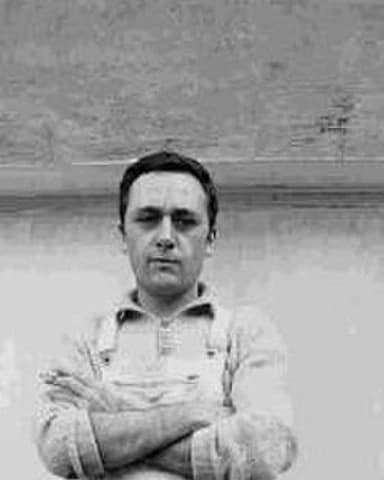
Biography
In 2024, at the German Hygiene Museum in Dresden, most of the wall painting “Joy of Life” (Lebensfreude) was uncovered. Gerhard Richter had painted it in 1956 as his diploma work, and after he fled to the West it was painted over for ideological reasons. The same fate befell “Communion with Picasso” (1955) in the academy refectory.
The beginning of his path lay under a layer of paint for almost seventy years.
Richter was born on 9 February 1932 in Dresden; his childhood was spent in Upper Lusatia, in Reichenau (now Bogatynia in Poland) and Waltersdorf, where his father worked as a village schoolteacher. He left school after the tenth grade, finished a vocational school in Zittau in 1948 and worked as a house painter. In 1950 the Dresden Academy of Fine Arts turned down his application as “too bourgeois”; a year later it admitted him. From 1957 to 1961 he stayed on at the academy as a master trainee and carried out state commissions: the mural “Workers’ Struggle”, portraits of the actress Angelica Domröse, a panorama of Dresden under the neutral title “Townscape” (1956). Two months before the Berlin Wall went up, in 1961, Richter moved to West Germany and entered the Düsseldorf Art Academy under Karl Otto Götz. Sigmar Polke and Konrad Lueg (later the gallerist Konrad Fischer) studied alongside him; with them he put into circulation the term “Capitalist Realism”, a name that took a swipe at Socialist Realism and mocked the consumer art of the West in the same breath. An exhibition under that name ran for two weeks in the Berges furniture store in Düsseldorf. His work was first shown in Düsseldorf in 1963, and his first solo exhibition took place at Galerie Schmela in 1964.
The method of the 1960s is simple to state: take a picture from a newspaper, a book or a family album, transfer it to canvas and blur the paint before it dries. This produced “Helga Matura” (1966) with its newspaper caption, “Alps” (1968) and the seascapes of 1969–1970. For the German Pavilion at the 1972 Venice Biennale, the first ever given over to a single artist, he painted “48 Portraits”: the faces of composers and writers, among them Mahler, Sibelius, H. G. Wells and Kafka. Earlier still, in “Table” (1962), the photorealist image had been overlaid with grey gestural strokes that seem to cancel it. Between 1965 and 1974 Richter made more than a hundred prints, looking for cheap ways to give a work a “non-art” look; then he all but abandoned printmaking and began painting from his own photographs. Landscape became a line of its own in 1968, after a holiday in Corsica. In 1972 in Utrecht he showed “Atlas” for the first time, a collection of photographs, cuttings and sketches: it then had 315 parts, and now holds about four thousand images on roughly six hundred panels.
Abstraction ran alongside. The first colour charts appeared in 1966, and for the small “10 Colours” the paints were called out at random by a friend, Blinky Palermo; in 1973–1974 the series reached “256 Colours”, where the shades were set by a mathematical system of mixing. The first grey monochromes were painted in 1969, and in 1976 he first titled a work simply “Abstract Painting”. From the mid-1980s a homemade squeegee came into play, with which he drags and scrapes broad bands of paint, and in the 1990s he began running it up and down so that the canvas comes to resemble a wall of planks. In 2007 he assembled “4900 Colours”: 196 panels, 25 colours, eleven ways of hanging them.
About his own aims he has always spoken evasively: “I have no programme, no style, no course to follow.”
In 1982–1983 he painted candles and skulls, 27 still lifes in all, from photographs taken in the studio; in 1995, for the fiftieth anniversary of the bombing of Dresden, one of his candles was reproduced on a monumental scale above the Elbe. The series “18 October 1977” (1988) consists of fifteen grey paintings after press and police photographs: the arrest, the prison, the deaths and the funeral of members of the Red Army Faction. It was first shown in Krefeld in 1989, and in 1990 the Saint Louis Art Museum toured it around the United States; Richter himself insisted that he was far from politics. In 2014 he painted four canvases, “Birkenau”, after photographs taken in secret by Sonderkommando prisoners at Auschwitz; since 2021 the cycle has been handed over to the International Auschwitz Committee and is displayed in a pavilion of the artist’s own design at the International Youth Meeting Center in Oświęcim.
Glass entered his work in 1967 with “Four Panes of Glass”; from 1981 large mirrors joined them, and at Documenta 9 in Kassel (1992) he showed paintings and coloured mirrors in a pavilion of their own. In 1971 Richter returned to the Düsseldorf academy as a professor and taught there for more than fifteen years; his students included Thomas Schütte and Thomas Struth. In 1983 he moved to Cologne, where he lives and works. Retrospectives followed one after another: Bremen (1976), Düsseldorf (1986), the Tate Gallery (1991) and “Forty Years of Painting” at the Museum of Modern Art in New York (2002), where 188 works were shown. His awards include the Golden Lion of the Venice Biennale and Japan’s Praemium Imperiale (both 1997), and the Wolf and Kokoschka prizes. In April 2007 Cologne made him an honorary citizen, and in August his window was unveiled in the south transept of Cologne Cathedral: 113 square metres, 11,500 small squares in 72 colours, their order set by a computer program. He took no fee, and the glass and installation were paid for by more than a thousand donors; Cardinal Meisner stayed away from the unveiling: he had wanted figurative martyrs of the twentieth century. In 2020 Richter completed three tall windows for Tholey Abbey in Saarland, called them his last major work and said that from then on he would only draw.
Profile notes
Profile and sources
Image
Artist image
Lothar Wolleh; Wikimedia Commons; CC BY-SA 3.0.
