
02.12.1933–03.02.2015
Georgy Kovenchuk
Georgy Kovenchuk, known to everyone as Gaga (1933–2015), drew the poster “Not for Narrow Trousers, but for Hooligan Tricks” at twenty-four, and it appeared in a tear-off calendar printed in 1.5 million copies. He later designed Mayakovsky’s “The Bedbug”, won the diploma “Best Book of the Year” for it, and for many years worked in Paris, drawing at the Moulin Rouge. He was the grandson of Nikolai Kulbin.
Biography
Kovenchuk’s first solo exhibition opened in Leningrad, in the Coffee House of the Summer Garden, in 1971 and ran for a few days: the authorities closed it on ideological grounds, citing “formalism”, the standard Soviet charge against art judged too far from official realism. Many years later he wrote an article on what formalism in painting was and how the Soviet government fought it. He knew the subject at first hand.
He was born in Leningrad on 2 December 1933. His mother, Nina Nikolaevna, was a theatre sculptor and prop maker who worked at the Akimov theatre; his maternal grandfather, Nikolai Kulbin, was an artist and theorist of the Russian avant-garde. His father, Vasily Grigoryevich, who had fought in the people’s militia from 1941, was arrested in 1950 on a false charge of espionage. During the Siege of Leningrad the boy was evacuated with his mother, first to Kuibyshev and then to Stalinabad. Later the family lived in a communal flat on Gorokhovaya Street; he described it in his stories, and the collection “Apartment No. 8 and Other Stories” came out in 2011.
He studied at the secondary art school (1948–1954), then in the graphic arts department of the Repin Institute of Painting, Sculpture and Architecture, in the studio of Alexander Pakhomov (1954–1960). He defended his diploma with a series of posters and received the top mark. While still a student he joined “Battle Pencil”, an association of poster artists, and from 1960 he belonged to the graphics section of the Leningrad branch of the Union of Artists. His first studio, shared with Mikhail Belomlinsky, was on Repin Street; in the 1970s and 1980s he spent sixteen years in a studio on the Karpovka embankment, and later worked in Pushkin.
In the 1960s to 1980s Kovenchuk made sharp, sometimes ironic social posters. The best known, “Not for Narrow Trousers…” (1957), was reproduced many times afterwards; others include “This Virus Grew Out of Laziness” (1959), “For Such Jokes You Get Days” (1972) and “Gentleman at the Dacha” (1972). Their print runs, in the thousands at the time, have since made them collectors’ rarities.
Alongside this he illustrated books and magazines: Avrora (from its founding in 1969; chief artist in 1971–1972), Kostyor and, from 1975, Murzilka. Twice he travelled on assignment for Kostyor to the Baikal–Amur Mainline, the railway then under construction, and those trips produced his books “From Komsomolsk to Urgal” (1977) and “A Month on the BAM” (1978). He illustrated the Strugatsky brothers, Daniil Granin, Viktor Golyavkin, Alexander Zhitinsky, Mikhail Zoshchenko and Ilya Ilf’s “From the Notebooks”. His most famous work became “The Bedbug”, from Mayakovsky’s comedy, published in an edition of 30,000 copies. Granin wrote that Kovenchuk does not accompany the text but enters it: the word in his hands “shouts, explodes, roars with laughter”. Without the artist’s drive and the help of Lilya Brik, Konstantin Simonov and Valentin Pluchek, the book, according to the publication, would not have appeared. For it he received the diploma “Best Book of the Year” (1975) and a silver medal at the international graphics biennale in Brno (1994). In 1986 a puppet production of “The Bedbug” was staged at the Stara Prochownia theatre in Warsaw: the stage design was by Zhanna and Georgy Kovenchuk, and he himself modelled the ceramic characters after his own illustrations. In 2013 a new author’s version appeared in silkscreen, 25 compositions in 70 copies; the work took about a year. In 2016 “The Bedbug” was published in Japan.
Printmaking deserves a separate mention: over half a century he made about three hundred compositions in etching, aquatint, lithography, linocut, woodcut, monotype and silkscreen. In the mid-1960s he produced the lithographs “The Last Trolleybus” and “Restaurant Vostochny”. In 1966–68 he began printing from cardboard, gluing scraps of fabric and gauze to it, and then found his own way into cardboard engraving. He travelled widely: the tundra, Yakutia, the mines of the Kuzbass, the Karakum Canal, Sakhalin six times, the Kuril Islands; hence “Surveyors of the BAM” (1974) and “Bridge over the Tynda River” (1978).
From the mid-1980s he lived and worked in France for long periods, most often on Rue Lepic in Montmartre. By his own account, in 1998 a gallery owner saw his paintings from a window across the street and arranged an exhibition; a picture of the Moulin Rouge hung there, and the director of the cabaret invited him to draw at rehearsals and performances. In 2006 came a series of about ten linocuts, “Moulin Rouge”. He also visited other European countries, the United States, Tunisia, Egypt, Japan and China.
It was said that in Leningrad he spotted Chagall in a theatre, quickly drew a caricature and showed it to him with the words “correct it”; Chagall, according to Sergei Dovlatov’s record, answered that it would cost him far too much. Among those he worked or was friends with, people name Nikolai Akimov, Georg Solti, Aleksei Kruchenykh, Lilya Brik, Bulat Okudzhava, Joseph Brodsky, Andrei Bitov and Oleg Tselkov.
His relations with the official art world stayed cool, but in 2003 he received a silver medal of the Russian Academy of Arts and the title Honored Artist of the Russian Federation. He made his last lithograph, “Morning in Kolomna”, in 2013. He died on 3 February 2015 in Saint Petersburg and was buried in the Smolensky Cemetery. The same year a posthumous exhibition of his work opened in the Marble Palace of the Russian Museum.
Profile notes
Profile and sources
Image
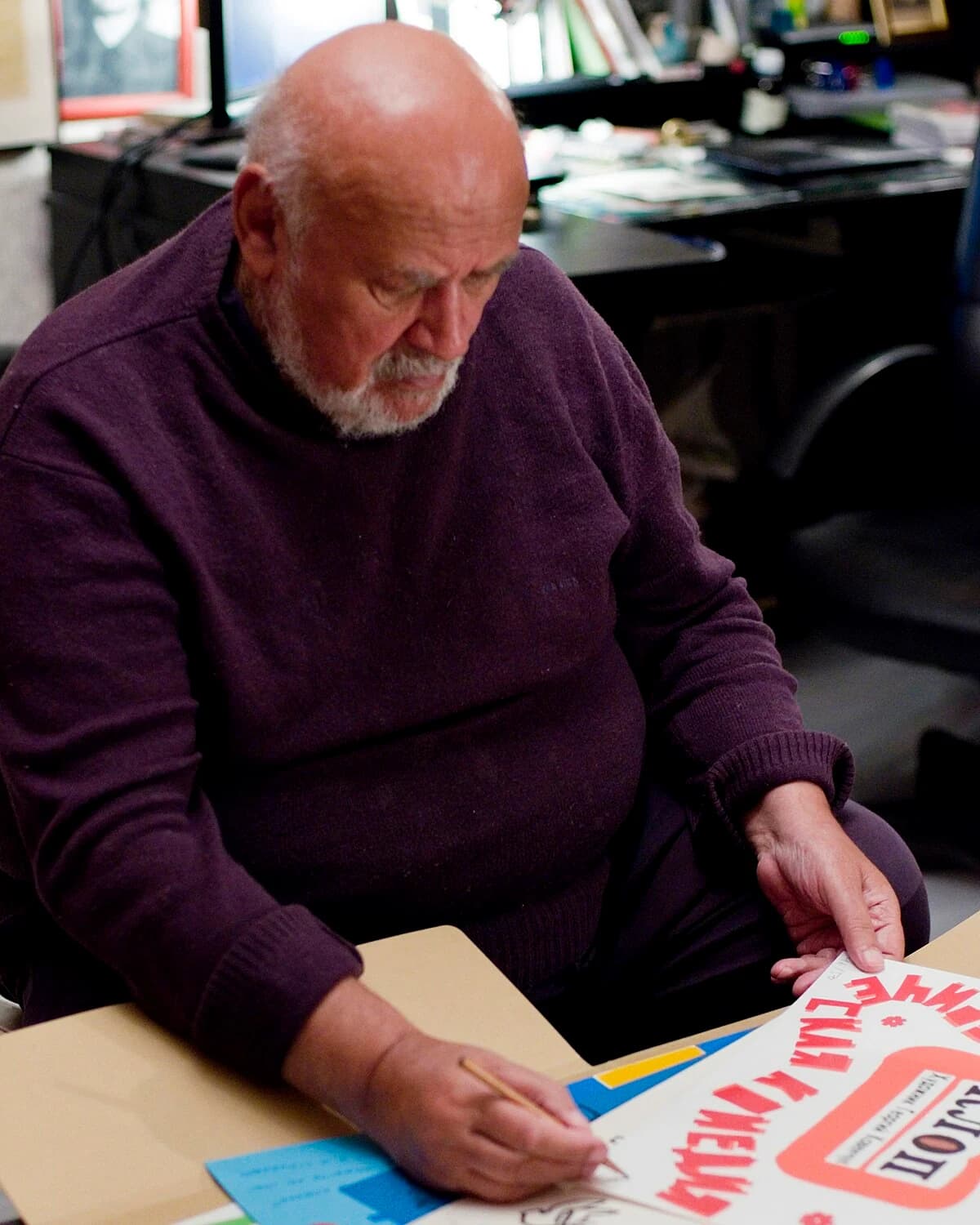
Artist image
Татьяна-88-88; Wikimedia Commons; CC BY-SA 4.0.
