
04.02.1885–29.08.1962
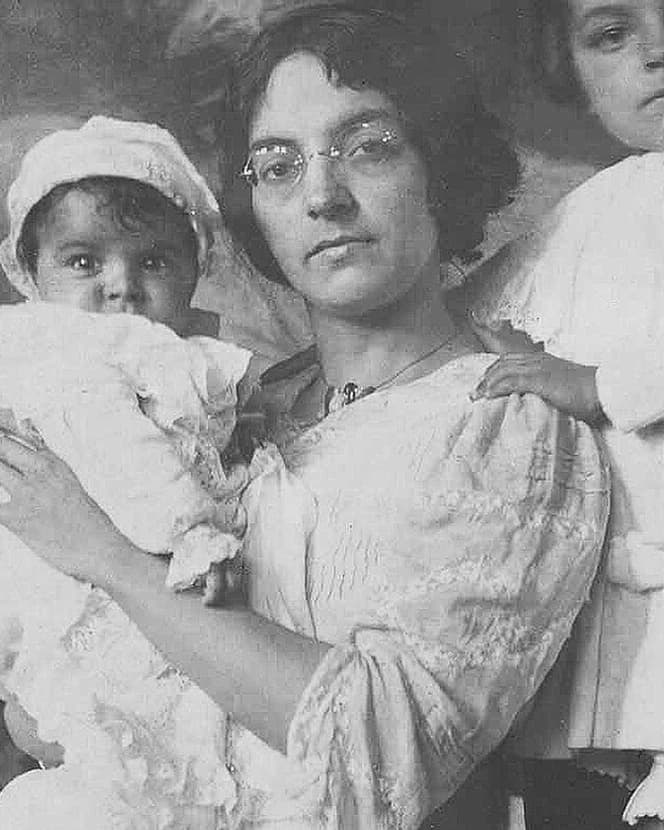
Georgina de Albuquerque
Georgina de Albuquerque (born Moura Andrade) studied in Taubaté, Rio de Janeiro and Paris, and in 1922 exhibited “Session of the Council of State”, a painting of the events on the eve of Brazilian independence with a woman at the centre of the composition. From 1927 she taught at the National School of Fine Arts in Rio, and in 1952–1954 she directed it. In 1940 she founded a museum named after her husband, the painter Lucílio de Albuquerque.
Biography
Georgina showed her work for the first time at eighteen, in 1903, at the Tenth General Exhibition of Fine Arts, while still a pupil of the Italian painter Rosalbino Santoro. A year later she left her home town for the capital.
She was born on 4 February 1885 in Taubaté, in the state of São Paulo, and her name was Georgina de Moura Andrade. She began to study painting at fifteen, in 1900, at home: the Italian painter Rosalbino Santoro explained to her the laws of perspective and the mixing of colours. Santoro taught at the Liceu de Artes e Ofícios in São Paulo, a school of art and crafts, and was connected with the landscape painters of the Grimm Group, who worked in the open air.
In 1904 she enrolled at the National School of Fine Arts (Escola Nacional de Belas Artes) in Rio de Janeiro and studied under Henrique Bernardelli. A year later she exhibited at the Twelfth General Exhibition, giving in the catalogue not the school but only the name of her teacher. At the school she met the painter Lucílio de Albuquerque. They married in March 1906. Lucílio had won a prize that entitled him to travel to Europe, and that same year the couple left for France. Georgina entered the École Nationale Supérieure des Beaux-Arts in Paris; she was the first Brazilian woman to pass its entrance examinations, placing fourth. At the same time she studied at the Académie Julian under Henri Royer, and her teachers at the École are named as Paul Gervais and Adolphe Déchenaud. No documents of her studies at the Académie Julian survive: the archives of the women’s studios were not preserved. The critic Quirino Campofiorito later wrote that in Paris she worked less productively than her husband, and linked this to the birth of their children. In 1907 Lucílio painted her portrait in oils, which is now in the Pinacoteca do Estado de São Paulo.
The couple spent five years in France and returned to Brazil in 1911. Georgina showed her work in São Paulo and then took part regularly in the General Exhibitions of Fine Arts. Her first award was an honourable mention in 1909. Then came a small silver medal for “Portrait of Azevedo Coutinho” (1912), a large silver medal for “The Christmas Tree” (1916) and a small gold medal for “Family” (1919). In 1920 she became the first woman to sit on the painting jury.
In 1922, for the centenary of independence, she painted “Session of the Council of State” (oil, 210 × 265 cm), which depicts the meeting of 2 September 1822 that preceded the declaration of independence. Until then history painting in Brazil had remained a male preserve. Instead of a heroic episode, as in Pedro Américo’s “Independence or Death”, she showed a diplomatic event in a study, and placed at its centre Empress Leopoldina of Austria. The painting won a prize at the centenary exhibition and was bought by the government for the collection of the National School of Fine Arts; later it passed to the National Historical Museum in Rio.
Besides history painting, she painted still lifes, nudes, portraits, genre scenes, and urban, rural and marine landscapes. The label “Impressionist”, usually attached to her, is disputed: Campofiorito held that European Impressionism was reproduced in Brazil in a “diluted” form, and José Roberto Teixeira Leite thought that she understood the technique in a simple way. Scholars more often call her an eclectic painter. To my mind both descriptions are best kept in view together: the light palette and free brushwork in her pictures are evident, but there may be no system behind them.
From 1927 she taught at the National School of Fine Arts in Rio de Janeiro, by some accounts until 1948. In 1935 she began teaching a course in decorative arts at the Institute of Arts of the University of the Federal District. In 1940 she founded the Lucílio de Albuquerque Museum in her home in the Laranjeiras district and set up one of the first courses in drawing and painting for children in the country. In 1942 she wrote an academic thesis, “Drawing as the Basis of Teaching in the Plastic Arts”. In 1952–1954 she was director of the National School of Fine Arts, where she had once been a student, and the first woman to hold that post.
Georgina de Albuquerque died on 29 August 1962 in Rio de Janeiro. In 1977, for the centenary of Lucílio’s birth, the National Museum of Fine Arts held an exhibition in which the works of the two were shown together.
Related context
Associations
Works connected through artistic movements, cultural context and period. Priced works available in this market appear first.








Profile notes
Profile and sources
Image
Artist image
Silva, M. Nogueira da, 1880-; Wikimedia Commons; Public domain.
