
15.11.1887–06.03.1986
Georgia O'Keeffe
Georgia O'Keeffe painted flowers as if looking at them through a magnifying glass, New York skyscrapers from a thirtieth-floor window, and sun-bleached skulls in the New Mexico desert. Her abstract charcoal drawings were first exhibited in 1916 by Alfred Stieglitz, who later became her husband. From 1949 she lived in New Mexico; a museum bearing her name is open in Santa Fe.
Biography
Early in 1916 Anita Pollitzer, a friend from her student days, brought a bundle of charcoal drawings to the 291 gallery in New York. Georgia O'Keeffe had posted them to her from South Carolina, where she had been teaching at a college since the autumn of 1915. They were abstractions built on her own sensations. The gallery's owner, the photographer Alfred Stieglitz, said he had not seen anything so pure and sincere at 291 for a long time, and in April he exhibited ten of the sheets.
She was born on 15 November 1887 in the town of Sun Prairie, Wisconsin. Her parents ran a dairy farm; her father was of Irish descent, and her middle names came from her maternal grandfather, George Victor Totto, an immigrant from Hungary. At about ten she decided to become an artist and took lessons from a local watercolourist, Sara Mann. In 1902 the family moved to Williamsburg, Virginia, and Georgia finished school there, at the Chatham boarding school, in 1905.
In 1905–1906 she studied at the School of the Art Institute of Chicago under John Vanderpoel and was top of her class. In 1907 she entered the Art Students League in New York, where William Merritt Chase, Kenyon Cox and Luis Mora taught, and a year later won the Chase prize for her still life Dead Rabbit with Copper Pot. At the same time she was visiting the 291 gallery.
In 1908 the money for her studies ran out: her father had gone bankrupt. She no longer wanted to copy nature, which was what all her training had been built on. Until 1910 she worked as a commercial artist in Chicago, and then for four years she did not paint at all, saying that the smell of turpentine made her feel sick.
What brought her back to painting was a summer course in 1912 at the University of Virginia. It was taught by Alon Bement, and through him O'Keeffe came to know the ideas of his colleague Arthur Wesley Dow. Dow taught that a picture should be built as a composition, drawing on the principles of Japanese art, and that one should not chase after copying nature. From 1912 to 1914 she taught drawing in the schools of Amarillo, Texas, and in the summers assisted Bement. In the spring of 1914 she went to study with Dow herself at Columbia University. Her Virginia watercolours already move away from realism, and the charcoal drawings of 1915 arrive at complete abstraction. I think that without these dull-looking teaching courses there would have been no parcel for Pollitzer to carry to Stieglitz.
From the autumn of 1916 she headed the art department of the teachers' college in Canyon, in north-west Texas. Here she came to love sunrises and sunsets and painted Palo Duro Canyon and the plains; Light Coming on the Plains No. I (1917) is built from just a few blue-green bands flowing into one another.
In 1917 Stieglitz gave her a solo exhibition.
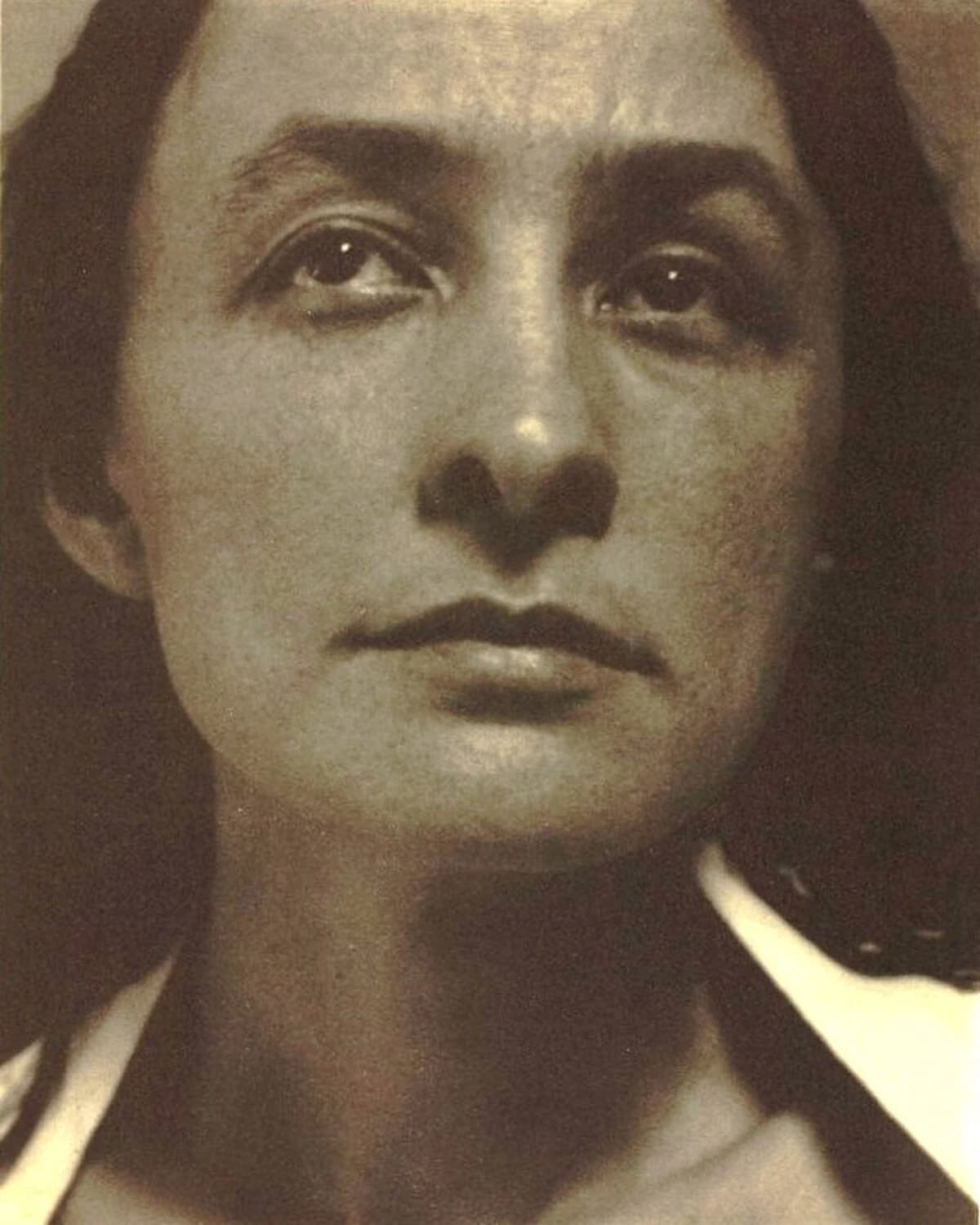
In June 1918 she accepted his invitation to move to New York: he took on the cost of a year of her work and a studio. They married on 11 December 1924. Stieglitz photographed her constantly; by 1937 he had more than three hundred and fifty portraits of her, and the showing of these photographs in 1921 caused a sensation. Through Stieglitz she entered the circle of the first American modernists: Charles Demuth, Arthur Dove, Marsden Hartley, John Marin, and the photographers Paul Strand and Edward Steichen. In 1922 she set out her method: the meaning of a thing is reached through selection, elimination of the superfluous and emphasis. She painted about two hundred flowers. The first large one, Petunia No. 2, appeared in 1924; her poppies and cannas grew until they filled the canvas. From 1922 onwards critics saw the female body in these flowers; she denied it all her life. In 1925 the couple moved to the thirtieth floor of the Shelton Hotel, and the skyscrapers began: New York Street with Moon (1925, now in the Thyssen-Bornemisza Museum in Madrid), and a view of the East River with the smoking factories of Queens (1928).
In 1929 she came to New Mexico for the first time, stayed with Mabel Dodge Luhan in Taos, bought a Model A Ford and learned to drive. From then on she went there for several months almost every year and exhibited in New York in the winter. From the desert she brought back stones and bones. So came Cow's Skull: Red, White, and Blue (1931), Ram's Head, White Hollyhock-Hills (1935) and Summer Days (1936). From the end of 1932 until roughly the mid-1930s she hardly worked, recovering her strength in Bermuda, and in August 1934 she stayed for the first time at Ghost Ranch near Abiquiú. In 1939 a company selling Hawaiian pineapples sent her to Hawaii to paint pictures for its advertising. In nine weeks she painted twenty canvases of flowers and landscapes, and she painted a pineapple only when the plant was sent to her New York studio.
In 1946 the Museum of Modern Art in New York held its first retrospective of a woman artist, and it was hers. On 13 July that year Stieglitz died. In 1949 she moved to New Mexico for good; back in 1945 she had bought an abandoned hacienda in Abiquiú. There came Black Place and White Place, the patio wall with its door, Ladder to the Moon (1958), and in the mid-1960s Sky Above Clouds, seen from an aeroplane window. In 1970 the Whitney Museum of American Art mounted a large retrospective.
By 1972 she had almost lost her central vision and stopped painting in oil without assistance. From 1973 her assistant was the potter Juan Hamilton; he taught her to work in clay and helped her write an autobiography, which came out in 1976. O'Keeffe worked in pencil and charcoal until 1984. In 1977 she received the Presidential Medal of Freedom, and in 1985 the National Medal of Arts.
She spent her last two years in Santa Fe and died there on 6 March 1986, at the age of ninety-eight. Her ashes, as she had wished, were scattered over the land around Ghost Ranch. The Georgia O'Keeffe Museum opened in Santa Fe in 1997.
Related context
Associations
Works connected through artistic movements, cultural context and period. Priced works available in this market appear first.








Profile notes
Profile and sources
Image
Artist image
Alfred Stieglitz; Wikimedia Commons; Public domain.
