
02.12.1859–29.03.1891
Georges Seurat
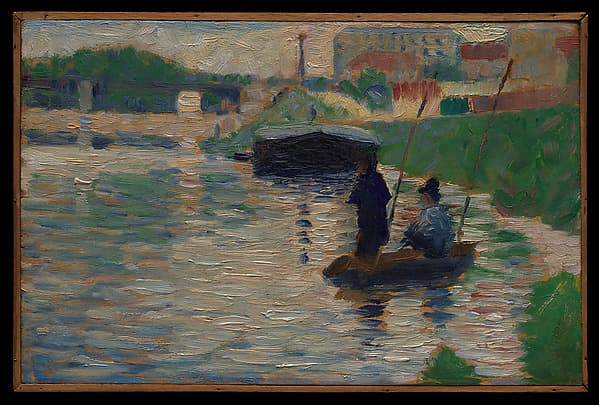
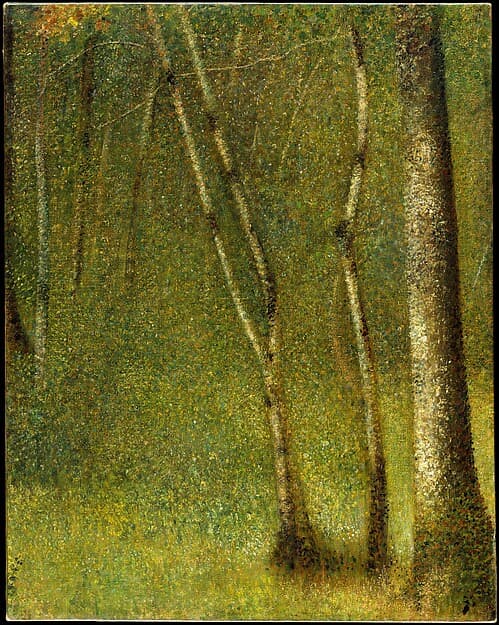
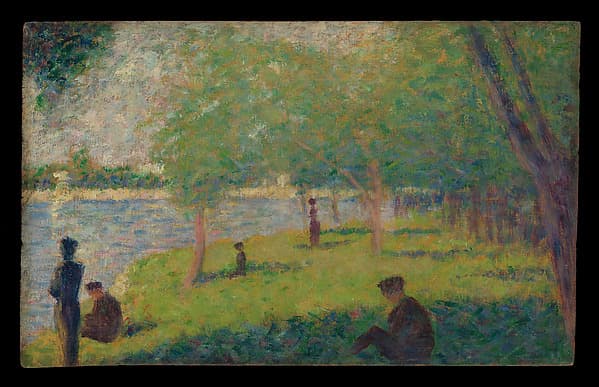
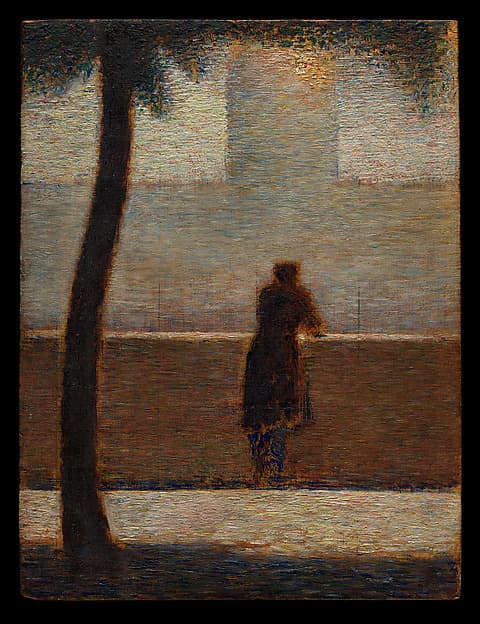
In less than ten years Georges Seurat (1859–1891) worked out the method that came to be called divisionism or pointillism: pure colours laid side by side in small strokes and mixed only in the viewer’s eye. “A Sunday Afternoon on the Island of La Grande Jatte” (1884–1886), shown at the last Impressionist exhibition, gave Neo-Impressionism its name. He died at thirty-one, leaving “The Circus” unfinished.
Biography
The lid of his paintbox served Seurat as a palette, and the colours on it always lay in the same order: the three primaries, red, blue and yellow, with a lump of white beside each for mixing. Paul Signac recalled how, in front of the motif, Seurat would squint for a long while, compare, hunt for reflections and contrasts, and only then “peck” the colour he needed out of the little heaps. He liked to show friends that the green tops of trees against a grey sky are ringed with a pink halo, and that sand which is orange in the sun turns blue in the shade.
That is how a man worked who was given thirty-one years.
He was born on 2 December 1859 in Paris, on the rue de Bondy, into a well-off family: his father, Antoine-Chrysostome Seurat, a native of Champagne and a former legal official, had grown rich on property deals, lived apart in Le Raincy and visited his wife and children once a week; his mother, Ernestine Faivre, was a Parisian. In 1862 or 1863 the family moved to the boulevard de Magenta, and Georges had his first lessons nearby, at the municipal school of drawing and sculpture run by the sculptor Justin Lequien. In 1878 he entered the École des Beaux-Arts, in the studio of Henri Lehmann, drew from antique casts and copied old master drawings; it was there that his theory of contrasts began to take shape. In November 1879 he left for a year in the army, in the 19th Line Regiment at Brest, and on his return to Paris he shared a studio with his friend Aman-Jean and for two years did almost nothing but black-and-white drawing, in conté crayon on rough paper. His first exhibited work was a drawing of exactly that kind, a portrait of Aman-Jean at the Salon of 1883. At the same time he was studying Delacroix closely and noting down how he handled colour.
His theory came from books. Friends called Charles Blanc’s “Grammaire des arts du dessin” (1867) his bedside book; from it a trail led to Chevreul, the chemist at the Gobelins manufactory who had described the law of simultaneous contrast of colours. Seurat copied out paragraphs from the chapter on painting, read “Modern Chromatics” (1879) by the American Ogden Rood and “Phenomena of Vision” (1880) by David Sutter, and in the 1880s went to the Sorbonne to hear the mathematician Charles Henry lecture on the expressive meaning of lines. Out of this grew a practice: not mixing paints on the palette but laying pure colours side by side in small strokes, so that they would combine on the viewer’s retina. He painted his studies from nature on small wooden panels and built the large canvases in the studio from dozens of preparatory drawings, which was in itself a departure from Impressionist habit.
His first large canvas, “Bathers at Asnières” (1883), was turned down by the Salon jury. In May 1884 Seurat showed it at the exhibition of the Groupe des Artistes Indépendants in a pavilion in the Tuileries, where he met Signac; the critic Paul Alexis called the picture a “faux Puvis de Chavannes”. Disappointed with the organisers, Seurat joined Signac, Charles Angrand, Henri-Edmond Cross and Albert Dubois-Pillet in founding the Société des Artistes Indépendants. That same summer he began “A Sunday Afternoon on the Island of La Grande Jatte”: a canvas three metres wide, about sixty studies and drawings, two years of work. In May 1886, at the eighth and last Impressionist exhibition, the painting hung at the centre of his display of nine works. Roger Marx and Félix Fénéon wrote about it seriously, the public laughed, and Degas, when Pissarro said the picture was very interesting, replied that he would have noticed, were it not so big. Seurat blamed the failure on a dark, cramped room: the dots needed distance. On 19 September 1886, in the Brussels paper “L’Art moderne”, Fénéon named the new movement Neo-Impressionism, and the word stuck. To my mind he also described the heart of the method better than anyone: no virtuoso handling is wanted here, but the eye must be quick, sharp and understanding.
Critics called the figures in his canvases cardboard dolls. The surviving studies show that he could paint living people when he chose; the simplification was deliberate. He wrote to a friend that he wanted to reduce modern people to their essence and make them move as they do on the frescoes of Phidias.
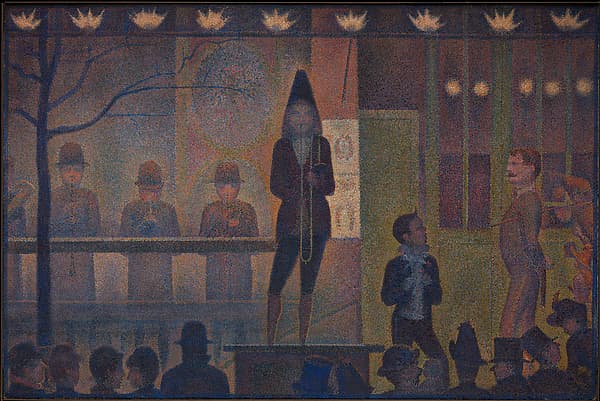
Then came the spectacles: “Circus Sideshow” (1888), “Le Chahut” (1889–1890), “Young Woman Powdering Herself”, for which Madeleine Knobloch posed. In the summer of 1890 at Gravelines, on the Channel coast, he painted four canvases and eight panels. In a letter to the writer Maurice Beaubourg of 28 August 1890 he set out his whole system in a few lines: “Art is Harmony. Harmony is the analogy of contraries”; gaiety lies in a light dominant, warm colour and a rising line, sadness in a dark and cold one and a falling line. By now he was composing his canvases by linear “rhymes” and bordering them with a band of the same dots. He was exhibiting regularly by then: at the Salon des Indépendants, with the Brussels group Les XX in 1887, 1889 and 1891, at the Théâtre Libre in the winter of 1887–88 alongside Signac and Van Gogh. His last picture, “The Circus”, in which acrobats and audience are seen through the eyes of a clown standing with his back to us in the foreground, he sent to the Salon des Indépendants in March 1891 unfinished.
Seurat died on 29 March 1891, aged thirty-one, in his parents’ home on the boulevard de Magenta. A funeral Mass was said for him on 30 March at the church of Saint-Vincent-de-Paul, and on 31 March he was buried at Père-Lachaise.
Artist works
Works by the artist
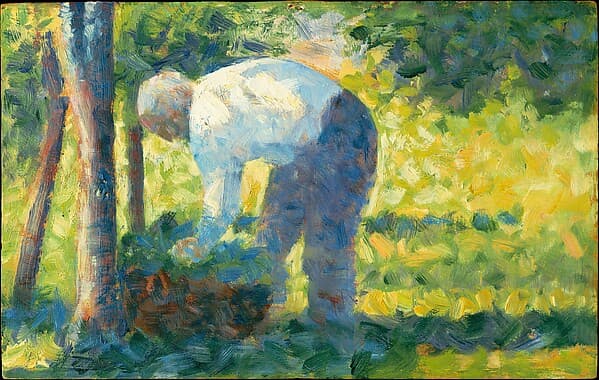
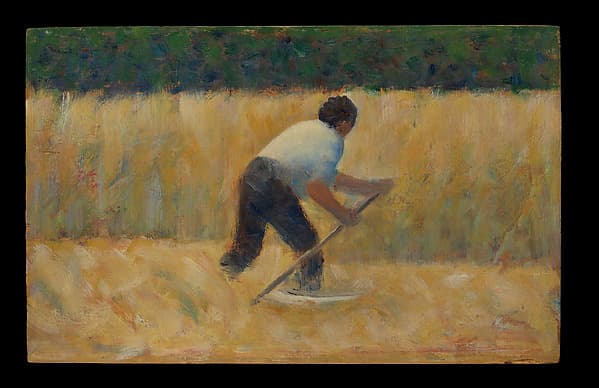
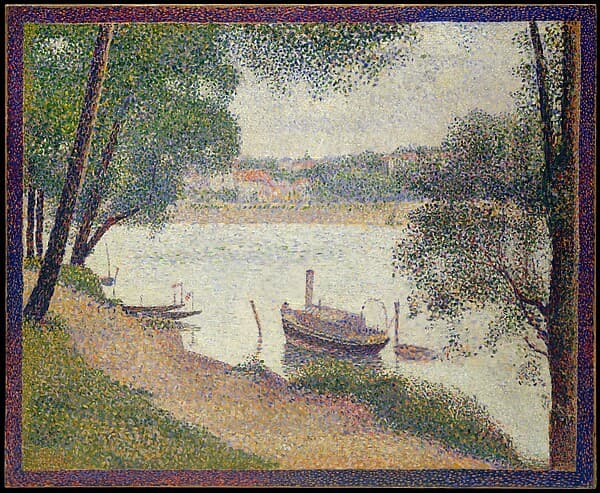
Works by Georges Seurat available in this edition of NEOARCA.
Related context
Associations
Works connected through artistic movements, cultural context and period. Priced works available in this market appear first.








Profile notes
Profile and sources
Image
Artist image
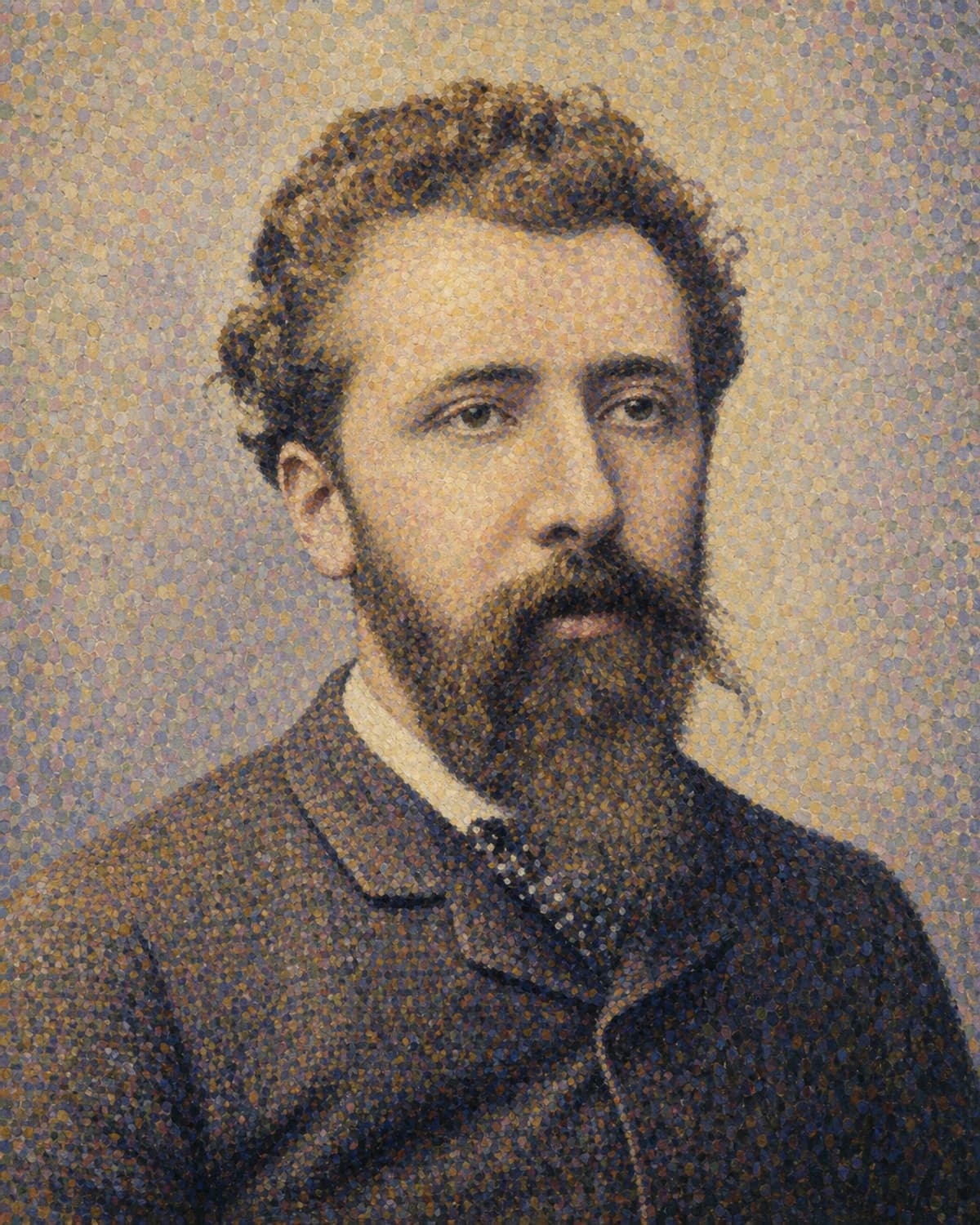
На основе открытого изображения: Unidentified photographer; Wikimedia Commons; Public domain.
