
13.05.1882–31.08.1963
Georges Braque
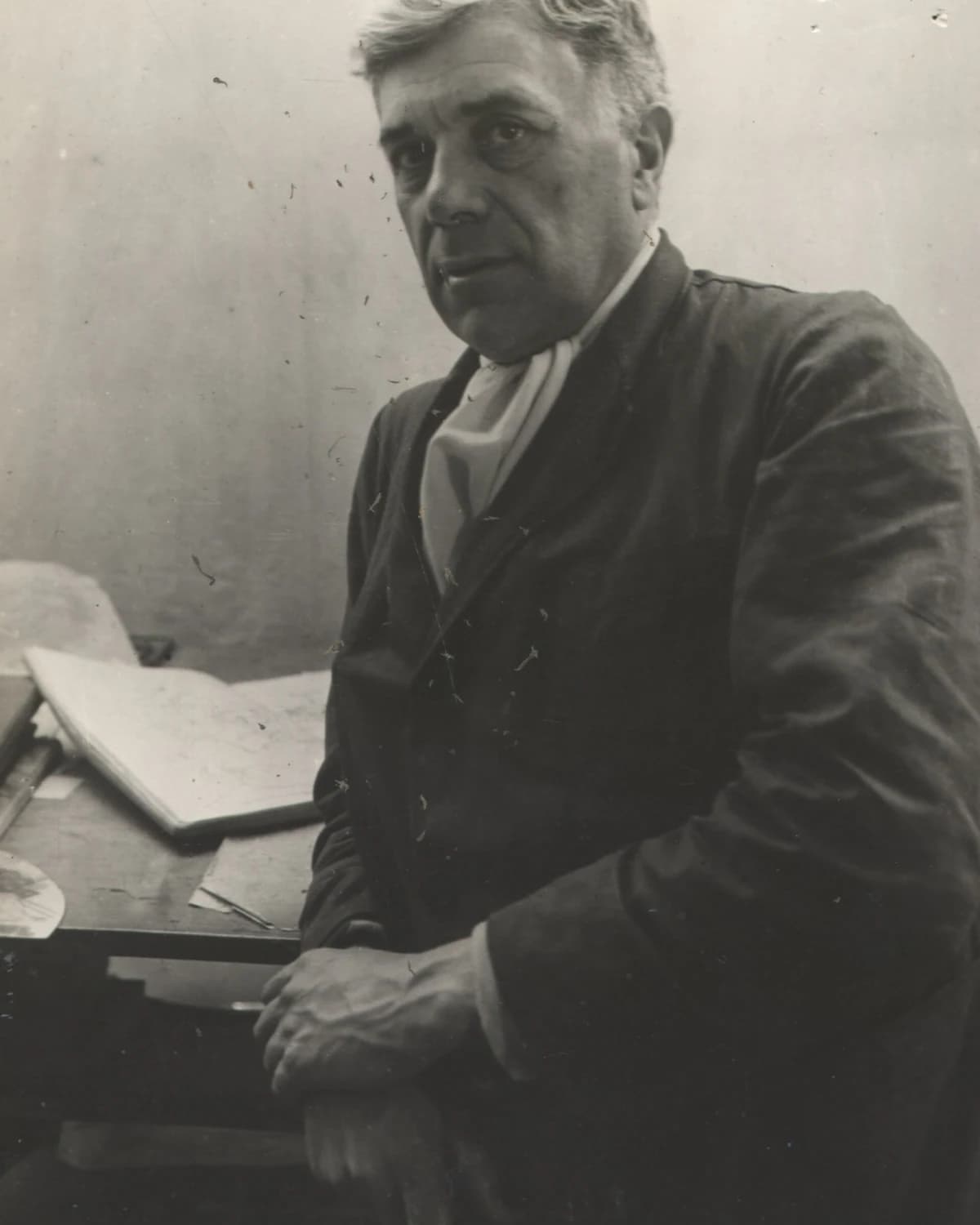
The son and grandson of house painters and decorators, raised in Le Havre, Georges Braque created Cubism together with Picasso in 1908–1914: the canvases they painted side by side at Céret in the summer of 1911 are still hard to tell apart. In 1912 he invented papier collé. The late Braque means the eight “Studio” canvases, the birds on a ceiling in the Louvre and the stained glass of the Norman church beside which he is buried.
Biography
In the autumn of 1908 the jury of the Salon d’Automne rejected the pictures Georges Braque had brought back from a summer of painting at L’Estaque, among them “Houses at L’Estaque”. The dealer Daniel-Henry Kahnweiler, who had just opened a small gallery in the rue Vignon, offered to show these canvases and everything else the artist had made recently; Guillaume Apollinaire wrote the preface to the catalogue. On 14 November the critic Louis Vauxcelles responded with a review: Braque, he wrote, despised form and reduced everything, places, figures and houses, to geometric schemes, “to cubes”.
The word caught on quickly. Braque himself and Picasso were slow to accept it.
He was born on 13 May 1882 in Argenteuil and grew up in Le Havre. His father and grandfather were house painters and decorators, and the son was trained in the same trade; in the evenings, from about 1897 to 1899, he attended classes at the art school in Le Havre. In 1900 he moved to Paris, finished his apprenticeship with a decorator and received his certificate in 1902. Then came the Académie Humbert, where he painted until 1904 and met Marie Laurencin and Francis Picabia. His first works were Impressionist. After seeing the pictures of the Fauves, Matisse, Derain and their companions, in 1905, he took up open colour, though he kept to a more restrained version of the style, which he worked out together with two fellow natives of Le Havre, Raoul Dufy and Othon Friesz. In 1906 he went with Friesz to paint at L’Estaque and in Antwerp. In May 1907 his Fauve canvases were a success at the Salon des Indépendants.
That same year turned everything around. In September 1907 a large retrospective of Cézanne, who had died the year before, opened in Paris, and Braque began to study methodically how Cézanne handled contour. At about the same time he visited Picasso’s studio and saw “Les Demoiselles d’Avignon”. From 1909 the two worked in close contact. Picasso was then absorbed by Gauguin, African masks and Iberian sculpture; Braque was more interested in Cézanne’s idea of many viewpoints on a single object. His subjects became ordinary things: a jug, a violin, a bowl of fruit, a guitar. He later explained his move from landscape to still life by saying that in a still life space is tactile, “I might almost say a manual space”, and that he had always wanted to touch things, not merely see them. On 25 March 1909 Vauxcelles, having seen his painting at the Salon des Indépendants, wrote of “bizarreries cubiques”, cubic oddities. In the summer of 1911 the friends worked side by side at Céret, in the French Pyrenees, and many canvases from that summer are difficult, sometimes impossible, to assign to one or the other. In 1912, at Sorgues, Braque made the first papiers collés, pasting strips of paper into a drawing, among them wallpaper imitating wood; stencilled letters, sand and playing cards then appeared in his paintings. Later, in conversations with Kahnweiler, Picasso claimed both papier collé and Cubism itself for himself. I think it is fairer to speak of a joint invention, as is now the accepted view.
The partnership ended in 1914, when Braque went into the army. In May 1915 he received a severe head wound, was trepanned and for a time could not see; he was twice mentioned in dispatches and awarded the Croix de Guerre. He began painting again towards the end of 1916, now on his own. In the same period he became close to Juan Gris. The hard geometry of the pre-war years softened: saturated colour, textured surfaces and black grounds appeared, while still life remained his principal genre. For Diaghilev’s Ballets Russes he designed “Zéphire et Flore”, staged by Léonide Massine to music by Vladimir Dukelsky.
In 1928 Braque bought a house at Varengeville-sur-Mer, on the Normandy coast, and the architect Paul Nelson built him a studio there. In 1934 the first monograph on him appeared, a book by Carl Einstein. He spent the war mostly in his Paris studio in the rue du Douanier; his most austere works, “The Cauldron” and “The Kitchen Table”, were painted in those years.
In 1949 he began the “Studios”, eight large canvases on a single theme that he reworked for years, changing their content and even their numbering, to the despair of catalogue compilers. In the fourth of them a bird with outspread wings appeared for the first time, and from then on it never left his work. In 1952 Georges Salles, director of the museums of France, commissioned him to paint the ceiling of the Henri II room in the Louvre; “The Birds” was unveiled in 1953. The lithographs and book illustrations of the 1940s and 1950s were printed at Fernand Mourlot’s workshop; he made stained glass, including “The Tree of Jesse” (1954) for the church of Saint-Valery at Varengeville, and designs for jewellery, and in 1962, with the printmaker Aldo Crommelynck, he issued the series of etchings “L’Ordre des oiseaux” (The Order of Birds) to a text by Saint-John Perse. A year earlier the Louvre had shown the exhibition “L’Atelier de Braque”, and he became the first artist the museum exhibited in his lifetime.
Braque died on 31 August 1963 at his home in the rue du Douanier in Paris. He was given a state funeral, and André Malraux delivered the eulogy at the Louvre. He is buried in the seaside cemetery at Varengeville, beside the church for which he made stained glass.
Related context
Associations
Works connected through artistic movements, cultural context and period. Priced works available in this market appear first.








Profile notes
Profile and sources
Image
Artist image
Unknown Unknown; Wikimedia Commons; Public domain.