
20.05.1808–1876
George Henry Ford
George Henry Ford drew for zoologists: as a child he ended up in Cape Town with a broken hip, and a decade and a half later he was working at the British Museum. He made the plates for Andrew Smith’s “Illustrations of the Zoology of South Africa”, and in the 1860s he produced the colour lithographs for George Viner Ellis’s anatomical atlas.
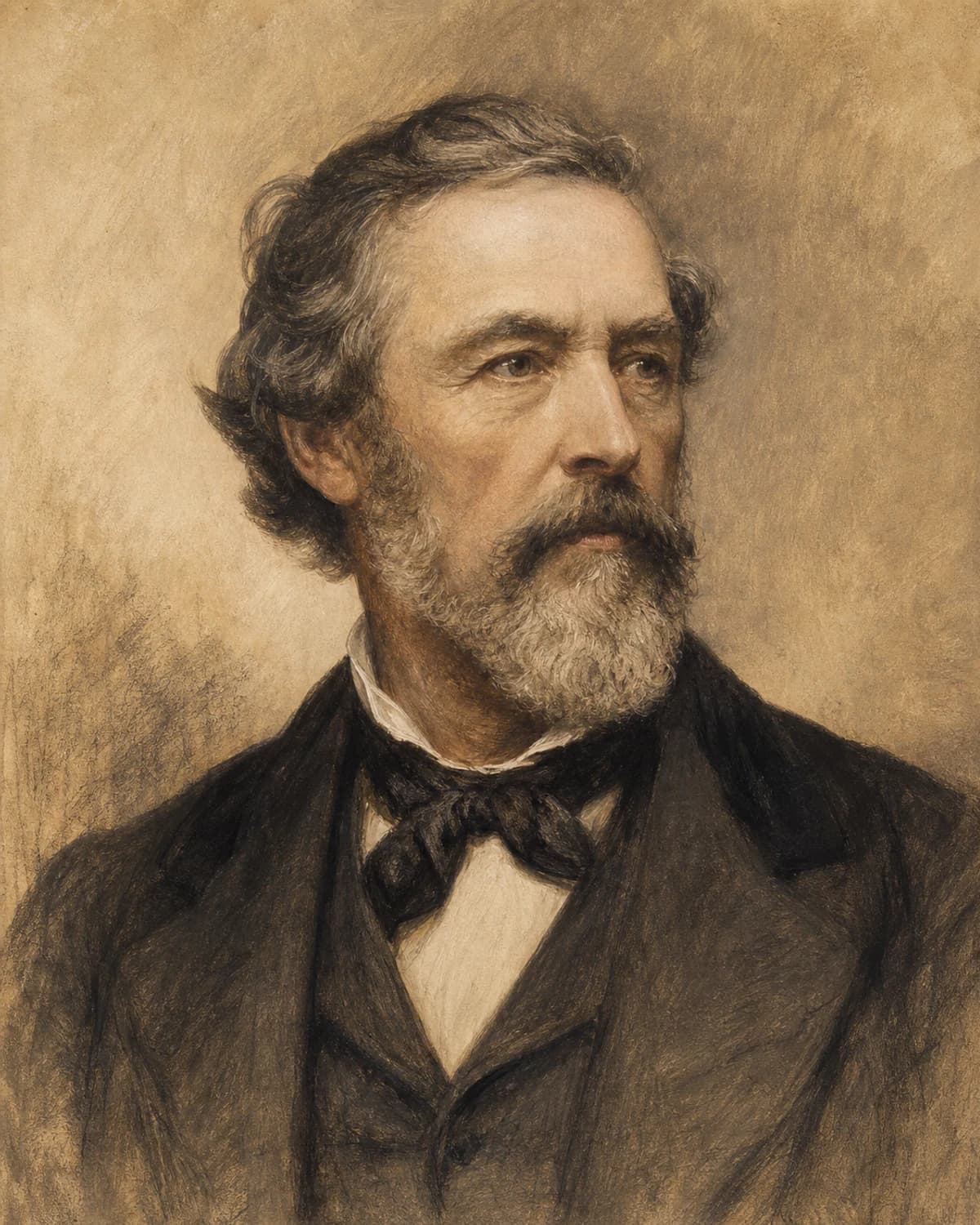
Biography
A dislocated or broken hip, which the boy suffered from a cow, shaped his life. The injury left George Ford lame, and Andrew Smith, who in 1821 was visiting settlers’ farms in search of zoological specimens, took him with him to Cape Town.
Ford was born on 20 May 1808. Sources give his birthplace differently: by some accounts it was the Cape Colony, by others London; in some sources the year of birth is given as 1809. His father, Captain James Edward Ford, was born in England in 1770, painted miniatures, and in April 1820 landed at Port Elizabeth with a party of the 1820 Settlers, the British emigrants who were given land in the eastern Cape. With his wife, Frances Stransham, and their seven children he sailed on the ship Chapman; George was then eleven. The land allotted to the party lay between Bathurst and the mouth of the Great Fish River and was called Cuylerville. In Cape Town, while the hip healed, the boy was encouraged to draw and paint specimens from Smith’s collection. He did it so well that in 1825 Smith recommended him to the newly founded South African Museum in Cape Town. Later Ford was seconded to the expedition of 1834–1836 that explored the interior of South Africa. Its report was “Illustrations of the Zoology of South Africa”, for which Ford made the plates of animals.
In 1837 Smith returned to England, and Ford went with him. His work was quickly recognised, and he was taken on at the British Museum. Smith soon gave up his place there because of the damp semi-basement in Bloomsbury. Ford stayed and worked under John Edward Gray, assistant to the Keeper of Zoology. Because of chronic back pain he eventually worked at the home of Albert Günther in Surbiton; Günther succeeded Gray in 1875.
Ford’s largest work outside zoology was in anatomy. George Viner Ellis (1812–1900) had held the chair of anatomy at University College London since 1850. Together with Ford he produced an atlas in imperial folio, “Illustrations of Dissections in a Series of Original Coloured Plates the Size of Life”: fifty-eight plates printed by chromolithography, then still a fairly new technique. The plates were made between 1863 and 1867, four to seven a year. They were printed by the Mintern Brothers and published by James Walton. The plates are considered clear and accurate, and the cadavers on them are drawn with evident attention to form and colour.
A species of Hispaniolan snake, Chilabothrus fordii, bears Ford’s name.
He died in London in July 1876; by some accounts, on 23 July.
Related context
Associations
Works connected through artistic movements, cultural context and period. Priced works available in this market appear first.








Profile notes
Profile and sources
Image
Artist image
На основе открытого изображения: Неизвестен; Wikimedia Commons; CC BY 4.0.
