
20.04.1950–present
George Baloghy
George Baloghy (born in Budapest in 1950) came to New Zealand as a child after the events of 1956 and graduated from the Elam School of Fine Arts in Auckland. Since 1978 he has held about thirty solo exhibitions in New Zealand and Australia. He paints in oil on canvas: views of Auckland and Wellington, and in recent years retellings of famous New Zealand paintings.
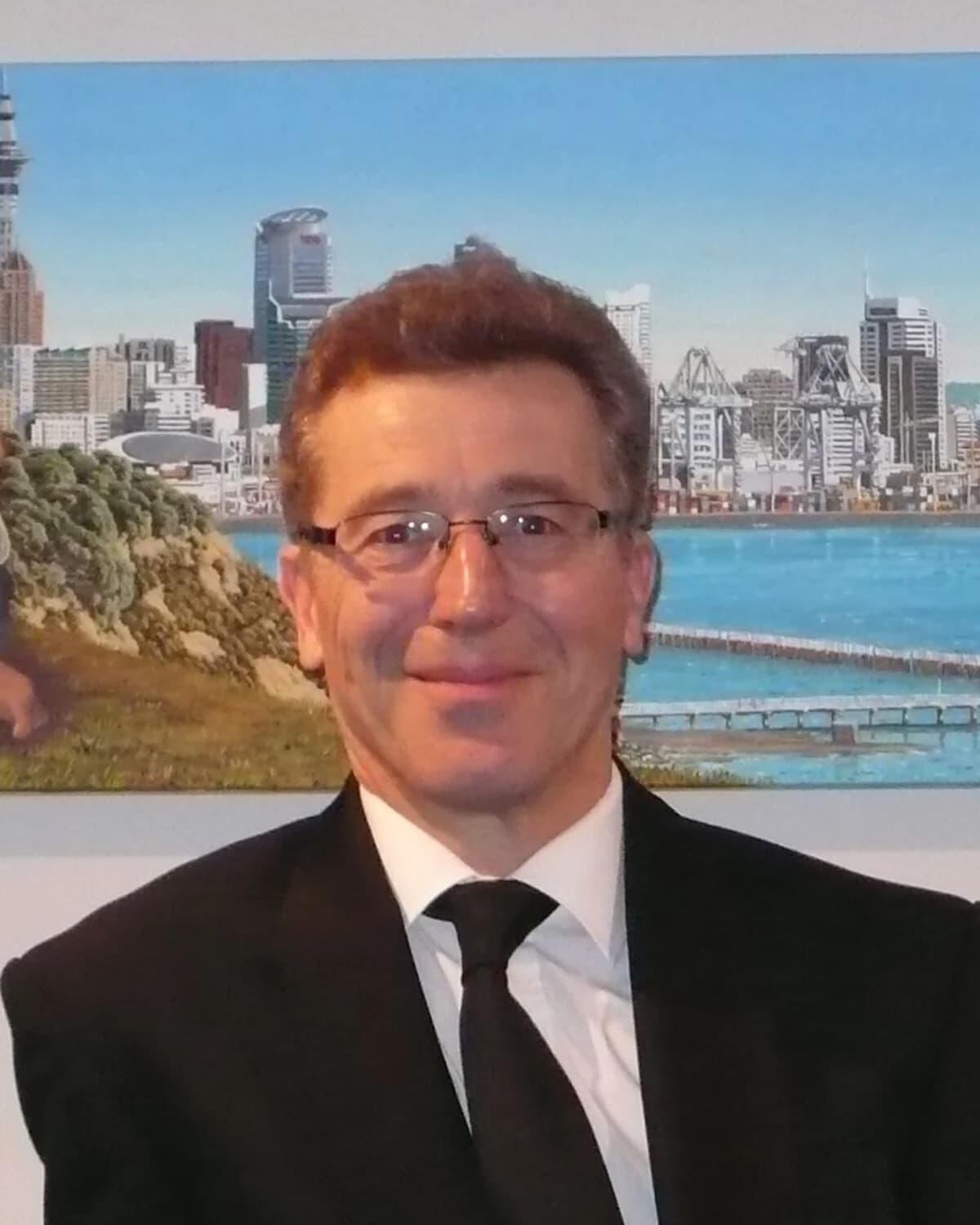
Biography
George Baloghy’s first solo exhibition opened in 1978 at Barry Lett Galleries in Auckland, a year after he finished his studies. Such shows then followed almost every year.
He was born on 20 April 1950 in Budapest. In 1956, after the Hungarian Revolution, the family left, and the boy ended up in New Zealand as a refugee; he was six or seven years old. He studied at St Peter’s College in Auckland, then at the University of Auckland. In 1977 he received a Bachelor of Fine Arts from the Elam School of Fine Arts at that university.
In the 1980s he received several awards. In 1980 he was given the Tokoroa Art Award, in 1982 a studio grant from the Queen Elizabeth II Arts Council, and in 1985 a travel grant from the same council. In 1984 he took part in the touring exhibition “New Image: Aspects of New Zealand Art”.
His solo exhibitions were held in Auckland, Wellington, Christchurch and Sydney. For many years he showed at Artis Gallery in Auckland, almost every year from 1993 to 2008. In 1994 his work was shown at the Montserrat Gallery in New York, and in 2008 at the Dickerson Gallery in Melbourne. By 2008 he had held twenty-seven or twenty-eight solo exhibitions, depending on how they are counted.
His realism is of an unusual kind. Baloghy shifts and alters the main elements of a landscape for dramatic effect, so that some paintings are closer to fiction yet try to convey the feeling of a place. The critic John Daly-Peoples compared what he saw to painting in which the landscape has been turned into a model. Edges and colours are heightened, so the detail is sharp and the atmosphere familiar yet faintly alien. Many works contain references to other artists and their paintings. He lives and works in Auckland and at Hahei Beach on the Coromandel Peninsula, and many of his subjects come from those places, for example the volcanic cone of Mount Eden, which he has painted countless times from different angles. In 2007 he completed a large series of paintings of Wellington.
Then he turned to the best-known New Zealand paintings and made parodic versions of them: Robin White’s “Mangaweka” and Christopher Perkins’s “Taranaki” (1931). To do this he studied the methods of several important New Zealand artists, among them Colin McCahon, Don Binney, Rita Angus and Bill Hammond, and reproduced their manner, placing himself and his car in these pictures. Some of the artists he parodied had themselves once been his students. I think this is a rare case of a teacher arguing so openly with his pupils.
His most recent works return to Auckland: they are chronicles of city districts over the past hundred years, with the smallest details, from the spectacular to the mundane. In these Auckland views he often places anachronistic classical buildings, objects and scenes, or copies of other artists’ paintings.
Baloghy’s works are held by a number of New Zealand museums, including the Museum of New Zealand Te Papa Tongarewa and the Auckland Art Gallery; his work is included in university courses on contemporary art in New Zealand.
Profile notes
Profile and sources
Image
Artist image
User:Eino81; Wikimedia Commons; CC BY-SA 4.0.
