
22.04.1846–18.12.1887
Georg Grimm
The Bavarian Georg Grimm, a carpenter’s son from the Allgäu, studied at the Munich Academy, spent five years wandering around the Mediterranean and in 1877 sailed to Rio de Janeiro. In Brazil he painted coffee fazendas to their owners’ commission, taught landscape at the Imperial Academy of Fine Arts and took his students out to paint in the open air; this is how the “Grimm Group” came about.
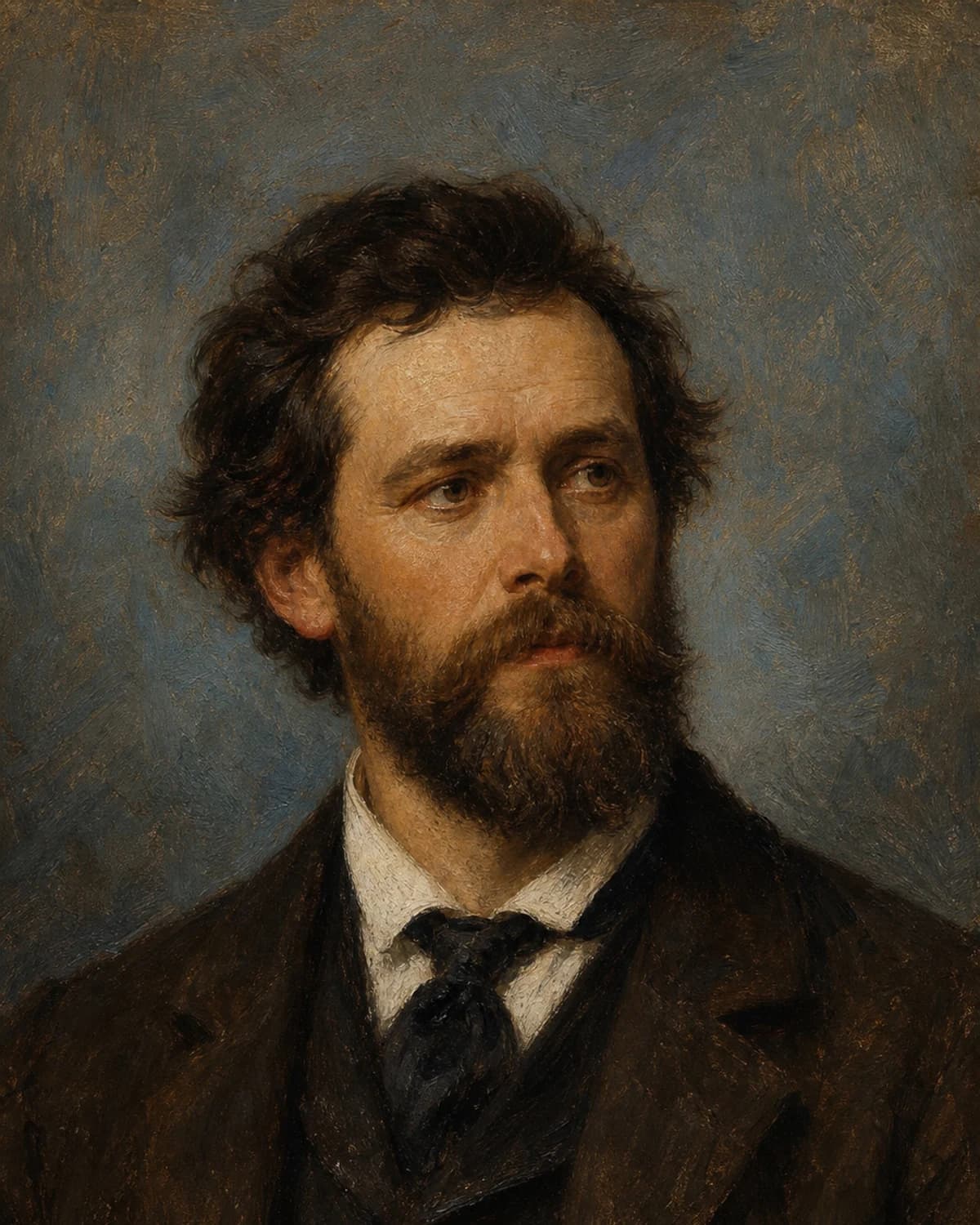
Biography
In March 1882 the Sociedade Propagadora das Belas Artes staged an exhibition of 418 works at the Liceu de Artes e Ofícios in Rio de Janeiro. One hundred and twenty-eight of them belonged to a single artist, the Bavarian Georg Grimm: oils and watercolours painted mostly in 1873–1876 on the road in Europe. Grimm received a gold medal, the press praised him, and through the personal intervention of Emperor Pedro II he was offered the chair of landscape at the Imperial Academy of Fine Arts, which had been vacant since September 1881.
He was thirty-five, and he had lived in Brazil for less than five years.
Johann Georg Grimm was born on 22 April 1846 in the village of See near Bühl am Alpsee, now within Immenstadt, in the Kingdom of Bavaria. His father was a carpenter who made everything from tables and wall panelling to boats for the lake and church altars. At the drawing school in Immenstadt Georg learned architectural drawing, calligraphy and ornament, and then trained as a carpenter himself. The turning point, according to a later account by his pupil Antônio Parreiras, was a commission to renew the library of Rauhenzell Castle: the art books there so captivated the young craftsman that he decided to become a painter. In 1867 or 1868 he entered the Munich Academy of Fine Arts and studied there in real poverty; Parreiras recalled his teacher’s stories of eating bread that had turned black from being used to clean drawings, washed down with water. He is described as a pupil of Karl von Piloty and Franz Adam, although Grimm himself never spoke of his teachers. There are reports that in 1870 he fought in the Franco-Prussian War; there are no documents to show it.
In 1872, with no money for the train, he walked to Berlin. There he was helped by a patroness, apparently the Berlin painter Therese Ravoth, wife of a professor of surgery, and she may also have paid for his later travels. At the end of the same year he went south and until 1877 hardly left the Mediterranean: Rome, Naples, Capri, Sicily, Tunisia and Algeria, Granada and Toledo, then France, England, Portugal. Some two hundred drawings, watercolours and oil studies remain from these journeys. In Lisbon in 1877 he unexpectedly decided to sail for Brazil; why is not known.
He arrived in Rio de Janeiro in 1877 (according to other accounts, early in 1878) and at first worked for a German, Friedrich Anton Steckel, who painted houses and ships, did gilding, painted signs and sold paints. Owners of coffee fazendas in the Paraíba valley, around Petrópolis and Valença and in the province of Minas Gerais commissioned views of their estates from him, and he painted them with almost photographic precision. It was apparently with these commissions that his interest in landscape began. In 1879 he painted two panels in 22 days for the church of Nossa Senhora do Carmo in São João del-Rei. From early 1880 until July 1881 he was in Europe again: he spent nine months at home after his father’s death, then travelled through Italy, Greece, Turkey, Syria, Lebanon, Palestine and Egypt, stayed for a long time in Corsica, and returned to Brazil by way of Paris and Bordeaux. This journey is known only from a small sketchbook.
He began teaching at the Academy in June 1882 and at once took his students out of the classrooms into nature. The leadership and his colleagues disliked both the open-air painting and his sober realism, and after constant disputes Grimm did not renew his contract in mid-1884. His students left with him for Niterói; they came to be called the “Grimm Group”. Its members included Antônio Parreiras, Giovanni Battista Castagneto, Domingo García y Vásquez, Hipólito Boaventura Caron, Thomas Georg Driendl and others. In August 1884, at the Exposição Geral de Belas Artes, Grimm and almost all his students received gold medals and honourable distinctions. For another six months they worked on the beaches of Niterói, in January and February 1885 they painted together for the last time in the mountains of Teresópolis, and then they went their separate ways.
Grimm went off to Minas Gerais again. In 1885 he painted the curtain for the opera house in Sabará, and in 1886 he produced many paintings of coffee plantations, their work and their buildings. The largest of all his paintings, a view of the Fazenda Catangá, he finished in December 1886 after two months’ work. In June 1887 he said goodbye to his students and left for Europe, stayed with his brother in Wengen, went to Merano on his doctor’s advice, and in the autumn to Sicily. He died in hospital in Palermo in December 1887, on the 18th according to some sources, on the 24th according to others, and was buried in the English Cemetery at the foot of Monte Pellegrino. His grave was found again only in 2007.
Related context
Associations
Works connected through artistic movements, cultural context and period. Priced works available in this market appear first.








Profile notes
Profile and sources
Image
Artist image
На основе открытого изображения: Georg Grimm; Wikimedia Commons; Public domain.
