
1982–present
Ganzeer
Ganzeer is the pseudonym of an Egyptian artist who worked in graphic design and comics before the 2011 revolution and then became known for street murals in Cairo. In 2011 he painted a series of portraits of people killed during the revolution and was detained over stickers of the “Mask of Freedom”. He rejects the label of street artist, and in 2019 he published his first graphic novel, The Solar Grid.
Biography
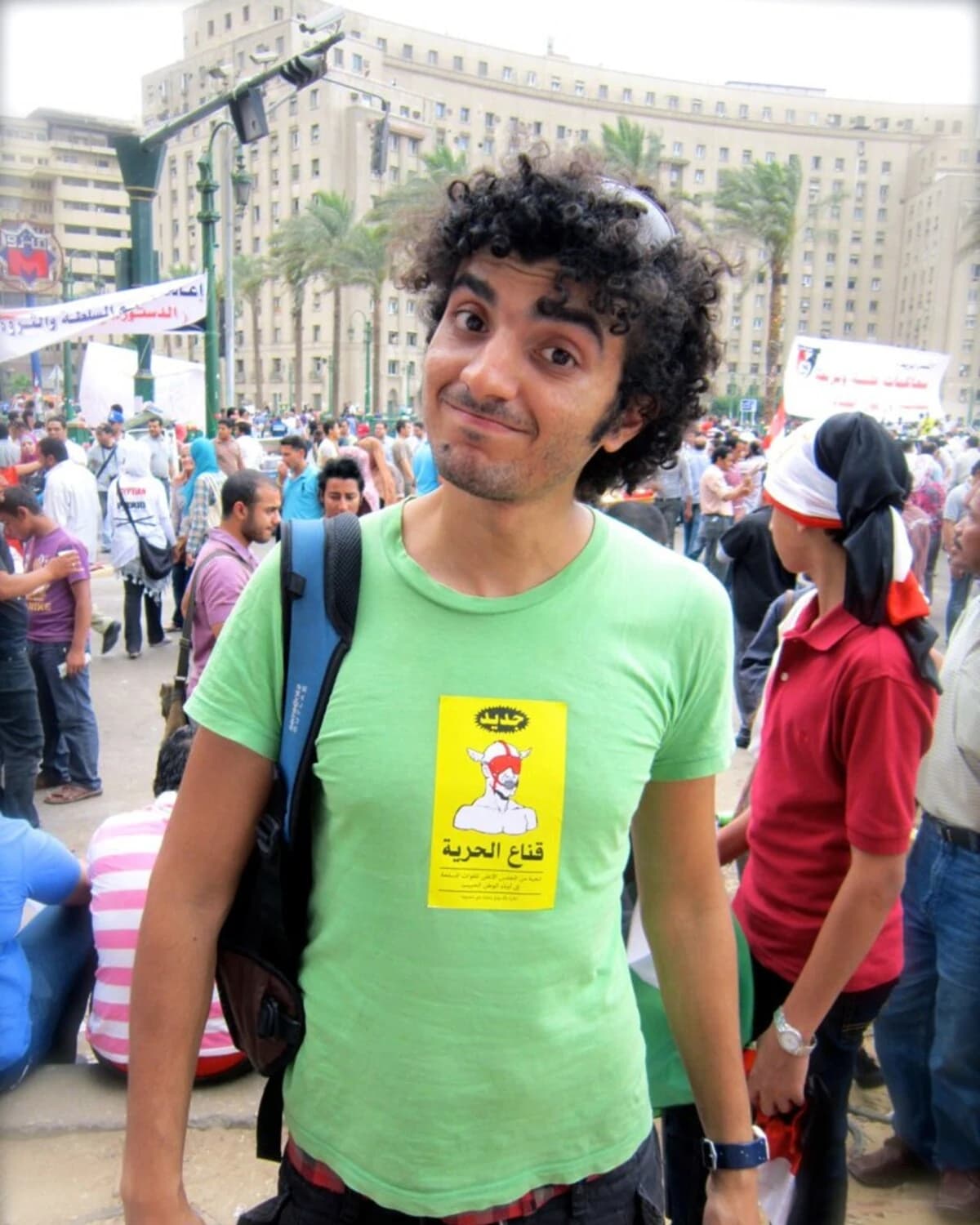
On 26 May 2011 in Cairo, a man was detained for handing out stickers showing a mannequin’s torso in a mask, with two tiny wings on its head. The image was called “Mask of Freedom”. The author was Ganzeer.
He was born in 1982 in Giza. According to one source, his real name is Mohammed Fahmy, but in public he uses only the pseudonym. He studied at a business school in Cairo, although he dreamed of drawing comics. He then moved into graphic design and, according to the same source, opened his own studio in 2005, which operated for about eight years. The pseudonym means “chain” in Arabic. He himself explained it by the chain of a bicycle: artists do not turn the pedals, but they connect ideas, and that lets everything move. The name was meant for the studio, but visitors began to call its owner by it.
Before 2011 his work was known mainly in art and design circles. His list of exhibitions begins in 2007, with “This Should Be Made Public” at the Goethe-Institut in Cairo and “Everyday Heroes” at Townhouse. Shows followed in Dubai, Rotterdam, Berlin, Brussels and Amsterdam. In 2008 came the book “Ruins of the Future”, made together with George Azmy, and in 2009 he self-published “From the End”.
The revolution changed the scale. In 2011 he painted a series of murals with portraits of the “martyrs” killed in the events, and called it the “Martyr Murals”. Street art was appearing everywhere at the time, but these paintings, to my mind, answered a specific demand: people wanted to see the dead named in public, and at once. Attempts to remove the murals from buildings led in May 2011 to the protest action “Mad Graffiti Weekend”.
Trouble began at the same time. According to the available information, he was held for a day over the “Mask of Freedom” stickers and then released without charge.
His geography then widened: Toronto (“Cairo 20x20”, 2011), Frankfurt, Katowice, Porto Alegre, Mechelen, Basel, New York (The Cooper Union, 2012; Apexart, 2013), Helsinki, Bahrain and Völklingen. In 2015 his exhibition “All American By Ganzeer” was held at the Leila Heller Gallery in New York. He gave lectures in Lebanon, Germany, Poland and Finland; listeners, it is reported, describe them as semi-performances with humour.
He does not accept the label “street art”. In his words, he is not exactly a graphic designer, a product designer, a street artist or a comics author, but at different times and in different places he has taken on each of those roles. Calling him a graffiti artist, he said, is unfair to real street artists. Bidoun magazine called him a “Contingency Artist”: for each subject he chooses a new style, technique and medium. He has made work for magazines, events, projects and musicians, and he writes regularly for the online magazine Rolling Bulb.
In 2014 he became one of the protagonists of the documentary “Art War” by the German director Marco Wilms. He was also included in the book “Walls of Freedom” and in the Huffington Post list “25 Street Artists from Around the World Who Are Shaking Up Public Art”. Al-Monitor placed him on its list of “50 People Shaping the Culture of the Middle East”. His first graphic novel, The Solar Grid, appeared in 2019.
Profile notes
Profile and sources
Image
Artist image
Gigi Ibrahim from Cairo, Egypt; Wikimedia Commons; CC BY 2.0.
