
07.01.1917–17.11.1977
Gamal El-Sagini
Gamal El-Sagini (1917–1977) grew up by the Khan el-Khalili bazaar in Cairo, where his father worked as a metal chaser, and from the early 1950s worked in hammered copper relief himself, joining the ancient Egyptian turn of the figure to Arab ornament. He studied sculpture in Cairo, Paris and Rome, where he took a diploma in medal art. His bronze monument to the poet Ahmed Shawqi stands in the gardens of the Villa Borghese in Rome.
Biography
In the hammered copper relief “Freedom”, a seated naked man pushes his arms through the bars of a prison and bends them apart. The face and legs are in profile, the chest frontal, as in ancient Egyptian reliefs, and the dove flying out to freedom is treated with the same convention. Only the arms, muscular and straining, are modelled almost from life.
Gamal El-Sagini was born on 7 January 1917 in Cairo, in the poor district of Bab al-Sha’riya, the son of a craftsman who chased metal at the Khan el-Khalili bazaar; he watched the coppersmiths and goldsmiths at work from childhood.
In 1933 or 1934 he entered the sculpture department of the Cairo School of Fine Arts, founded by Prince Youssef Kamal, where his teacher was the Swedish sculptor Frodman-Cluzel. In 1937 he won the prize of the Mahmoud Mokhtar competition, set up by Huda Shaarawi in memory of the sculptor, and in 1938 he graduated. In 1945 he formed the group “Voice of the Artist” to support young Egyptian artists and then went to Paris at his own expense, where he looked at Rodin, Bourdelle, Maillol and Brancusi; afterwards, on a scholarship, he continued his studies in Rome and in 1950 took a diploma there in sculpture and medal art. Back in Egypt in 1951, he opened a studio in Zamalek and began teaching sculpture at the Cairo School of Fine Arts; in 1958 he became head of the sculpture department at the new Faculty of Fine Arts in Alexandria, and from 1964 until his retirement in 1977 he headed the sculpture department in Cairo.
His early work was sculpture in the round; from the early 1950s he preferred hammered copper relief, a technique the Cairo craftsmen had practised since the Middle Ages. From ancient Egypt he took the generalised body and the differing scale of figures and objects, from the Arab Middle Ages the filigree finish and the generous ornamental frame. His own birth as an artist he linked to the revolution of 1952. Hence his subjects: “Chains” of 1952, “The Serpent” of 1954, the bronze “The Nile” of 1958 in the guise of a bearded old man, “Egypt My Mother Land” of 1957, in which a woman nurses infants while carrying on her shoulders an ear of wheat, bricks and a book. In 1954, in the copper relief “The Will”, 33 by 28 centimetres, he showed himself in a tomb, like a pharaoh, among everything he loved: love, hope, art, music. After the war of 1967 Egypt appears in his work as the sugar doll of the popular festivals, crippled and hanged; after 1973 as a boat full of soldiers in “The Great Crossing of the Suez Canal” and as a woman in “Egypt, The Future” of 1975. In that same year, 1975, his stone “Crossing”, five and a half metres long, was set up in Beni Suef. He also worked a great deal in medals.
In 1969, according to the family website, he sank some of his sculptures in the Nile in protest at the state’s indifference. I have not been able to verify this story from independent sources.
He exhibited at the Venice Biennale of 1956; in 1955 he received the sculpture prize of the first Alexandria Biennale of Mediterranean Countries, in 1957 the gold medal of the international exhibition in Moscow at the World Festival of Youth, in 1958 an award in Brussels. His work was included in exhibitions of Egyptian art in Rome, Beijing, Moscow and Bucharest in 1957–1959 and in “Art Against War” in Cairo in 1967 and in Leningrad and Moscow in 1972–1973. In 1962 he received the State Appreciation Prize, and from Italy a knighthood. His work is held by the Museum of Modern Egyptian Art in Cairo, the Pushkin Museum and the Museum of Oriental Art in Moscow, and a museum in Beijing.
In 1977 the Egyptian information agency organised a large exhibition of his work in Madrid and Barcelona. It was in Barcelona that he died, in November 1977, on the 17th by one account and the 19th by another, at the age of sixty. His wife Hoda accompanied the body home; he is buried in the family tomb in Cairo. For his centenary, in 2017, a retrospective was shown by the Mahmoud Mokhtar Museum and the Zamalek Art Gallery.
Profile notes
Profile and sources
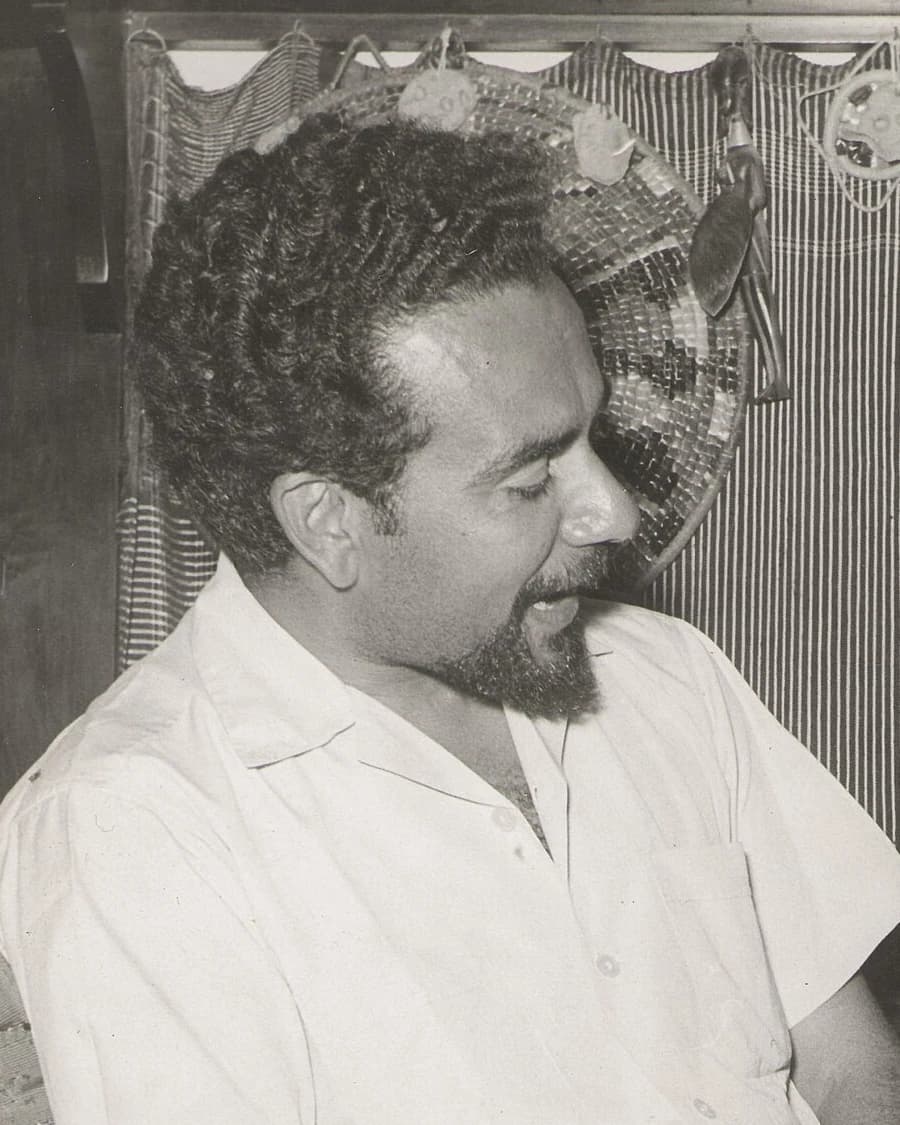
Image
Artist image
Nour El-Sagini; Wikimedia Commons; CC BY-SA 3.0.
