
18.09.1867–14.02.1938
Gaganendranath Tagore
Gaganendranath Tagore (1867–1938), elder brother of Abanindranath and nephew of Rabindranath Tagore, began in the spirit of the Bengal School and Japanese brush painting, then became a caricaturist and published several albums of satirical lithographs. Together with his brother he is counted among the first Indian modernists; in 1920–1925 he painted in a Cubist manner. He also wrote a children’s book.
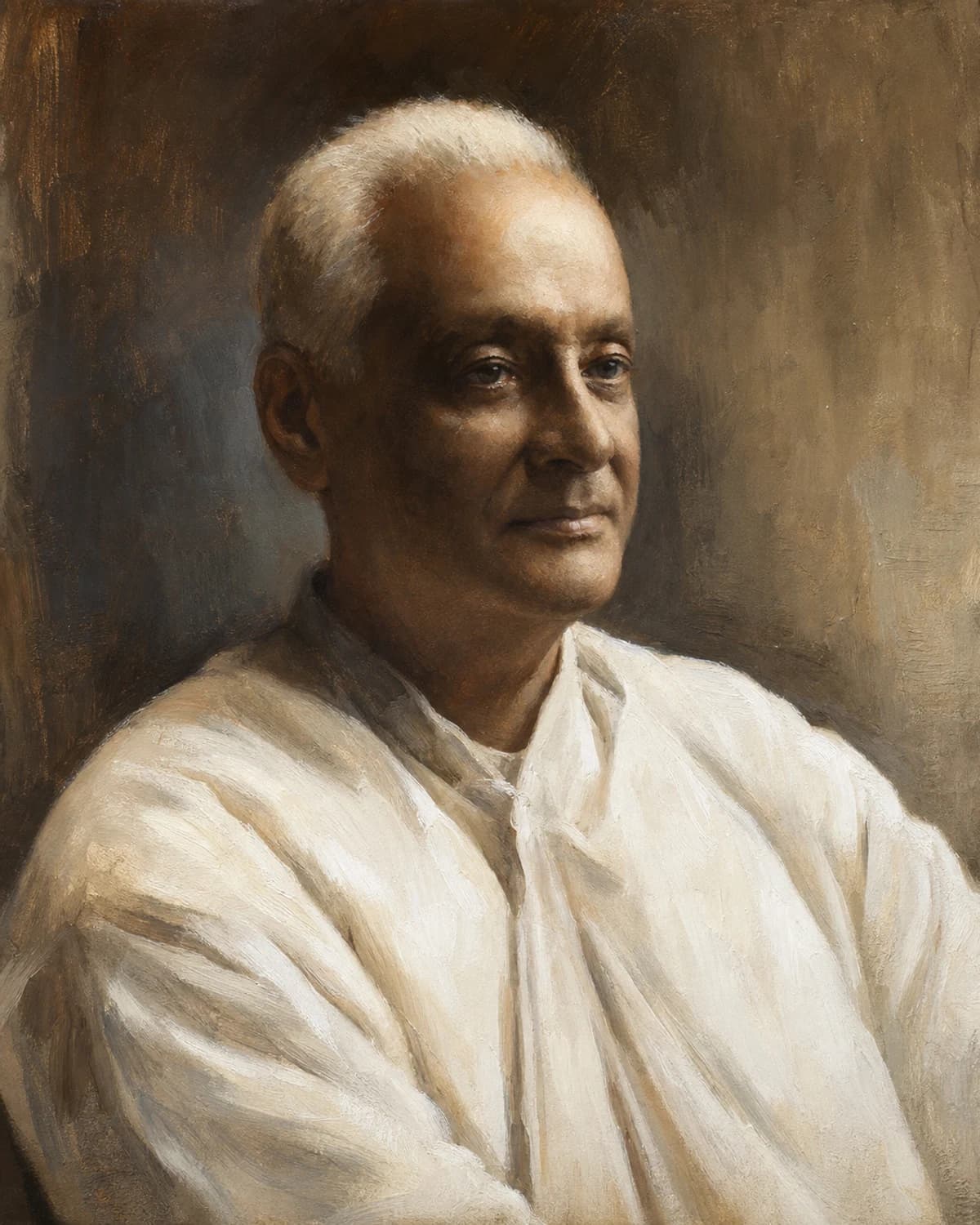
Biography
In one of his satirical sheets, “The Power of the Law”, a well-fed, contented policeman strolls under an umbrella, leading two beggars, hungry and soaked to the skin, to the police station. In 1917 the journal “The Modern Review” printed many of Gaganendranath Tagore’s cartoons, and that same year his album “Adbhut Lok”, “Realm of the Absurd”, thirteen satirical pictures, came out in Calcutta.
He was about fifty, and until then he had been known for quite different work.
He was born on 18 September 1867 in Calcutta, in the Tagore family house at Jorasanko. He was the eldest son of Gunendranath Tagore, grandson of Girindranath and great-grandson of Dwarkanath Tagore; his younger brother, Abanindranath, became a pioneer and the leading master of the Bengal School, and the poet Rabindranath Tagore was his uncle. Gaganendranath received no formal education and trained with the watercolourist Harinarayan Bandopadhyay. In 1906–1910 he mastered Japanese brush technique and Far Eastern painting in general; the decorative work of Ogata Kōrin is named among his models. In 1907, together with his brother, he founded the Indian Society of Oriental Art, which later published the journal “Rupam”. His Japanese training shows in his illustrations for Rabindranath’s “Reminiscences” (1912). Then came series of his own, “Chaitanya” and “Pilgrims”, and around 1915 the watercolour “Immersion of the Image”, “Pratima Visarjan”.
In the end he moved away from the revival of old models on which the Bengal School stood and took up caricature. “Realm of the Absurd” was followed by “Reform Screams” (1921), a pictorial review of the closing year, and “Play of Opposites” (1930). His targets were vice and injustice.
The most unexpected turn came in 1920–1925: Gaganendranath began to paint in a Cubist manner. Partha Mitter, the historian of Indian modernism, regards him as the only Indian painter before the 1940s who used the very language and syntax of Cubism. One of the works of these years is called “Meeting at the Staircase” (c. 1920–1925). From 1925 his manner grew more complex and is described as post-Cubist. It seems to me that these late works are more interesting than his early Japanese experiments, but it is hard to judge from the few reproductions available.
He loved the theatre and wrote a children’s book in the manner of Lewis Carroll, “Bhodor Bahadur”, “Otter the Great”. Gaganendranath Tagore died in Calcutta on 14 February 1938. His works are held by the Victoria Memorial in Calcutta, the National Gallery of Modern Art and the Victoria and Albert Museum in London.
Related context
Associations
Works connected through artistic movements, cultural context and period. Priced works available in this market appear first.








Profile notes
Profile and sources
Image
Artist image
На основе открытого изображения: Unknown author Unknown author; Wikimedia Commons; Public domain.
