
10.02.1850–24.09.1873
Fyodor Vasilyev
Fyodor Vasilyev (1850–1873) lived to twenty-three and had about five years of serious work. He studied with Ivan Shishkin, who was married to his sister, was friends with Kramskoi and sailed the Volga with Repin. His “The Thaw” was shown at the International Exhibition in London, and “Wet Meadow” and “In the Crimean Mountains” are in the Tretyakov Gallery. He spent the last two years of his life in Yalta.
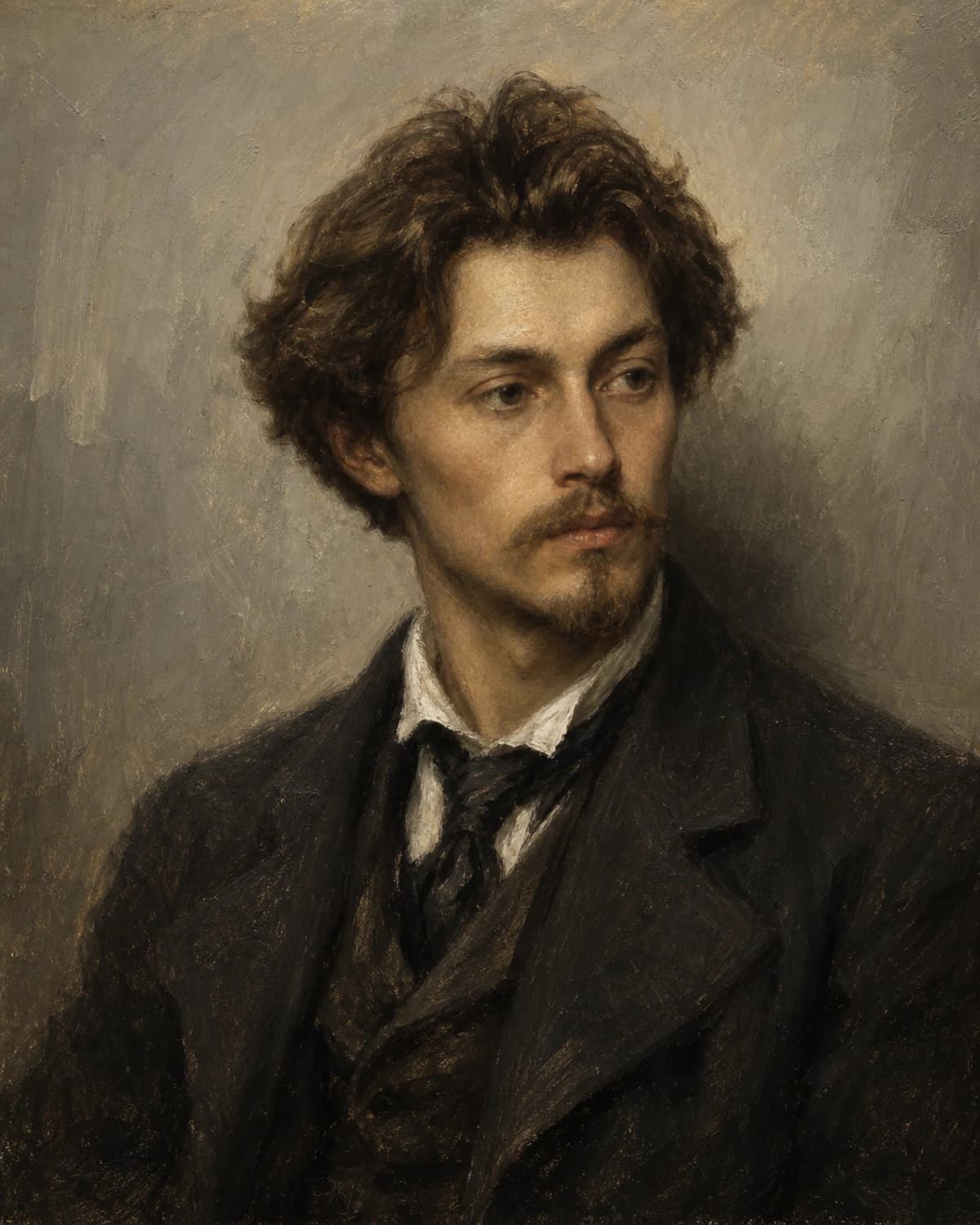
Biography
Fyodor Vasilyev spent the last two years of his life in Yalta, and what he painted there was mostly not Crimea. From memory he painted wet meadows, marshes, a northern sky after a storm, everything Yalta did not have. Tuberculosis would not let him go back to St Petersburg, and judging by the pictures, that was where he was looking the whole time.
He was born on 10 (22) February 1850 in Gatchina. A caveat is needed here, though: no documents recording his place and date of birth have been found, and this information goes back to his first biographers. His father was a minor postal official, the family was poor, and at twelve the boy was put to work at the Main Post Office for three roubles a month. He had wanted to draw since childhood. In the end Vasilyev left the job, and in 1865–1868 he studied at the Drawing School of the Society for the Encouragement of Artists: classes in the evening, and during the day work for the Academy restorer P. K. Sokolov.
School was all very well, but his real teachers were people. He grew closest to Ivan Kramskoi and to Ivan Shishkin, who was married to his sister. From June until late autumn 1867 Vasilyev and Shishkin worked together on Valaam. From there come “After the Rain”, “Village Courtyard” and “In the Churchyard. Valaam”. From Shishkin he learned to draw a tree, grass or stone so that it was clear how they were made. But what interested him was something else. Weather: damp air, a departing cloud, light after rain, the brief moment when the sky changes before your eyes.
Count Pavel Sergeyevich Stroganov helped him. In the summer of 1869 Vasilyev stayed at the count’s estate of Znamenskoye in Tambov province, and in the autumn at Khoten in Ukraine. For the nineteen-year-old artist these were his first long trips to work from nature.
In 1870, together with Ilya Repin and Yevgeny Makarov, he sailed down the Volga from Tver to Saratov; they stayed near Stavropol in Samara province. Repin painted his barge haulers there and later recalled how much he had learned about landscape from his younger companion. Vasilyev brought back studies from the Volga and the painting “View of the Volga. Barges”.
Straight after the trip came “The Thaw” (1871). A winter road in the slush, dark scrub, a low, heavy sky, small figures of travellers. Nothing happens, and yet you feel the damp on your skin. The painting was an event; the artist’s own replica, painted in warmer tones, was shown in 1872 at the International Exhibition in London. Some twenty years later Levitan would build his landscapes in much the same way, through the state of the weather and the air.
While he was working on “The Thaw”, in the winter of 1870, Vasilyev caught a bad chill. It turned out to be tuberculosis. Stroganov offered him the summer of 1871 on his estates in Kharkov and Voronezh provinces, but that did not help, and with money from the Society for the Encouragement of Artists Vasilyev left for Crimea.
In Yalta he lived on Simferopolskaya Street (the house has not survived) and worked more than his health allowed: pencil, watercolour, sepia, oil paintings. “Wet Meadow” (1872) is one of the northern memories. A huge sky after a storm, the shadow of a cloud creeping across the meadow, water glinting in the hollow. The main Crimean work is the large painting “In the Crimean Mountains” (1873): a road between rocks, tall trees, clouds and very tiny people. Both are now in the Tretyakov Gallery. Also painted in Yalta were “Morning”, “Abandoned Mill” and “Swamp in the Forest. Autumn”. By then the Academy of Arts had enrolled him as an external student and given him the title of artist of the first degree, on condition that he pass an examination in the academic subjects, and in 1873 it made him an honorary free associate.
Vasilyev died on 24 September (6 October) 1873. He is buried in Yalta, in the Polikurovskoye Cemetery.
Related context
Associations
Works connected through artistic movements, cultural context and period. Priced works available in this market appear first.








Profile notes
Profile and sources
Image
Artist image
На основе открытого изображения: Репин И.Е.; Wikimedia Commons; Public domain.
