
06.07.1907–13.07.1954
Frida Kahlo
Frida Kahlo (1907–1954) spent almost her whole life in the Blue House in Coyoacán, which is now her museum. She painted mostly herself: after the accident of 1925 a mirror was hung above her bed. Among her works are “The Two Fridas”, “The Broken Column” and “Henry Ford Hospital”. André Breton enrolled her among the Surrealists, but she rejected the label and said that she painted her own reality.
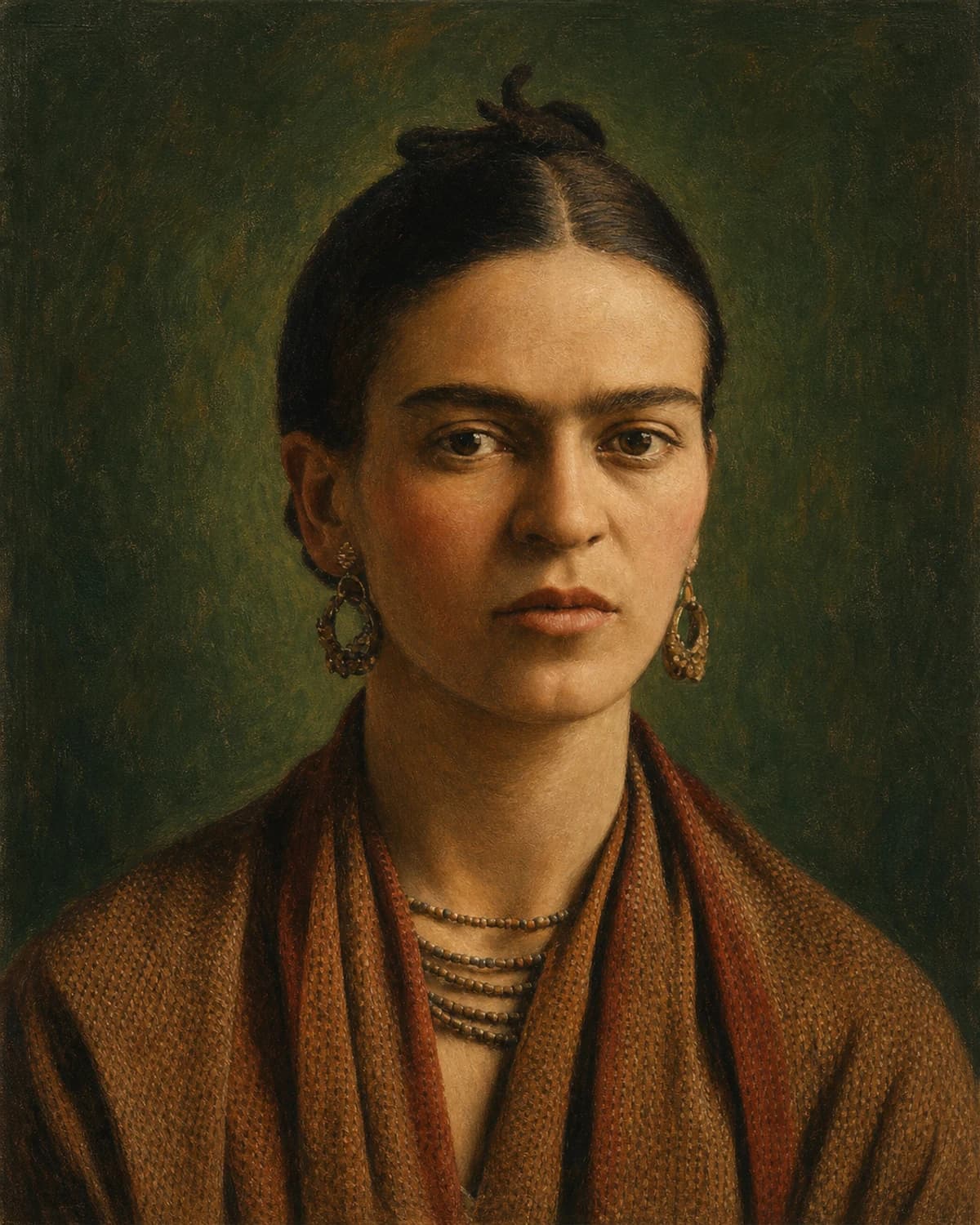
Biography
In April 1953 Frida Kahlo’s first solo exhibition in her own country opened in Mexico City. Her doctors had ordered her to stay in bed, so first her four-poster bed was brought to the gallery, and then the artist herself, by ambulance. She was carried on a stretcher to the bed and spent the whole evening receiving guests lying down. A few months later part of her right leg was amputated, and a little more than a year later she was gone.
The story is retold often, because the whole of Frida is in it: pain, stubbornness and a sense of theatre.
Magdalena Carmen Frida Kahlo Calderón was born on 6 July 1907 in Coyoacán, then a suburb of Mexico City, in the Blue House. Her father, the photographer Guillermo Kahlo, had come to Mexico from Germany; her mother, Matilde Calderón, was Mexican. Frida herself always said she had been born on 7 July 1910. That made her younger and, what is more, the same age as the Mexican Revolution, a “daughter of the revolution”.
At six she had polio, and her right leg stayed thinner than her left. In 1922 she entered the National Preparatory School, the best in the country, where there were very few girls, and she meant to become a doctor. Diego Rivera was working in the school’s amphitheatre at the time, and that is where she first saw him.
On 17 September 1925 the bus she was riding in collided with a tram. Fractures of the spine, the pelvis, the leg. Her back hurt for the rest of her life; there were many operations, and for long periods she had to wear rigid corsets. While she lay in bed, her mother ordered an easel for her that could be set up on the bed, and a mirror was hung above it. That is how her main subject arrived. Later she explained it without any mysticism: I paint myself because I am often alone and because it is the subject I know best.
In 1928 she joined the Mexican Communist Party and met Rivera again, by now a famous muralist. They married in 1929. He was forty-two, she was twenty-two. He was huge and she was small, and in the double portrait “Frieda and Diego Rivera” (1931) you can see it quite literally. The marriage was a hard one, with affairs on both sides; in 1939 they divorced, and in 1940 they married again.
From 1930 to 1933 they lived in the United States: San Francisco, Detroit, New York. Rivera was given mural commissions there, while Frida missed home and called America, ironically, “Gringolandia”. In “Self-Portrait on the Borderline between Mexico and the United States” (1932) she stands between Mexican ruins and American factory chimneys. In Detroit, after losing a pregnancy, she painted “Henry Ford Hospital” (1932), a small picture on metal. The format comes from Mexican retablos, votive pictures on tin that are hung in churches to thank a saint for a deliverance. She would return to this folk form more than once.
In April 1938 André Breton came to Mexico. He saw her work, promptly declared her a Surrealist and called her art “a ribbon around a bomb”. On the strength of his letter Julien Levy invited her to show at his gallery on East 57th Street in New York, and that autumn Frida’s first solo exhibition was a success. In 1939 she went to Paris, for an exhibition Breton had promised to organise. Sales were poorer there, but the Louvre bought the self-portrait “The Frame”, and Frida became the first Mexican artist in its collection. She argued with Surrealism all the same: she did not paint dreams, she said, she painted her own reality. The “magical realism” of reference books is the language of later critics.
“The Two Fridas” (1939) was painted during the divorce. Two women sit side by side holding hands, one in a white European dress, the other in a Mexican one; both have their hearts laid open, joined by a single artery. “The Broken Column” (1944): a body in a corset split open, a cracked Ionic column in place of the spine, the skin studded with nails. In the self-portraits of the 1940s she is surrounded by little monkeys, parrots, hummingbirds and thorn necklaces, and Christian symbols get along easily with images of pre-Columbian Mexico. There are still lifes too, such as “Pitahayas” (1938): cactus fruit, cut open, overripe.
From 1943 she taught at La Esmeralda, a school of painting and sculpture. When travelling became difficult for her, the students started coming to her at the Blue House. The four most devoted (Fanny Rabel, Arturo García Bustos, Guillermo Monroy and Arturo Estrada) became known as “Los Fridos”. Frida fought to get them mural commissions.
One of her last paintings shows watermelons, and on the flesh of one she wrote “Viva la Vida”, “Long live life”. Frida Kahlo died on 13 July 1954 in the Blue House. In 1958 the house opened as a museum. World fame came to her later, in the 1970s and 1980s, and the biography Hayden Herrera published in 1983 played no small part in it.
Related context
Associations
Works connected through artistic movements, cultural context and period. Priced works available in this market appear first.








Profile notes
Profile and sources
Image
Artist image
На основе открытого изображения: Guillermo Kahlo; Wikimedia Commons; Public domain.
