
1591–26.08.1666
Frans Hals
Frans Hals (c. 1582/1583–1666) worked in Haarlem all his life and made his clients come to him: the only group portrait he began in Amsterdam was finished by another painter. His open brushwork, visible from any distance, was taken for carelessness for two centuries, until Hals was rediscovered in the 1860s; Van Gogh counted twenty-seven shades of black in his work.
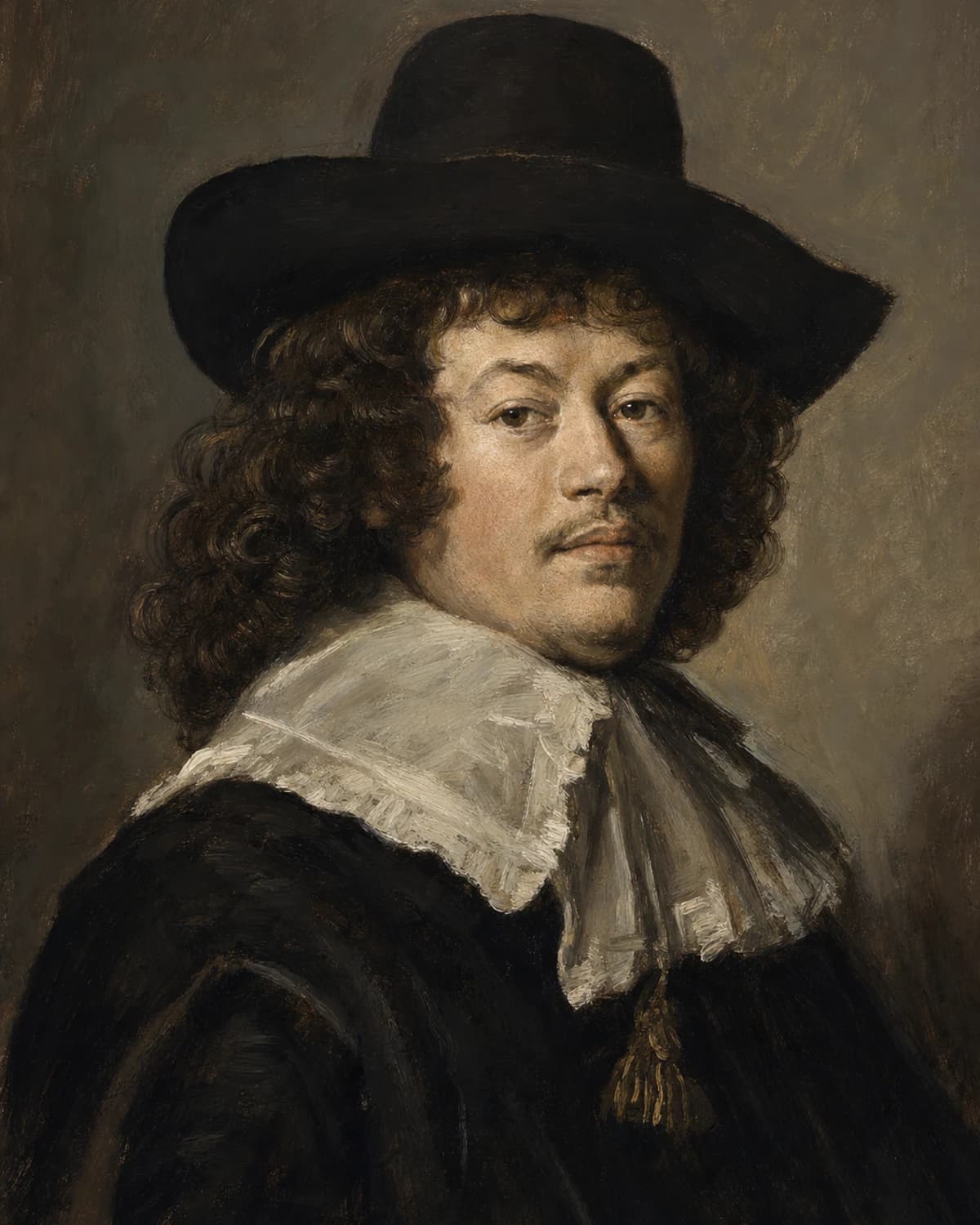
Biography
In 1652 Frans Hals was selling off his belongings to pay a debt to a Haarlem baker. The inventory of what was to be seized lists three mattresses with bolsters, a cupboard, a table and five pictures: his own, his sons’, one by Karel van Mander and one by Maarten van Heemskerck.
Hals was then about seventy. Behind him lay four decades of commissions from the wealthiest families in town.
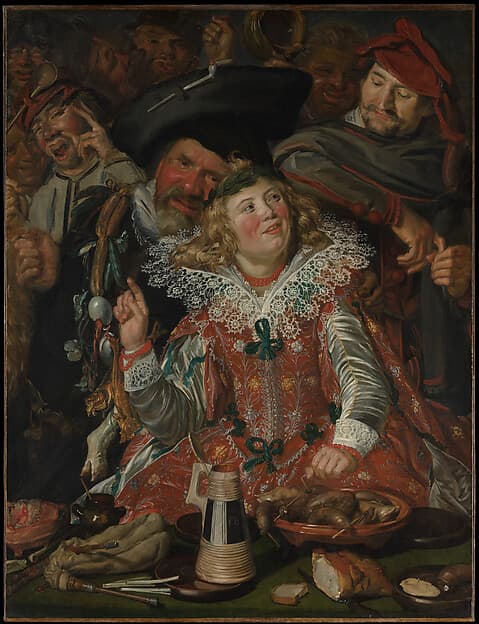
He was born in Antwerp in 1582 or 1583; the exact date is not known. His father, Franchois Fransz Hals of Mechelen, was a cloth merchant; his mother was Adriaentje van Geertenryck. After the Fall of Antwerp in 1585 the family went north to Haarlem, and Hals lived there for the rest of his life. His younger brother Dirck, also a future painter, was born in Haarlem in 1591. All we know of his training comes from an anonymous life of Karel van Mander published in 1618, which names Hals as his pupil; if that is right, the training ended before 1603, when Van Mander left Haarlem, and almost nothing of the teacher’s Mannerism survives in Hals’s pictures. In 1610 he joined the Haarlem Guild of St Luke and was given work as a restorer for the town council. The town had confiscated Catholic church paintings, and someone had to put them in order; there was no longer a market for religious pictures in Haarlem, and what remained was the portrait. Hals’s earliest dated work, the portrait of Jacobus Zaffius, is from 1611. In 1616 he painted the life-size “Banquet of the Officers of the St George Militia Company”, and with that picture the big commissions began. The same year he travelled to Antwerp to look at Rubens and Van Dyck. From 1612 to 1624 he himself was enrolled in the Haarlem civic guard.
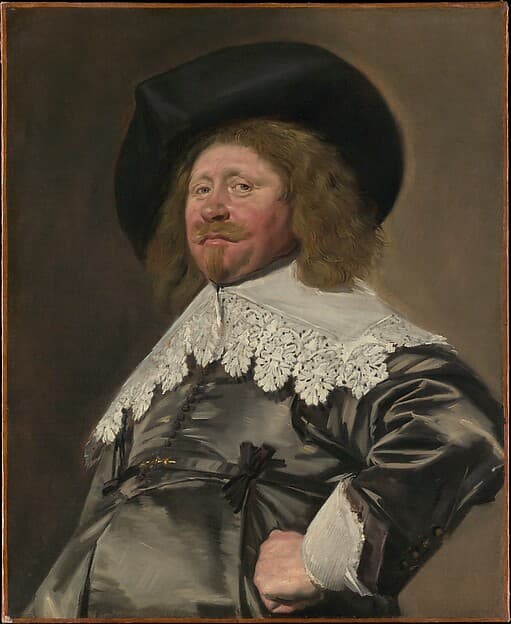
He painted the St George company three times, in 1616, 1627 and 1639, and the St Adrian company twice, in 1627 and 1633. In the 1639 picture, if an inscription on its nineteenth-century frame is to be believed, he included himself; this could not be verified. He gave each officer his own turn of the head and his own expression, and the eye moves from one to the next as if along a table. He refused to travel for commissions: the Amsterdam militiamen were expected to come and sit in Haarlem, and the only group picture he began in Amsterdam was finished by Pieter Codde. So of any of his sitters one can say with certainty that he was a Haarlemer or a visitor to Haarlem.
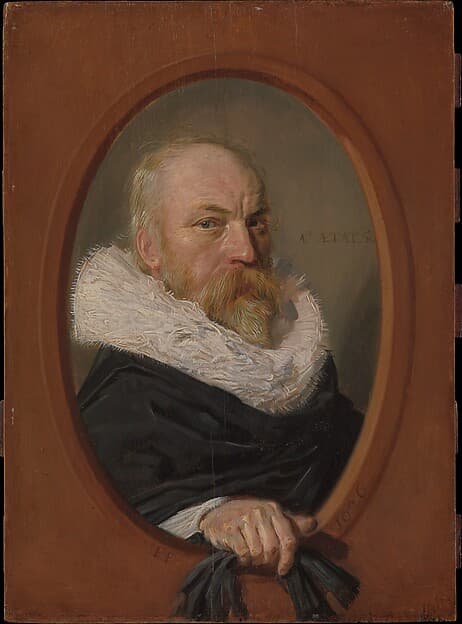
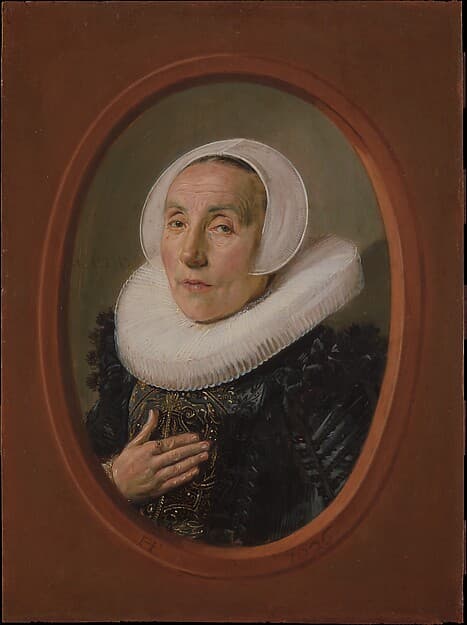
From the 1620s to the 1640s he painted pendant marriage portraits, the husband on the left panel, the wife on the right. Only once did a couple share a single canvas: Isaac Massa and Beatrix van der Laen seated in a garden, c. 1622 (Rijksmuseum). Hals painted Massa three times. Willem van Heythuysen poses full-length with a sword, a rarity in Hals. In 1649 Descartes sat for him.
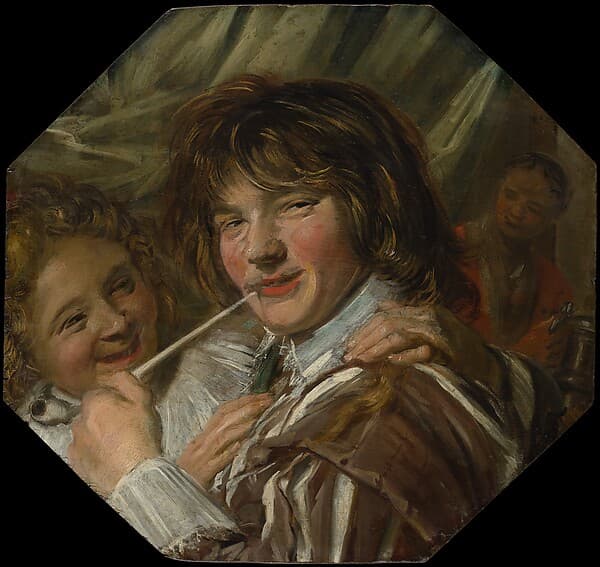
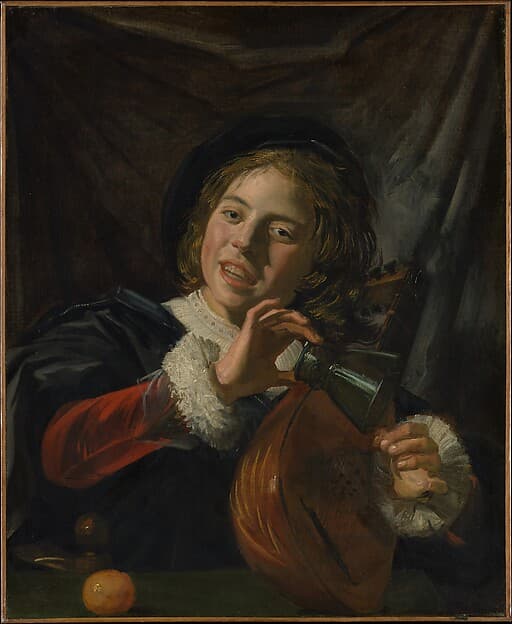
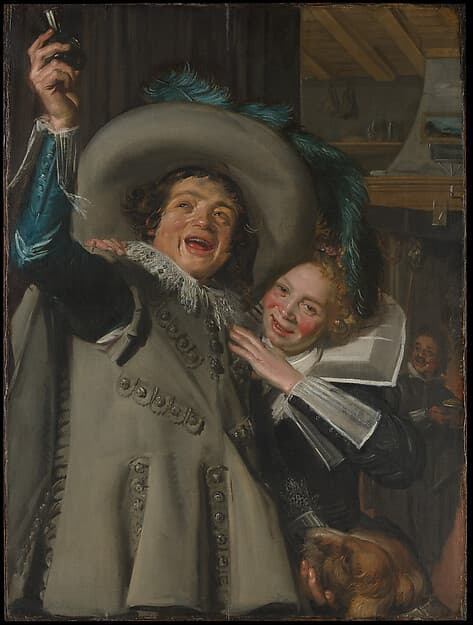
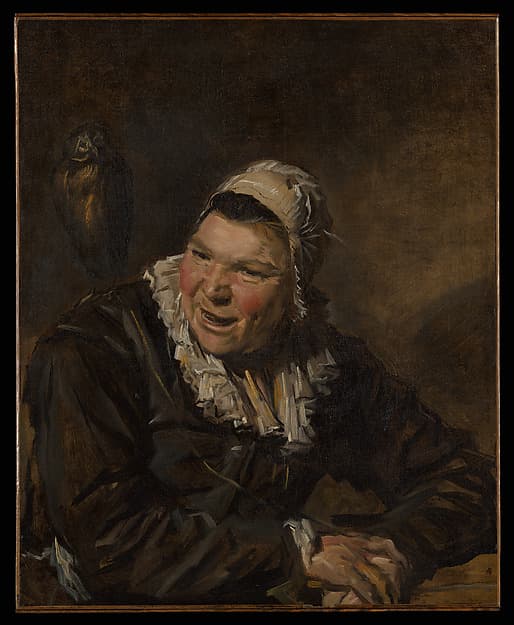
Alongside the commissions came figures painted for the open market, on which much of his fame rests: “Jester with a Lute”, “The Merry Drinker”, “Malle Babbe”, “The Gypsy Girl”, “Laughing Fisherboy”, all from the 1620s and 1630s. The “St Luke” and “St Matthew” were painted around 1623–1625; in Russia many know Hals’s name from the 1970 film “The Return of ‘St Luke’”. His brushstroke lies openly on the surface, and his contemporaries took this for a manner all his own, unlike anyone else’s: the Haarlemer Theodorus Schrevelius wrote in the middle of the seventeenth century that Hals “seems to challenge nature with his brush”. The idea that he painted everything in one sitting is not supported by the documents. Sometimes he did do without an underpainting, but more often he worked in layers like everyone else, only laying in the underpainting very loosely. The old stories of his drinking and of beating his first wife were sorted out by Seymour Slive in the archives: the assault case concerned another Haarlem man of the same name, and Hals’s first wife, Anneke Harmensdochter, was by then already dead. In 1617 he married Lysbeth Reyniers.
He kept a large workshop. Houbraken in 1718 names as his pupils Philips Wouwerman, Adriaen Brouwer, Adriaen van Ostade, Dirck van Delen and Pieter van Roestraten, who married Hals’s daughter Adriaentje; of all the Haarlem painters, the closest to his manner is Judith Leyster. Five sons, Harmen, Frans the Younger, Jan, Reynier and Nicolaes, also became painters, and none of them followed his path.
Over the years his palette darkened: the bright colours of the early banquets gave way to black cloth and white linen. This is explained by the sober dress of his Protestant sitters, and sometimes also by the fact that black and white pigments were cheaper than lakes and carmines; to my mind both explanations are true at once. The shadows in the late works are almost pure black. “The Regents of the St Elisabeth Hospital” (1641) and the pair “The Regents” and “The Regentesses of the Old Men’s Almshouse” (c. 1664) are painted in little more than two colours. In 1644 he was elected chairman of the Guild of St Luke, but commissions were growing scarcer, his creditors took him to court more than once, and in 1664 the town granted him an allowance of two hundred guilders a year. Hals died in Haarlem on 26 August 1666 and was buried beneath the choir of the Grote Kerk, the church of St Bavo on the main square. His widow applied for relief and was admitted to the town almshouse, where she died.
After that the name all but vanished. Catherine the Great bought ten of his paintings; Reynolds lectured on him in London in 1774, praising the faces and censuring the lack of finish. It was Théophile Thoré-Bürger who brought Hals back into circulation in the mid-1860s, and from then on Manet, Monet and Courbet looked at him; Van Gogh counted twenty-seven shades of black in his work. The large pictures from the town hall have hung in the Frans Hals Museum in Haarlem since 1913; the Hermitage has two male portraits, one with a glove in the hand. How much he painted in all is still disputed: Seymour Slive counted 222 paintings in his catalogue of 1970–1974, and Claus Grimm in 1989 left 145.
Artist works
Works by the artist
Works by Frans Hals available in this edition of NEOARCA.
Related context
Associations
Works connected through artistic movements, cultural context and period. Priced works available in this market appear first.
Profile notes
Profile and sources
Image
Artist image
На основе открытого изображения: Anefo; Wikimedia Commons; CC0.
