
27.08.1924–02.06.1984
Fernando Zóbel de Ayala y Montojo
Fernando Zóbel was born in Manila into the influential Zóbel de Ayala family and became one of the central figures of Spanish abstract painting. In 1966 he founded the Museum of Spanish Abstract Art in Cuenca, and in 1980 he gave its collection to the Juan March Foundation. His first series, the Saetas and the Serie Negra, were made with paint squeezed from a medical syringe and with Chinese calligraphy as a model.
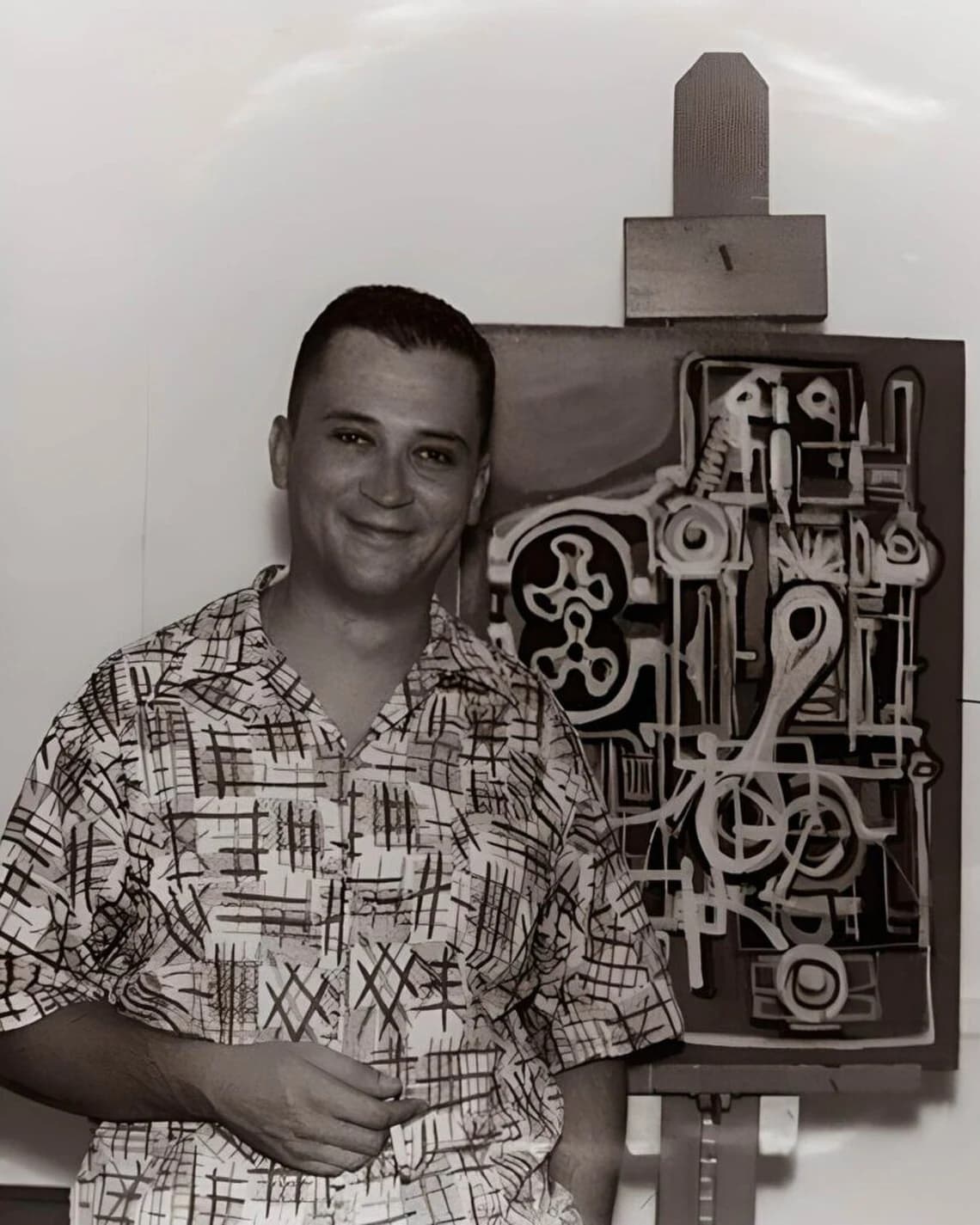
Biography
In 1942 Fernando Zóbel, then a medical student, was confined to bed with a spinal injury. It was there, according to his biographers, that he began to draw.
He was born on 27 August 1924 in Ermita, a district of Manila, to Enrique Zóbel de Ayala and Fermina Montojo. The family was among the best known in the Philippines, and his father owned paintings by Fernando Amorsolo; Amorsolo, a Filipino painter, became the young man’s first teacher and one of his patrons. Zóbel gave up medicine at the University of Santo Tomas. In 1946 he transferred to Harvard, where he studied history and literature, and in 1949 he took his degree with distinction in three years; his thesis was on Federico García Lorca’s play “The Love of Don Perlimplín and Belisa in the Garden”.
He began painting in oils at Harvard without any training. In the autumn of 1946 he met Jim Pfeufer and his wife Reed, a painter loosely connected with the Boston School, who became his mentor. After his degree Zóbel briefly studied law, then worked as a curator at the Houghton Library. His paintings of that time are representational and often have a touch of caricature.
Back in the Philippines, he made friends with local modernist artists, collected their work and organised exhibitions for them, because modernism was hardly appreciated there. His first one-man show took place in 1953 at the Philippine Art Gallery. In 1954 he went away for six months: he showed his work at the Swetzoff Gallery in Boston and enrolled at the Rhode Island School of Design, where he saw an exhibition by Mark Rothko. This strengthened his interest in abstraction. He then became absorbed in Chinese and Japanese art and took calligraphy lessons until 1960. He taught at the Ateneo de Manila University, later received an honorary degree from it and became honorary director of the Ateneo Art Gallery, which he had founded in 1960. For nine years he worked in the family’s Ayala Corporation, and in 1961 he resigned to become a professional painter and move to Spain for good.
His first series, the Saetas, brought him recognition. It is named after the liturgical songs of Holy Week in Spain and was painted for the most part in the Philippines. Zóbel needed lines that were, in his words, “long, fine, and controlled”, and he squeezed the paint out through a surgical syringe. Then, from 1959, he spent four years in Madrid painting the Serie Negra (Series in Black), in which the influence of Chinese calligraphy is evident.
In Spain he grew close to artists of the new generation: Antonio Lorenzo, Antoni Tàpies, Eusebio Sempere, Martín Chirino, Antonio Saura, Luis Feito and Gerardo Rueda. He collected their work and helped them. In 1966 the Museum of Spanish Abstract Art, which he had founded, opened in Cuenca, in the Casas Colgadas (the Hanging Houses, built on the edge of a gorge); the artists themselves took part in setting it up, and they were later called the Cuenca Group. The museum was enlarged in 1978, and in 1980 Zóbel gave its collection to the Juan March Foundation, a Spanish cultural foundation. In 1967 the Ayala Museum was founded in Makati, which he had conceived as a museum of Philippine history and iconography.
In the late 1960s and early 1970s he painted the series Dialogos, free variations on paintings he admired in museums. Next came works inspired by the River Júcar, and, after a stroke that left slight after-effects, the series Las Orillas (The Banks) on the theme of rivers. In 1972 he became an honorary citizen of Cuenca.
In 1983 King Juan Carlos I presented him with the Gold Medal of Merit in the Fine Arts. Zóbel died in Rome on 2 June 1984, aged 59. He is buried in the San Isidro cemetery in Cuenca, above the bend of the Júcar that he had painted many times.
His work was later shown in Madrid at the Reina Sofía Museum (2003) and the Prado (2022, the exhibition “Zóbel: The Future of the Past”, 178 works), then at the Ayala Museum in Manila and at the National Gallery Singapore (2025). In 2006 the president of the Philippines posthumously awarded him the Presidential Medal of Merit.
Profile notes
Profile and sources
Image
Artist image
Philippine Art Gallery; Wikimedia Commons; Public domain.
