
26.01.1918–08.08.2013
Fernando Castro Pacheco
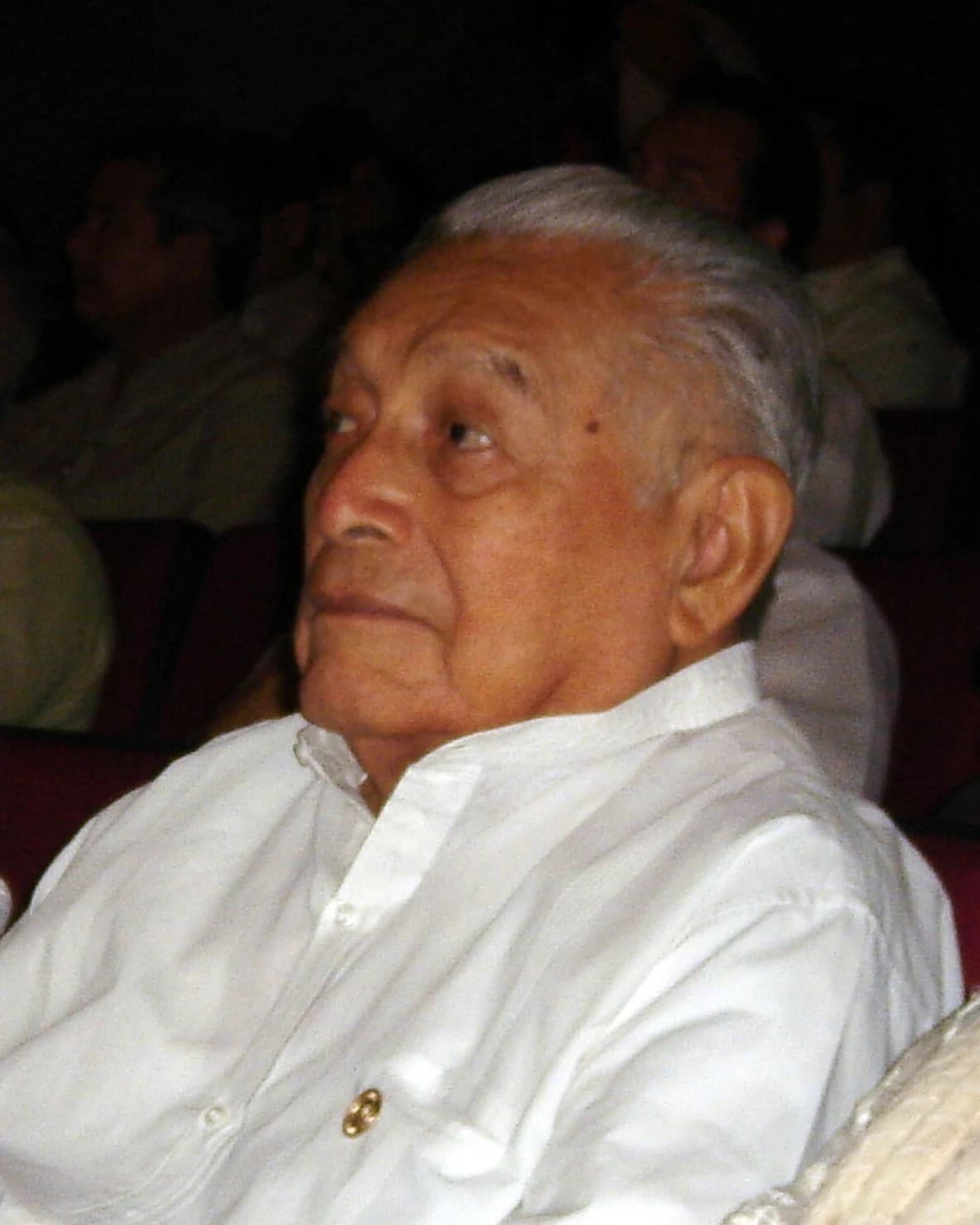
Fernando Castro Pacheco (1918–2013) painted for the Government Palace in Mérida more than twenty huge canvases on Yucatán, from the creation of people out of maize in the “Popol Vuh” to the hands of the henequen cutter, and nineteen more for the Government Palace in Querétaro. Before that he lived thirty years in Mexico City: cutting linocuts and woodcuts, teaching at San Carlos and running the school La Esmeralda.
Biography
The paintings by Fernando Castro Pacheco in the Government Palace of Yucatán in Mérida are called murals, but they are not painted on the wall. They are canvases of enormous format, painted in oil in the studio and hung in the palace’s halls and galleries, which is why they have none of the sharp foreshortenings and perspective tricks of the Mexican muralist school: simply very large pictures. In the 1970s (by one account in 1970–1977, by another in 1971–1979) he made more than twenty of them: the creation of people out of maize in the “Popol Vuh”, the four cardinal points, the conquest, the cacique Nachi Cocom, the Caste War, the hands of the henequen cutter, General Salvador Alvarado.
It is late work: the painter was past fifty and had only just come home after thirty years in Mexico City.
He was born in Mérida on 26 January 1918; little is known of his childhood. At fifteen he entered the city’s School of Painting and Plastic Arts, long run by the sculptor of Italian origin Alfonso Cardone, studied under Modesto Cayetano and Ignacio Rubio Milán and there learned engraving on wood and linoleum; he spent six years at the school and himself taught drawing. In 1941 he was one of the founders of the Free School of Plastic Arts of Yucatán, where, on the model of Alfredo Ramos Martínez’s schools, classes were held in the open air; from these years come his watercolours “Fishermen” and “The Hacienda Corral” and dark drawings built on chiaroscuro such as “Awakening” (all 1941). In 1942 he made his first lithographs and showed paintings and drawings at the Gallery of the University of Yucatán, and in 1941–1942 he painted his first murals: in the kindergartens of Mérida, in the rural school at Tecoh, in the middle of the henequen plantations, and frescoes on themes of culture and sport in the library of the Yucatán Truckers’ Union.
In 1943 he moved to Mexico City. There he joined the Taller de Gráfica Popular, founded in 1937 by Leopoldo Méndez, Pablo O’Higgins and Luis Arenal; how closely is still argued: by some accounts he was a notable figure in the workshop, by others he took part in a single exhibition. That exhibition was enough: a portfolio of his prints drew the attention of the capital, and then of other countries. Until 1960 he remained a printmaker, first in linoleum and from 1945 mainly in wood, and illustrated books and magazines: “The Reed Flute” by Fernando Espejo, “The Sacred Wells” by Miguel Álvarez Acosta, Elmer Llanes Marín’s essay “The Lonely Plain”. In 1945 his paintings were shown in San Francisco, in 1947 in Havana; in that same year, 1945, he received the first prize of the National Institute of Fine Arts for engraving, in 1947 second prize in the capital’s competition of prints on the Mexican Revolution, and in 1954 first prize at the Salón de la Plástica Mexicana for “Winter Salon”. From 1949 he taught at the National School of Plastic Arts, the former Academy of San Carlos, then at the Ministry of Education’s school of painting and sculpture La Esmeralda, of which he became director in 1962 and which he reorganised in its teaching and administration. In 1953 he designed the sets for the ballets “Guernica” and “The Barren Cloud” at the Palace of Fine Arts. In 1963, for three months, at his own expense and with diplomatic support from the institute, he went to see the museums of Spain, France, England, the Netherlands and Belgium. In all he had twenty-eight solo exhibitions and sixty group ones, including in Italy, Japan, Israel, Cuba, France, Sweden, Canada, Switzerland, Brazil, Chile and Yugoslavia.
In 1964 Yucatán gave him the state medal, and in 1972 the Autonomous University of Yucatán the Eligio Ancona Medal. In December 1973 he gave up teaching and returned to Mérida, where he proposed a project for a higher school of theatre, dance, music and plastic arts; it got no further than preliminary work.
After the Yucatán canvases, in 1977–1979, he painted nineteen of the same kind for the Government Palace of Querétaro: the plan of the city, Conín in the Cañada, the battle of Sangremal, the Corregidora of Querétaro, the Reform War, the triumph of the Republic. He sculpted too: about eight bronzes, thirty-five enamels and sixty ceramics. His main subject in every medium is the woman, nude or clothed, Mexican, more often alone, sometimes with a man or a child. In 1993 the university made a film about him, in 1994 the Museum of Contemporary Art of Yucatán named one of its galleries after him and the book “Fernando Castro Pacheco: Colour and Image of Yucatán” came out; in 2012 he received the Culture of Yucatán Medal. He died in Mérida on 8 August 2013, aged ninety-five.
Profile notes
Profile and sources
Image
Artist image
Comvaser; Wikimedia Commons; CC BY-SA 4.0.
