
19.04.1932–15.09.2023
Fernando Botero
Fernando Botero (1932–2023), a Colombian from Medellín, found his manner when he drew a mandolin with a tiny sound hole: small details make the form enormous. His voluminous people and animals, in paint and in bronze, have stood on Park Avenue and the Champs-Élysées, and he gave hundreds of his works and his own collection to museums in Bogotá and Medellín. He also painted political series: on violence in Colombia and on Abu Ghraib prison.
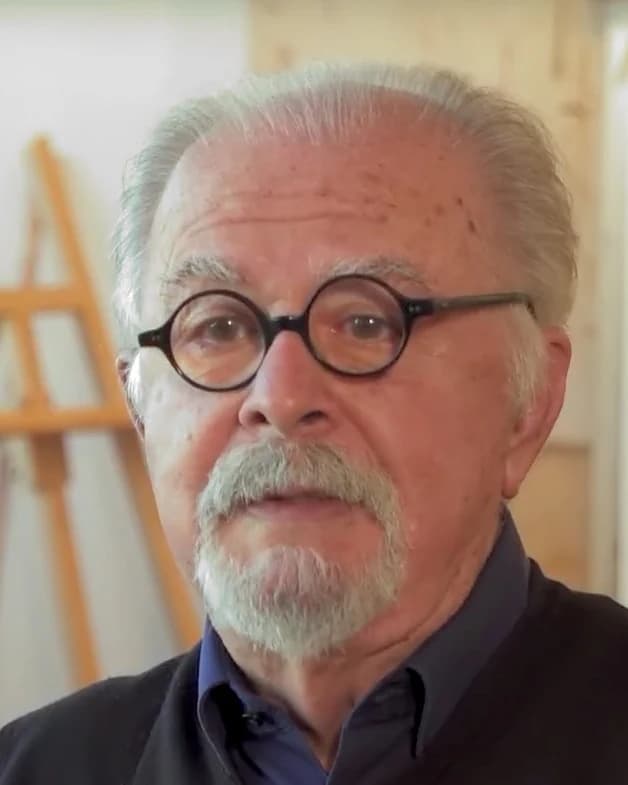
Biography
In San Antonio Square in Medellín two bronze birds by Botero stand side by side. One is whole, the other mangled by an explosion. On 10 June 1995 a bomb with ten kilograms of dynamite went off under the sculpture; 23 people were killed and about two hundred injured, and those responsible were never found. Botero had the twisted bird left where it was, as a “monument to the country’s imbecility and criminality”, and set beside it an intact copy that he donated.
He was born in Medellín on 19 April 1932, the second of three sons. His father, a travelling salesman who made his rounds on horseback, died when Fernando was four; his mother took in sewing to feed the family, and an uncle played a large part in the boy’s life. There were hardly any museums in his childhood; what shaped him were the Baroque colonial churches and the street life of Medellín. He went to school at the Ateneo Antioqueño, then on a scholarship at the Jesuit School of Bolívar. In 1944 his uncle sent him to a school for matadors for two years, and his first drawings were of bullfighting. A love of drawing the nude sat badly with a Catholic upbringing, and after an essay in defence of Picasso he was expelled from school. In 1948, at sixteen, he had illustrations printed in the Sunday supplement of the newspaper El Colombiano, and with that money he finished his schooling at the lyceum in Marinilla. That same year his work appeared in a group exhibition for the first time.
In 1949–1950 he worked as a stage designer, and in 1951 he moved to Bogotá, where a few months later his first solo exhibition was held, at Leo Matiz’s gallery. In 1952, with the money he had earned, he sailed for Europe. From Barcelona he went on to Madrid and studied at the Academy of San Fernando, but more at the Prado, copying Goya and Velázquez and selling the copies in the street. In 1953 he lived in Paris and spent almost all his time in the Louvre, then until 1954 studied the Renaissance masters in Florence.
He himself told how once, drawing a mandolin, he made the sound hole very small, and the instrument suddenly became gigantic. Everything else follows from that: his people have tiny eyes and mouths and huge bodies. “Still Life with Mandolin” was the beginning of the style that would later be called Boterismo. He would not try to explain his manner: an artist, he said, is drawn to certain forms without knowing why, and the explanations come later. Recognition did not come at once. At exhibitions in Washington and Mexico City in 1956–1958 his paintings sold out, but the critics were cool; in 1958 he won first prize at the Salon of Colombian Artists, and in 1961 the Museum of Modern Art in New York acquired his “Mona Lisa, Age Twelve”, after which attitudes to him changed. After his divorce from his first wife, Gloria Zea, he lived in New York for more than ten years, and in 1973 he settled in Paris. He called himself “the most Colombian of Colombian artists”, though he spent only a month a year at home, and he explained this by his isolation from international trends. It sounds paradoxical, but I think there is a logic to it: his Colombia was a Colombia of memory.
He first tried sculpture around 1964. He had no money for bronze, and the first heads, such as “Small Head (Bishop)”, he made from acrylic resin and sawdust, but the material proved too porous. He came back to three dimensions in Italy in the mid-1970s, now in bronze, and in 1977 showed his sculptures for the first time at the Grand Palais in Paris. Later he had a house in Pietrasanta in Italy, where his eightieth birthday was marked with an exhibition.
His son Pedro was killed at the age of four in a car crash in Spain (Botero himself lost the top joint of the little finger on his right hand), and in the months that followed he painted the boy in “Pedrito a Caballo”.
He spoke out directly about violence in Colombia in 2004, when he showed 27 drawings and 23 paintings on the years 1999–2004 and gave them to the National Museum of Colombia. A year later the “Abu Ghraib” series began: the idea came to him on a plane, and for more than fourteen months he did nothing else, making more than 85 paintings and 100 drawings on the abuse of prisoners in the Iraqi prison and, in his words, painting out the poison. He refused to sell them, and in 2009 he gave 56 works from the series to the art museum in Berkeley. Then he went back to the family, motherhood and the circus (twenty works in oil and watercolour in 2008), and in 2010 he said that after all this he always returned to the simplest thing, still lifes.
He gave a great deal away. In 2000 the Botero Museum in Bogotá received 123 of his works and 85 pieces from his collection, among them Chagall, Picasso, Rauschenberg and the Impressionists; the Museo de Antioquia in Medellín received 119 works, including 23 bronzes for the square in front of the museum, now known as Plaza Botero. In 2016 he gave the Colombian government the sculpture “Dove of Peace” for the signing of the peace agreement. In 2012 the International Sculpture Center honoured him for his contribution to contemporary sculpture.
His third wife, the Greek artist Sophia Vari, died on 5 May 2023. Botero outlived her by four months and died in Monaco on 15 September 2023, in his ninety-second year.
Profile notes
Profile and sources
Image
Artist image
Culturespaces; Wikimedia Commons; CC BY 3.0.
