
30.05.1892–24.04.1972
Fernando Amorsolo
As a teenager Fernando Amorsolo (1892–1972) sold watercolour postcards to a bookshop for ten centavos each, and by the end of his life he had left, by some estimates, more than ten thousand works. He painted sunlit rural landscapes with backlighting, and his “Rice Planting” (1922) was reproduced on posters and tourist brochures. In 1972 he was named the first National Artist of the Philippines.
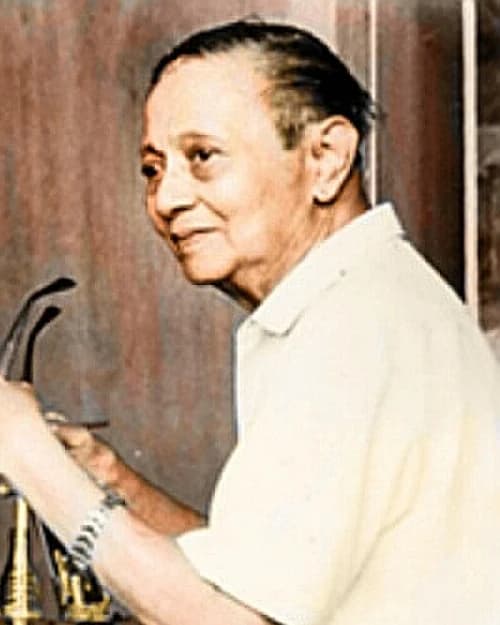
Biography
In 1908 the sixteen-year-old Fernando Amorsolo won second prize at the Bazar Escolta competition for his painting “Leyendo el periódico” (“Reading the Newspaper”). The contest was organised by the Asociacion Internacional de Artistas. Money in the family was counted in small coins at the time: his mother earned a living by embroidery, and he took watercolour postcards to a bookshop.
He was born on 30 May 1892; sources give his birthplace as Paco (a district of Manila) or simply Manila. A few months later his father, Pedro Amorsolo, found work in Daet, in the province of Camarines Norte, and the family lived there until his death, when the boy was eleven. He attended the local public school, and his parents taught him Spanish at home. After his father’s death his mother brought the children back to Manila, where they settled with a relative, Fabián de la Rosa, also a painter. At thirteen Fernando became his apprentice. His younger brother, Pablo Amorsolo, later became a painter too. From 1909 to 1914 Fernando studied at the art school of the Liceo de Manila; with his graduation picture, showing a young man and a young woman in a garden, he took first prize at the school exhibition. He then entered the School of Fine Arts of the University of the Philippines and graduated in 1914 with medals. Among those he looked to as a student, sources name Diego Velázquez, John Singer Sargent, Anders Zorn, Claude Monet and Pierre-Auguste Renoir, while closest to him were his Spanish contemporaries Joaquín Sorolla and Ignacio Zuloaga. To earn money he entered competitions and drew for publications: he illustrated Severino Reyes’s first novel in Tagalog, “Parusa ng Diyos” (“Punishment of God”), the book “Madaling Araw” (“Dawn”) by Iñigo Ed. Regalado, and editions of the Pasyon, the Filipino narrative of the Passion of Christ.
After university he worked as a draftsman at the Bureau of Public Works, was chief artist at the Pacific Commercial Company, and taught at the university. His teaching lasted 38 years, 14 of them as head of the art department; he was director of the College of Fine Arts from 1938 to 1952. After three years of this work the businessman Enrique Zóbel de Ayala paid for him to study at the Academia de San Fernando in Madrid. During seven months in Spain he sketched in museums and in the streets, experimenting with light and colour; with money from the same grant he also visited New York.
Back in Manila, he opened his own studio and painted a great deal in the 1920s and 1930s. “Rice Planting” (1922) became one of the best-known images of the Commonwealth of the Philippines. From the 1930s his work was shown widely in the Philippines and abroad: a solo exhibition at the Grand Central Art Galleries in New York in 1925, “The Conversion of the Filipinos” at the Paris Exposition in 1931, and in 1939 first prize at the New York World’s Fair for “Afternoon Meal of the Workers”. There were so many commissions that he photographed his paintings and mounted the prints in an album so that clients could choose from a catalogue. He avoided exact repeats and changed details in every version.
In his landscapes and figures he used natural light and backlighting, and the glowing outline around his figures became his trademark. He is believed to have painted a rainy day only once. He painted Filipina women with round faces and lively eyes, often basing them on members of his family, and deliberately rejected the Western ideal of beauty.
He lived through the Japanese occupation of Manila in a house near the Japanese garrison. From the windows and the roof he sketched scenes of the war, and his pictures of the 1940s show a ruined city, Manila burning, women mourning their husbands, lines of people with pushcarts. An exhibition of his wartime work was held in 1948 at Malacañang Palace. Of his historical paintings the best known remains “Making of the Philippine Flag” (1955); for “The First Baptism in the Philippines” (1949) he made numerous studies and consulted scholars, and for the sixteenth century he turned to the account of Antonio Pigafetta.
Critics argued about him even in his lifetime. In 1948 Francisco Arcellana wrote that Amorsolo’s paintings had nothing in them to understand. He was accused of commercialism and of making souvenirs for American soldiers, and his historical and formal portrait canvases were judged weaker than the small landscapes. To my mind it is fairer to judge him by his best work, as one critic proposes, and the best here seems to be the small early landscapes.
He had a cataract operation at seventy and went on drawing. He died on 24 April 1972 in Manila, and four days later he was posthumously named the first National Artist of the country, at the Cultural Center of the Philippines. In 2003 his children founded the Fernando C. Amorsolo Art Foundation.
Related context
Associations
Works connected through artistic movements, cultural context and period. Priced works available in this market appear first.








Profile notes
Profile and sources
Image
Artist image
AsianStuff03; Wikimedia Commons; CC0.
