
04.02.1881–17.08.1955
Fernand Léger
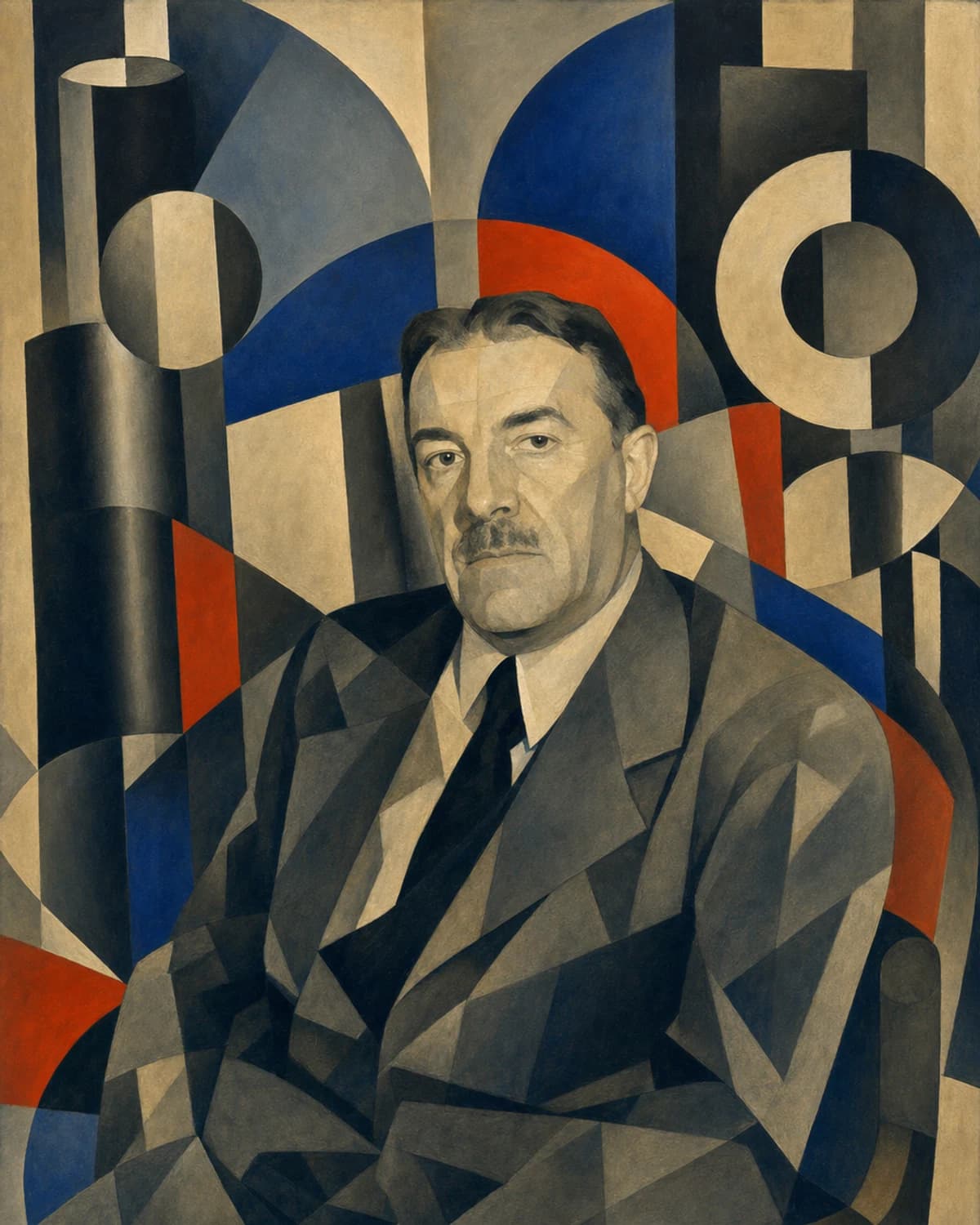
Fernand Léger began as a draftsman for an architect and took up painting only at twenty-five. Out of Cubism he developed a manner of his own built on tubular forms, which critics nicknamed “Tubism”; with Dudley Murphy he made “Ballet Mécanique”, and in the 1940s he produced mosaics, stained glass and panels for the United Nations. He died in Gif-sur-Yvette in 1955.
Biography
Léger later called his years in the official art schools “three empty and useless years”. He came to painting late, and not by a straight road.
He was born on 4 February 1881 in Argentan, in Normandy, in a family that raised cattle. His father died when the boy was a few years old, and his mother stayed on the farm at Lisores. In 1897–1899 Léger trained as an architect in Caen, in 1900 he moved to Paris, and he earned his living as a draftsman for an architect. After service in an engineers’ regiment at Versailles (1902–1903) he was refused entry to the École des Beaux-Arts; he enrolled instead at the School of Decorative Arts, and attended the Beaux-Arts and the Académie Julian as a non-enrolled student. Once in Paris he rented a studio with a fellow native of Argentan, André Mare, and took work as a retoucher for a photographer.
He began to paint seriously at twenty-five, and his early pictures show the influence of Impressionism. Almost everything from this period he later destroyed; “My Mother’s Garden” (1905), for example, survived. The Cézanne retrospective of 1907 turned him toward drawing and geometry. In 1908–1909 he found himself in Paris among the neighbours at La Ruche, the artists’ colony, and in Montparnasse: Alexander Archipenko, Jacques Lipchitz, Marc Chagall and Robert Delaunay worked nearby, and Henri Rousseau he knew personally and admired greatly.
In 1910 he showed “Nudes in the Forest” at the Salon d’Automne, the painting that prompted critics to coin the word “Tubism”: the figures are assembled from cylinders and cones. In 1911 his work hung in the “Cubist room” at the Salon des Indépendants, and in 1912 he joined the Puteaux Group, also called the Section d’Or (the Golden Section). Daniel-Henry Kahnweiler bought several of his canvases in 1910, gave him his first exhibition at his gallery in 1912 and signed a contract with him in 1913. Léger never made the collages that Georges Braque and Pablo Picasso had invented. His work up to 1914 grew steadily more abstract: rough patches of primary colours, green, black and white. In 1913 and 1914 he gave lectures at the Académie Vassilieff.
The war interrupted this movement. From 2 August 1914 Léger served with the engineers, spent two years at the front in the Argonne and at Verdun, and drew artillery pieces, aeroplanes and his fellow soldiers in the trenches. In September 1916 at Verdun, where he was carrying the wounded, he was gassed. After a hospital stay at Villepinte he painted “The Card Players” (1917), with figures that look like robots. He explained later that he had been struck by the breech of a 75-millimetre gun in the sunlight: this was the start of his “mechanical period”, and from 1918 of the “Disks” series.
His work of the 1920s fits the postwar “return to order”: clear forms, mother and child, the nude, figures in an ordered landscape. In 1919 he married Jeanne Lohy, in 1920 he met Le Corbusier, and the friendship lasted all their lives. “The Siphon” (1924) is based on an advertisement for an aperitif and is built like a cinematic close-up of a hand holding a bottle. Cinema interested him so much that, by his own account, he thought of giving up painting: in 1923–1924 he designed the laboratory scene in Marcel L’Herbier’s “L’Inhumaine”, and in 1924, together with Murphy, he made “Ballet Mécanique” (Man Ray and George Antheil took part in the work). In the same year, with Amédée Ozenfant, he opened a free school, later called the Académie Moderne; Alexandra Exter and Marie Laurencin taught there. For the theatre he designed sets and costumes, among them for the ballets “Skating Rink” (1922) and “The Creation of the World” (1923), to music by Darius Milhaud.
From 1927 more organic, irregular forms appear in his work. In the 1930s he showed “Two Sisters” (1935) and several versions of “Adam and Eve”, in which Adam wears a striped bathing suit or a tattoo. In 1931 he made his first trip to the United States, in 1935 the Museum of Modern Art in New York gave him an exhibition, and in 1938 he painted murals for Nelson Rockefeller’s apartment.
From 1940 to 1945 Léger lived in exile in the United States and taught at Yale University and at Mills College. He was struck by dumps of machines with flowers pushing up through the metal, and called the effect the “law of contrast”. The neon signs of New York suggested a device in which free bands of colour are laid over objects outlined in black. On his return to France in 1945 he joined the Communist Party. He painted acrobats, builders, divers and country outings. His commissions of these years include mosaics and stained glass for the church at Plateau d’Assy (completed in 1949), stained glass and a woven wall hanging for the church at Audincourt (1951), panels for the United Nations building in New York (1952), and a mosaic and stained glass for the university in Caracas (1954). Jeanne died in 1950, and in 1952 Léger married Nadia Khodossevitch, his former pupil and assistant; they settled in Gif-sur-Yvette.
He died on 17 August 1955 in Gif-sur-Yvette and is buried there. A few months before his death he had won the Grand Prize at the São Paulo Biennial. The museum named after him opened in Biot in 1960.
Related context
Associations
Works connected through artistic movements, cultural context and period. Priced works available in this market appear first.








Profile notes
Profile and sources
Image
Artist image
На основе открытого изображения: Carl Van Vechten; Wikimedia Commons; Public domain.
