
14.03.1853–19.05.1918
Ferdinand Hodler
Ferdinand Hodler (1853–1918) took over his stepfather’s workshop at twelve to feed his family, and at thirty-seven painted “Night”, which was pulled from a Geneva exhibition as obscene. He developed his own system, “parallelism”, painted frescoes for the Swiss National Museum and made Alpine landscapes. His “Woodcutter” and “Reaper” appeared on Swiss banknotes in 1911.
Biography
In February 1891, at the fine arts exhibition in Geneva, Hodler’s painting “Night” was withdrawn from the show: the authorities judged its entwined nude figures obscene. The artist was thirty-seven, and his whole career until then had rested on poverty and ridicule. The private exhibition organised after the ban was a great success.
He was born on 14 March 1853 in Bern, the eldest of six children of Johannes (Jean) Hodler, a carpenter, and Marguerite, née Neukomm. His father died of tuberculosis in 1860, and two younger brothers went with him. His mother married a decorative painter, Gottlieb Schüpbach, and also died in 1867; in the following years the remaining brothers and sisters died one after another of the same disease. Around 1865 the twelve-year-old Hodler took over his stepfather’s workshop and supported the family. It seems to me that this constant closeness of death explains why the theme stays with him through to his last self-portraits.
Then came Thun and an apprenticeship with Ferdinand Sommer, a painter of topographical views: Alpine scenes copied from prints and sold to tourists. At the end of 1871 he walked to Geneva, painted signs, copied Alexandre Calame in the museum and soon became a pupil of Barthélemy Menn. In 1874 he won first prize in the Calame competition for “Sous-Bois”; in 1875 he studied Holbein in Basel, above all “Dead Christ in the Tomb”; and in 1878 he spent several months in Madrid, at the Prado. In 1881, together with other pupils of Menn, he worked on the Bourbaki Panorama by Edouard Castres.
His early works are in the manner of Swiss realism. “The Angry One” (a self-portrait of 1880–81) was ridiculed in Geneva, and Hodler remarked to a friend that the Swiss would not understand him until they saw that he had been understood elsewhere. The canvas was accepted at the Paris Salon, but the critics took no notice of it. In 1884 he met Augustine Dupin, and in 1887 their son Hector was born, who later founded the World Esperanto Association. His first marriage, to Bertha Stucki (1889), lasted until 1891; in 1898 he married Berthe Jacques.
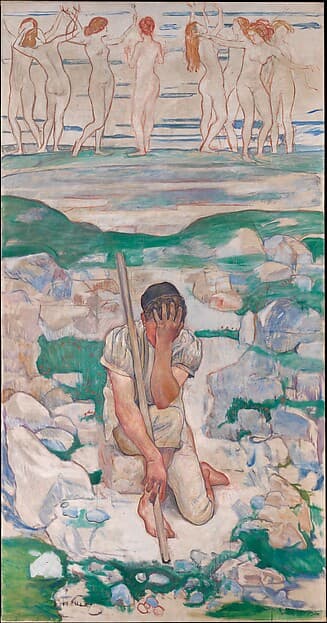
From the late 1880s he developed his theory of parallelism: nature, he held, is organised in parallel patterns, whether the trunks in a forest, the symmetry of the body, or the pairs of day and night, man and woman. He set it out publicly in the lecture “The Mission of the Artist” in Fribourg in 1897; in 1896–1899 he taught drawing and painting there at the industrial museum. Today the theory is not regarded as beyond dispute. In “Night” (1890) a frightened man lies among the sleepers, with a figure in black bending over him, a personification of death. In Paris, at the Salon, the painting was noticed by Auguste Rodin and Pierre Puvis de Chavannes. In “Eurythmy” (1895) five men in long robes walk along a path strewn with fallen leaves. In 1892 he showed “The Disillusioned Souls” at the Salon de la Rose+Croix in Paris and became a member of the society.
In 1897 Hodler won the competition to decorate the Weapons Room of the Swiss National Museum in Zurich. His sketches for “Retreat from Marignano”, which shows a lost battle, set off the largest dispute over art in Switzerland, and he was able to paint the fresco only by 1900. In that same year “Night”, “Eurythmy” and “Day” won awards at the Exposition Universelle in Paris, he joined the Berlin and Vienna Secessions (groups of progressive artists breaking with the official academies), and in 1904 he showed 31 works in Vienna, where sales lifted him out of poverty. In 1905 he declined a professorship at the academy in Stuttgart.
The banknotes of 1911.
In 1908 the Swiss National Bank commissioned designs for banknotes from him. Instead of portraits of famous men he chose a woodcutter for the 50-franc note and a reaper for the 100-franc note; both were issued in 1911. His standing in these years also rests on his landscapes: Alpine views and Lake Geneva reduced to bands of shore, mountains, water and clouds.
He met Valentine Godé-Darel in 1908. When she fell ill in 1913, he spent many hours at her bedside and made a series of paintings and drawings recording her condition; she died in January 1915. In 1916 he painted about twenty self-portraits.
In 1914 Hodler signed a protest by Geneva intellectuals against the German artillery bombardment of Reims Cathedral, refused to withdraw his signature under pressure from friends, and was expelled from most of the German art associations. In Switzerland his recognition grew: the University of Basel made him an honorary doctor, in 1916 he received a professorship at the School of Fine Arts in Geneva, and in 1917 the Kunsthaus in Zurich held the first large retrospective of his work. In 1918 Geneva made him an honorary citizen.
In his last months, mostly confined to bed, he painted views of Geneva from his balcony. Hodler died on 19 May 1918 in Geneva, leaving unfinished landscapes of Lake Geneva and the Mont Blanc range. He is buried in the Saint-Georges cemetery.
Artist works
Works by the artist
Works by Ferdinand Hodler available in this edition of NEOARCA.
Profile notes