
21.02.1855–13.03.1913
Félix Resurrección Hidalgo
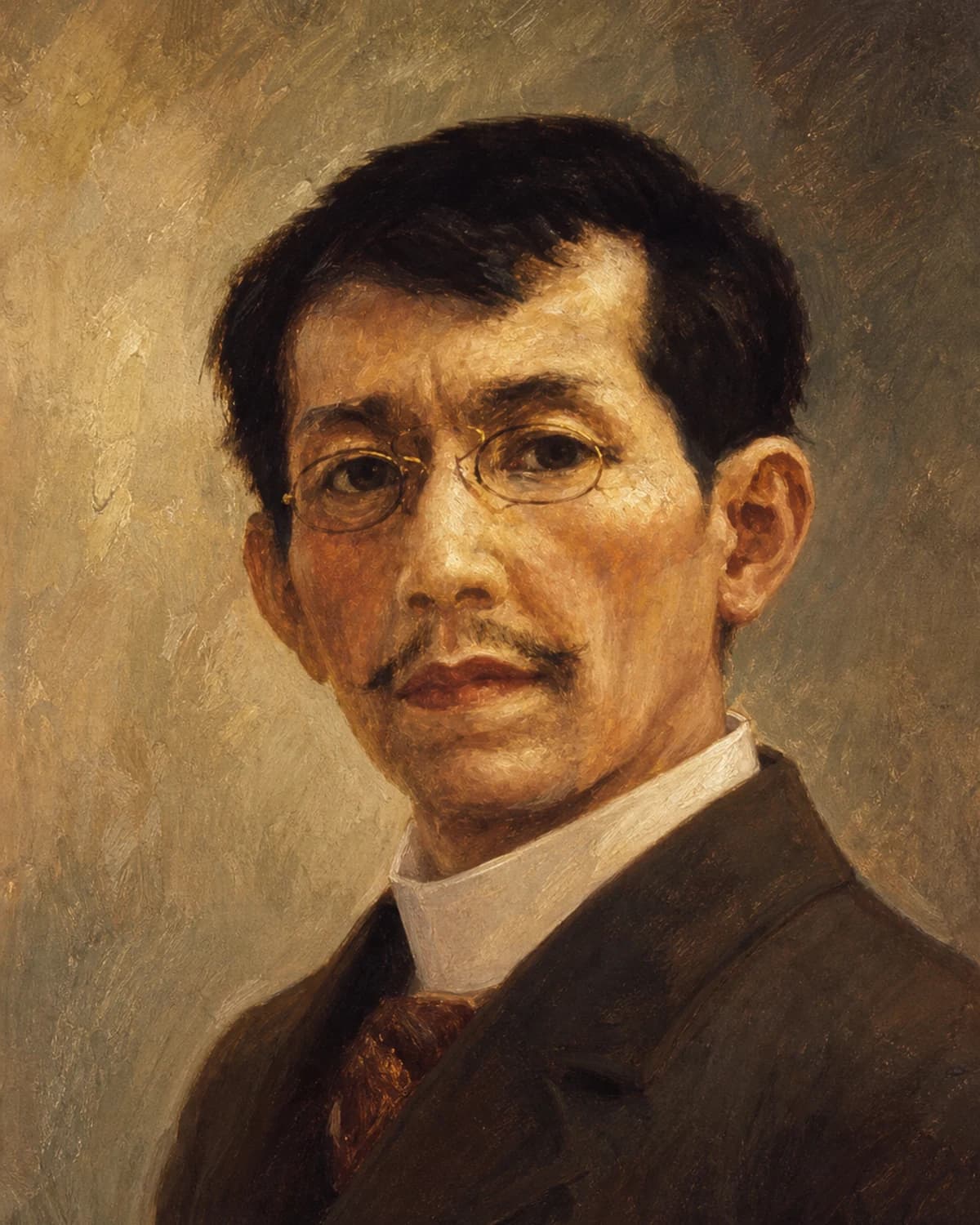
A Filipino painter born in Binondo, he studied in Manila and Madrid. In 1884 he won a silver medal at the Exposición General de Bellas Artes in Madrid for “Las Virgenes Cristianas Expuestas al Populacho” (“Christian Virgins Exposed to the Populace”). He later lived in Paris, where his studio became a meeting place for Filipino artists and intellectuals. He died in Barcelona in 1913 and was buried in Manila.
Biography
In the spring of 1884, two painters from the Philippines won prizes at the same exhibition in Madrid: Juan Luna took the gold medal, Félix Resurrección Hidalgo the silver. The celebratory dinner in their honour found its way into the memoirs of the Filipino reformers, and José Rizal raised a toast to the health of both artists.
Hidalgo was born on 21 February 1855 in Binondo, a district of Manila, the third of seven children of Eduardo Resurrección Hidalgo and María Bárbara Padilla. He studied at the Ateneo de Manila and at the University of Santo Tomas, where he read law but did not finish the course. At the same time he took lessons at the Escuela de Dibujo y Pintura in Manila under the Spanish painter Agustín Sáez. In 1876 his works, among them “La barca” and “Vendedora de lanzones”, were shown in Manila before being sent to the Centennial Exposition in Philadelphia, held to mark a hundred years of the United States. In 1877 he took second place in the competition for the cover of the deluxe edition of Fr. Manuel Blanco’s “Flora de Filipinas”, and in 1878 he painted “Los mendigos”. In 1879 he left for Spain as a scholarship student of the municipality of Manila and studied at the Real Academia de Bellas Artes de San Fernando in Madrid. By one account, he then lived in Rome among Spanish painters and finally settled in Paris. His studio there became a gathering place for Filipino artists and intellectuals.
The prize of 1884 was awarded for “Las Virgenes Cristianas Expuestas al Populacho”: in the picture, coarse-looking men mock semi-naked Christian women, one of whom sits in the foreground with her head bowed. The subject, it is thought, was suggested by his Roman period.
In 1887, at the Exposición General de las Islas Filipinas in Madrid, he showed “La barca de Aqueronte” and “La Laguna Estigia” and received a gold medal. “La barca de Aqueronte” then won a silver medal at the Exposition Universelle in Paris, a diploma of honour in 1891 at the exhibition in Barcelona, and a gold medal at the International Exposition of Fine Arts in Madrid, held for the 400th anniversary of the discovery of the Americas. In 1891 he exhibited “Adios del Sol”, and he showed “El crepusculo” at the exhibition in Chicago; both works were shown again in Bilbao in August 1894. In April 1895, at the Salon on the Champs-Élysées in Paris, he presented “Oedipus y Antigone”, “El violinista”, “Cabeza napolitana”, “Cabeza del viejo” and “Un religioso”. In January 1895, at the Exposición Regional de Filipinas in Manila, he was represented by works in the grand romantic manner. He knew Rizal, Marcelo del Pilar, Mariano Ponce and Graciano López Jaena, and the reformers valued him as an artist. He did not join their movement directly, and later did not associate himself with the First Philippine Republic under Emilio Aguinaldo. In 1904, at the Universal Exposition in St. Louis, he received a gold medal for his overall participation, and “El violinista” was separately awarded a gold medal. Among his later works are a self-portrait of 1901 and “Per Pacem et Libertatem” (1903).
In 1912 he came to visit his relatives in Manila for six months, then hurried back to Paris to see his dying mother. A year later, on 13 March 1913, Hidalgo died in Barcelona, where he had gone to recover his health. His remains were taken to the Philippines and lie in the Cementerio del Norte in Manila. In 1988 his works and those of Luna were shown together in a major retrospective at the Metropolitan Museum of Manila.
Related context
Associations
Works connected through artistic movements, cultural context and period. Priced works available in this market appear first.








Profile notes
Profile and sources
Image
Artist image
На основе открытого изображения: Félix Resurrección Hidalgo; Wikimedia Commons; Public domain.
