
10.05.1879–30.07.1947
Fedir Krychevsky
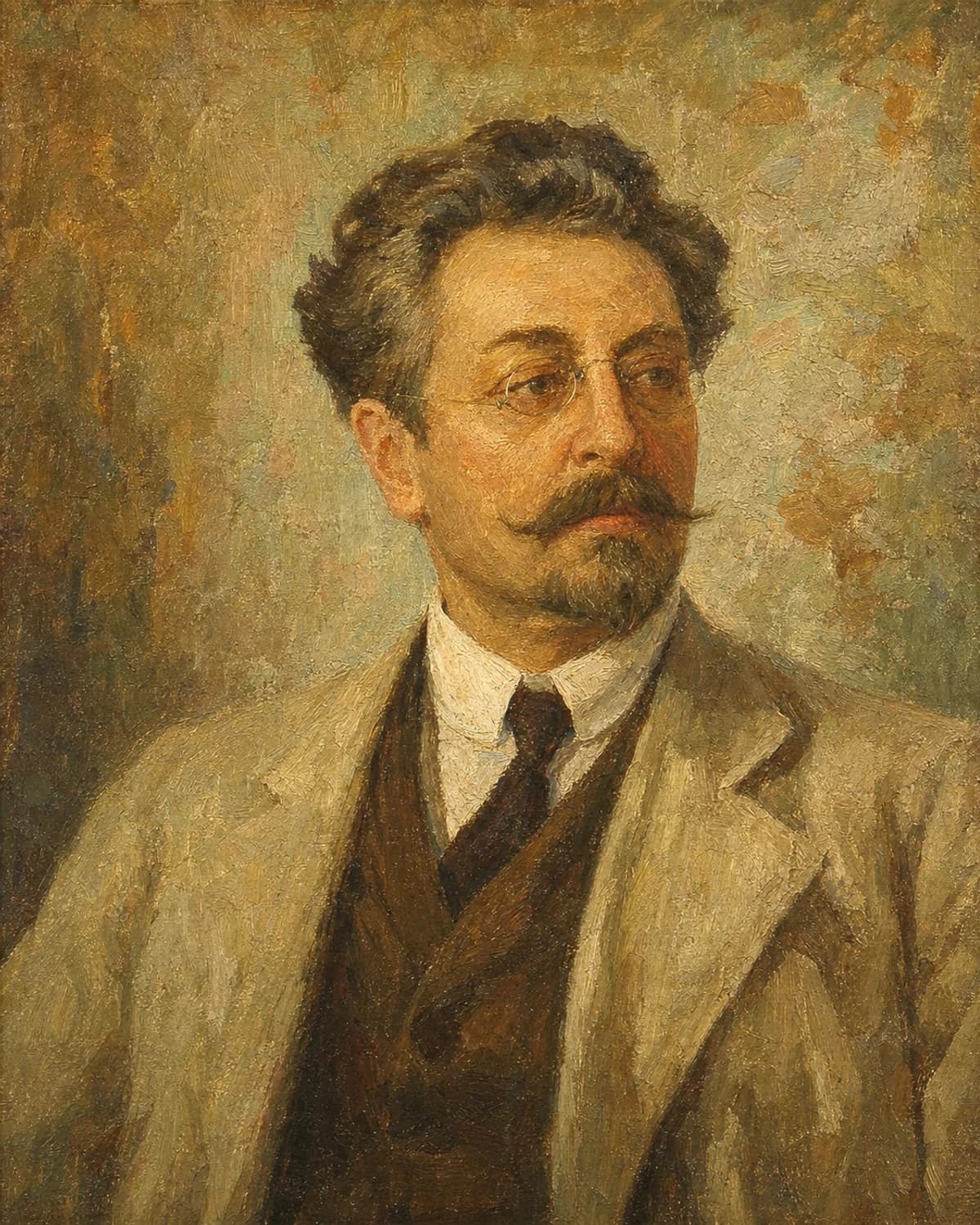
Fedir Krychevsky (1879–1947) entered the academic competition of 1910 with “The Bride”: a scene in which friends dress a girl for her wedding, treated as a solemn frieze. He was the first rector of the Ukrainian Academy of Arts, painted the triptych “Life” (1925–1927) and taught Tetyana Yablonska. He spent his last years in Irpin, stripped of his titles.
Biography
In Shyshaky, in the Poltava region, stood a small village house which Fedir Krychevsky bought and rebuilt to his brother’s design. In summer students came there for practical work. The walls were hung with carpets and embroidery, ceramics stood on the shelves, icons lay about: from this collection he took objects for his still lifes and checked his colour against it.
He was born on 22 May 1879 (10 May, Old Style) in Lebedyn, in the Kharkov Governorate, into the family of a country medical assistant, Hryhoriy Krychevsky, a Jew who had converted to Christianity. He grew up in the nearby village of Vorozhba. The eldest of the children was Vasyl, a future architect and graphic artist. According to accounts, the boy drew with charcoal, modelled in clay and bread, and invented embroidery patterns. The patronage of a local landowner, Count Kapnist, who had a gallery of Cossack portraits, and an acquaintance with the painter Kostiantyn Savytsky brought him to Moscow. In 1896 he entered the Moscow School of Painting, Sculpture and Architecture and graduated in 1901. He named Abram Arkhipov and Valentin Serov as influences on him; in Moscow he pined for Ukraine and promoted folk culture among his friends.
In 1902 Krychevsky, by some accounts, visited London as part of a delegation to the coronation of Edward VII, where he sketched the ceremonies. In 1903 he entered the Higher Art School attached to the Academy of Arts in St Petersburg, but broke off his studies and for several years worked on his own, painting a great deal from life. In 1907 he returned to the Academy, and in 1910 he received the title of artist for the paintings “The Funeral” and “The Bride”. “The Bride” avoids anecdotal genre: the rhythm of the composition is measured, the drawing firm, the colour restrained. The title gave him the right to travel abroad; in 1911–1912 he saw museums in Germany, Austria, France and Italy. In his painting of these years Klimt and Hodler are noticeable, and together with folk and icon traditions they form a manner close to the Secession. In 1911 and 1913 he also organised the first exhibitions of Ukrainian artists.
From 1913 he lived in Kyiv, taught at the art school and from 1914 directed it. Among his best-known pre-revolutionary works are “Three Generations” (1913), “Portrait of Lydia Starytska on a Golden Background” (1914) and “Portrait of the Artist’s Wife in a Headscarf” (1916). In 1917 he took part in founding the Ukrainian Academy of Arts and became its first rector, although the length of his term is given differently: one year, or until 1922.
When the academy was closed, he taught at the Kyiv Art Institute (1924–1932 and 1934–1941) and for a time worked in Kharkiv. His students included Petro Sliota, Tetyana Yablonska, Serhiy Hryhoriev, Viktor Kostetsky and Heorhiy Melikhov. He required his students to look for colour in nature and in folk art, not to violate harmony, and above all to master drawing.
In 1925–1927 he painted the triptych “Life”, which leans towards fresco and tempera. It is usually regarded as his creative answer in the dispute with Mykhailo Boichuk and his school over monumental painting, that is, murals for public buildings. In 1928 the triptych was shown at an exhibition in Venice, where it was a great success. In 1934 came “The Victors over Wrangel”; the subject was suggested by villagers of Shyshaky who had returned from the front. In 1939 he and his brother received the degree of doctor of art history, and in 1940 he became an Honoured Art Worker of the Ukrainian SSR.
In the war Krychevsky stayed in occupied Kyiv and headed the Union of Ukrainian Artists. Neither he nor his wife was handed over to the Germans, although his Jewish origin was known. After that the sources diverge. According to one version, in 1943–1944 he set out west to join his brother, but his train was caught by the advancing Red Army near Königsberg. He was arrested by the NKVD or by SMERSH, then released, stripped of his titles. He settled in Irpin near Kyiv. Which version is closer to the truth I find hard to decide from these texts.
Krychevsky died on 30 July 1947 in Irpin, by the commonly given account of hunger, although Yablonska helped him.
In 1965 he was reburied in the Lukianivka Cemetery in Kyiv. The first posthumous exhibition was held in Kyiv in 1959.
Related context
Associations
Works connected through artistic movements, cultural context and period. Priced works available in this market appear first.








Profile notes
Profile and sources
Image
Artist image
На основе открытого изображения: Фоторепродукція – власна робота. Картина - авторства Федора Кричевського.; Wikimedia Commons; Public domain.
