
1547–1615
Farrukh Beg
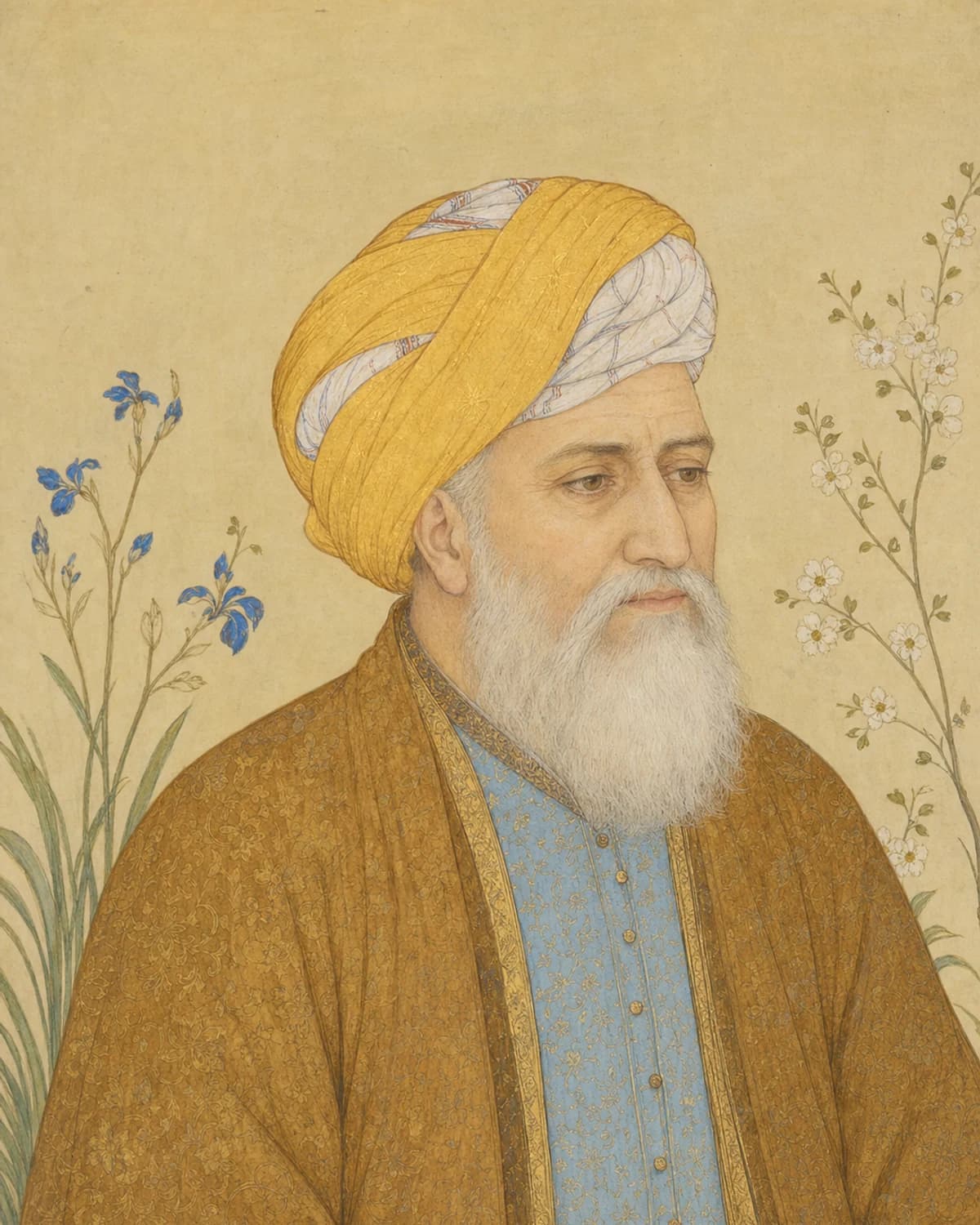
Farrukh Beg began in the workshops of Safavid Khurasan, then worked in Kabul, at Akbar’s court in Agra, in Bijapur for Ibrahim Adil Shah II, and again for the Mughals under Jahangir. The emperor gave him the title “Wonder of the Age”. His best-known pieces are single sheets of Sufis and youths set in empty landscapes. His exact dates and his stay in Bijapur are still debated.
Biography
In 1585, in the Mughal camp, whether at Rawalpindi or at Lahore, the court historian Abu’l Fazl recorded how the new arrivals were received: Farrukh Beg Musavvir (“painter”) and others were given costly robes, horses and trays of gold coins and rupees. The artist was about thirty-eight, and he already had several courts behind him.
He was born around 1547, and his origins are disputed. Abu’l Fazl calls him a Kalmyk; some scholars think he was writing about a different Farrukh, and by another account he came from the Qashqa’i tribe. The title “Beg” points, if anything, to Central Asia. His birthplace is also given in different ways: Iran in general, Tabriz, or, by other accounts, Khurasan. I would not choose between these versions.
He seems to have received his early training in the workshop of Ibrahim Mirza, a nephew of Shah Tahmasp and governor of Mashhad. Mirza Ali and Shaykh Muhammad worked there; the documents do not confirm a direct link with them as teachers. In the Mashhad manuscript of the Haft Awrang (“Seven Thrones”) Farrukh painted all the illustrations but one. The earliest mention of him comes from Iskandar Beg Munshi, court historian of Shah Abbas, who wrote of the friendship between Farrukh and his brother Siyavush and the Safavid prince Hamza Mirza. The first known manuscript with his miniatures is the Khamsa of Amir Khusrau of 1571–1572, with four miniatures; it was made in Herat, where he may have been living. The style there is somewhat provincial. Then he turns up in Kabul with Mirza Muhammad Hakim, Akbar’s half-brother. When he arrived there is unknown; two signed tinted illustrations from these years survive, kept in the Gulistan Palace Library in Tehran. Akbar probably heard of him in Kabul.
After Hakim’s death in 1585 Farrukh moved to Akbar’s court. He took part in the Khamsa of Nizami (seven illustrations out of thirty-six), in the first Akbar-period Baburnama and in the Akbarnama, where, by some accounts, only two miniatures in the large manuscript are his, among them “Akbar’s Triumphal Entry into Surat”. There are also reports that in 1586–1596 he was allowed to work alone on the illustrations; other authors write that he took part in manuscripts only now and then, and these accounts disagree. The manuscript pages are in the Persian manner: meticulous detail, patterned architectural backgrounds, golden skies. Around 1600 (by other accounts, already around 1590) he left Akbar. One explanation is that his refined style, with its strong Persian flavour, did not appeal to an emperor who preferred a more passionate art; no documents support such a reason. The following years are linked with Bijapur. Robert Skelton suggested in 1957 that the artist had served Ibrahim Adil Shah II, and at first many disagreed. Then John Seyller and Ellen Smart confirmed the idea: a Deccan miniature, “Ibrahim Adil Shah II Hawking” (1598), bears the signature “the work of Farrukh Beg”. Many Deccan sheets are signed “Farrukh Husayn”, and Skelton thought this was the same painter. Mark Zebrowski doubts it, since there is no written evidence. Works assigned to the Bijapur period include a portrait of Ibrahim Adil Shah playing the lute (about 1600–1610), “Sufis in a Landscape” in the Russian National Library, and “Horse and Groom” (1604).
Around 1609 he returned to the Mughals, now under Jahangir. The emperor’s memoirs record that he gave 2,000 rupees to the “unrivaled” Farrukh Beg. Jahangir ranked him alongside Mansur and Abu’l Hasan and gave him the title “Nadir al-Asr”, “Wonder of the Age”. For the emperor he worked on the Gulshan Album and the Minto Album; his other sheets are scattered among collections around the world.
In his later years he made single sheets: old Sufis, dervishes, idealised youths, alone among unusual plants and empty landscapes. Atmospheric perspective, modelled figures and folded drapery appear here. To this period belongs the “Old Sufi”, a copy of the engraving “Dolor” by Maarten de Vos, which goes back to Dürer. The Sufi was painted when the artist was about seventy; one may, perhaps, see a self-portrait in him, but nobody can prove a physical likeness. Stuart Cary Welch places Farrukh in the same company as Altdorfer, Sultan Muhammad and Hercules Segers.
Mutamad Khan, in the Iqbalnama-i Jahangiri, called him a man without equal in the universe. The date of his death is unclear: 1615 and around 1619 are both given; by some accounts he died in Agra.
Related context
Associations
Works connected through artistic movements, cultural context and period. Priced works available in this market appear first.
Profile notes
Profile and sources
Image
Artist image
На основе открытого изображения: Farrukh Beg; Wikimedia Commons; Public domain.
