
05.09.1921–16.10.1988
Farida of Egypt
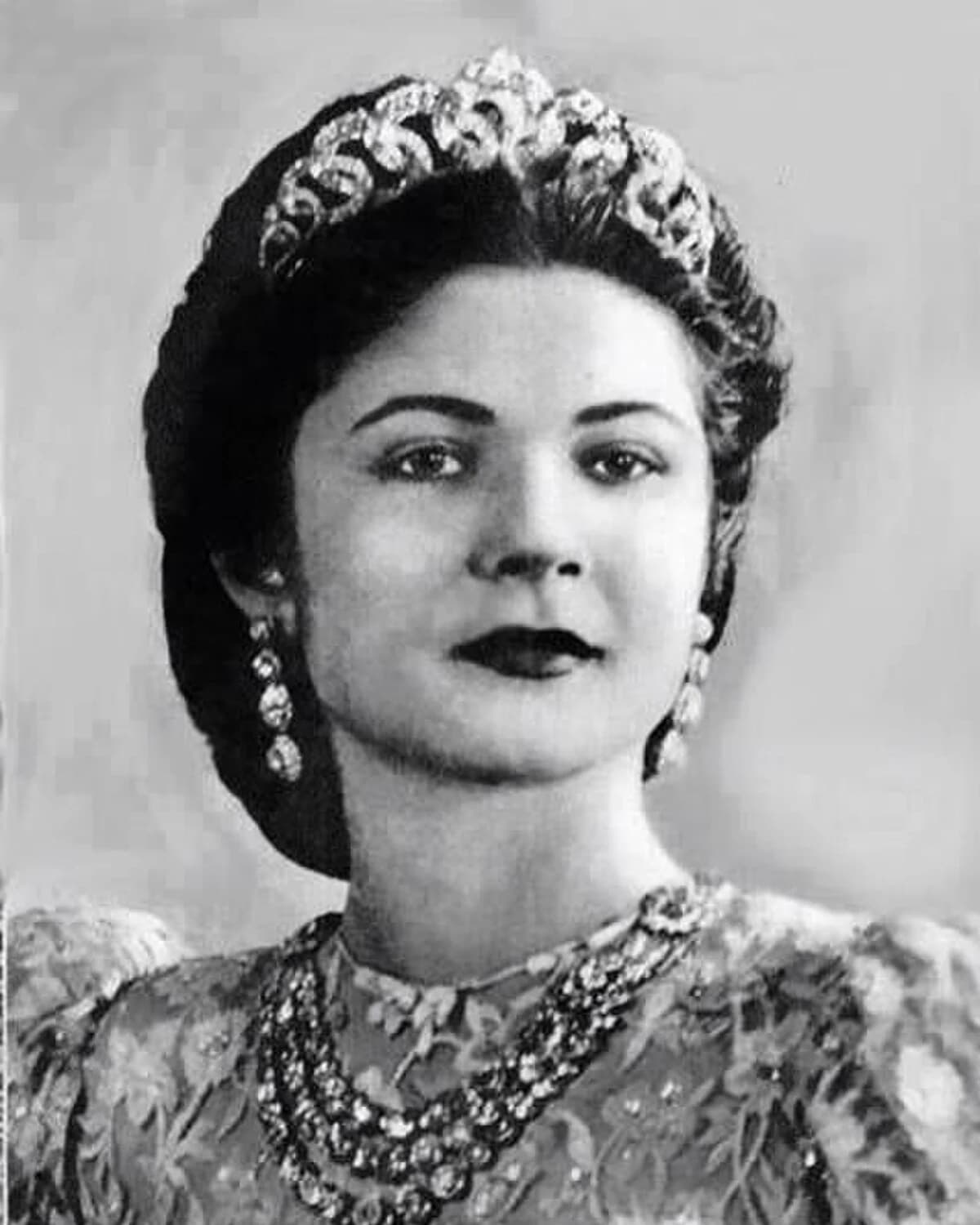
Farida (1921–1988), born Safinaz Zulficar, was queen of Egypt for almost eleven years as the first wife of King Farouk, and the first queen of her dynasty to appear in public. After the divorce of 1948 she lived in Egypt, Lebanon and France. In the late 1960s she began to paint and held solo exhibitions in Europe, the United States and Cairo.
Biography
In May 1980 an exhibition of paintings by Farida opened in Cairo. She was fifty-eight, had been painting for little more than ten years, and more than forty years earlier had become queen of Egypt.
Safinaz Zulficar was born on 5 September 1921 in Alexandria, in the Janaklis district, into a noble family of Circassian origin. Her father, Youssef Zulficar Pasha, was a judge and vice president of the Alexandria Mixed Court of Appeals; her mother, Zeinab, was a lady-in-waiting to Queen Nazli. Her maternal grandfather, Muhammad Said Pasha, had been prime minister of Egypt, and her uncle, Mahmoud Said, was a lawyer and a well-known painter. So there was painting in the family, though nothing is known of any lessons from her uncle. Safinaz was educated at the Notre Dame de Sion school in Alexandria, run by French nuns.
She met King Farouk in 1937 during his trip to London; their engagement was announced that summer, and on 20 January 1938 the wedding took place at Qubba Palace in Cairo. The gown was made by the House of Worth in Paris. Under a rule introduced by King Fuad I, the names of members of the royal family began with the same letter, and Safinaz became Farida. The marriage was presented as a model of the modern family. At the wedding banquet the new queen and the king’s mother and sisters sat in mixed company, the photographs were printed in the press, and two days later Farouk appeared with his wife on the royal balcony; no queen had ever been allowed to do so before. After Farouk came to the throne, the women of the Muhammad Ali dynasty stopped living in seclusion altogether. Farida took the chair of the Egyptian Red Crescent Society, was honorary president of the Egyptian Feminist Union and of the New Woman Alliance, and was patron of the Egyptian Girl Guides. She attended charity events and commemorations and received foreign guests.
They had three daughters: Ferial, Fawzia and Fadia. There was no heir, the marriage went wrong, and on 19 November 1948 Farouk divorced his wife. The king kept the two elder daughters with him, while the youngest stayed with her mother. In Egypt the divorce was unpopular, as Farida was much loved, and Doria Shafik saw in her decision to leave an unhappy marriage a call to Egyptian women: Farida, she wrote, had bought her freedom at the price of a throne.
Farida stayed in Egypt until 1964 and lived in Zamalek, on an island in the Nile. Then she moved to Lebanon, where she saw her daughters for the first time in almost ten years. In March 1965 Farouk died in Rome, and she and her three daughters went to see his body. From 1968 to 1974 she lived in Paris, and in 1974, under President Anwar Sadat, she returned to Egypt. She never married again.
She began to paint in the late 1960s and held solo exhibitions in Europe and the United States; the Cairo exhibition of 1980 was one of them. Of what exactly she painted, and how, almost nothing is known, and I would not venture to judge her painting.
Farida died on 16 October 1988 in Cairo, at the age of 67.
Profile notes
Profile and sources
Image
Artist image
twitter.com; Wikimedia Commons; Public domain.
