
0956–1026
Fan Kuan
Fan Kuan worked at the turn of the tenth and eleventh centuries, under the Northern Song dynasty, and is remembered above all for a single scroll: “Travelers among Mountains and Streams” in the National Palace Museum in Taipei, a landscape on silk about two meters high. Together with Li Cheng, with whom he most likely studied, and Guan Tong, he is called one of the three founders of the Chinese landscape school.
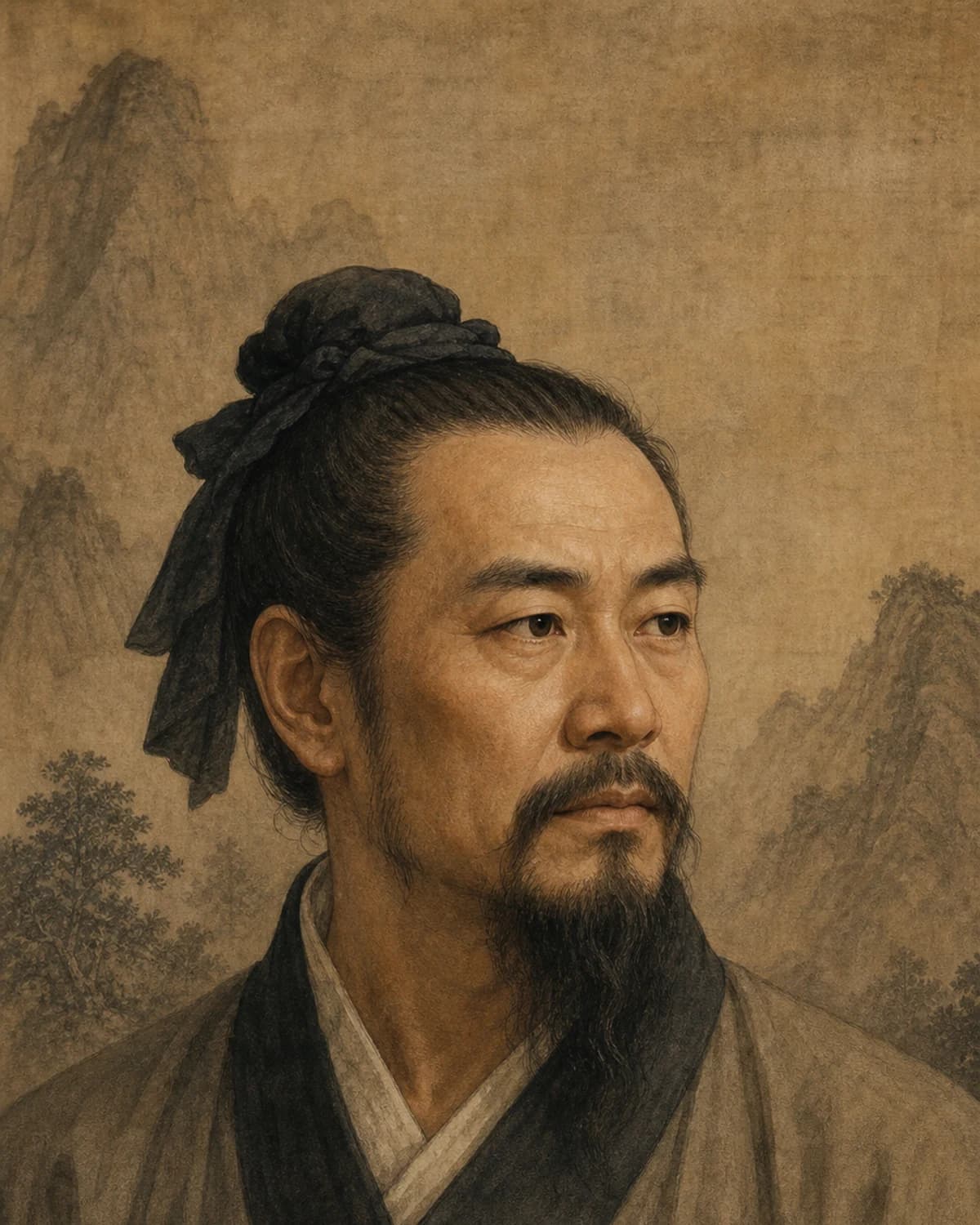
Biography
In the lower right corner of the scroll “Travelers among Mountains and Streams” there is a half-hidden signature of Fan Kuan. It was rediscovered only in 1958.
Little is known about the artist himself, and even the years of his life are approximate. By some accounts he was born in 956 and died in 1026, by others around 960 and around 1030; he is generally thought to have been active from the 990s. His real name was Fan Zhongzheng and his courtesy name Zhongli, while Fan Kuan was a nickname, the one by which he came to be remembered. He came from Yaozhou; the eleventh-century critic Guo Ruoxu calls him Fan Kuan of Huayuan.
The end of the tenth century and the beginning of the eleventh were a time of relative prosperity for the Song empire. Among the educated, military ideals were giving way to a taste for peaceful pleasures and aestheticism, and connoisseurs in the capital made a fashion of calling themselves shanren, “mountain hermits”: the name lent an enlightened man a touch of free-thinking. Fan Kuan was a hermit in fact. He was regarded as a Daoist; he lived in the mountains, wore coarse clothes, ate simple food, and loved wine and long roads. Guo Ruoxu describes his appearance as stern, in the old manner, and his behavior as unrestrained and rough. Beside the aristocratic and refined Li Cheng he looked like his complete opposite. Whether he studied with Li Cheng directly is hard to verify, although he is called the best known of the master’s pupils.
The contrast was described by the eleventh-century painter and critic Liu Daochun in a treatise on the painting of his own dynasty. He drew on the old pair of concepts wen and wu, the civil and the military: to Li Cheng went peaceful life and its pleasures, to Fan Kuan martial valor, directness and resolve. Li Cheng’s landscape, according to Liu Daochun, opens into the distance like a window, while Fan Kuan’s rises before the viewer like a wall and lets the eye go no further.
To my mind, no one has described “Travelers” more precisely since.
The scroll is made of two lengths of silk joined down the middle; perhaps it was once set into a large screen or fixed to a wall. Below, at eye level, everything is painted crisply and hard: boulders, gnarled trees of several kinds, a road on which a train of pack animals is barely emerging from a wood at the foot of a cliff, a temple in the thickets on the rock. Beyond lies a band of water and mist, and behind it rises the bulk of the central mountain, heavy and flat, like a backdrop slotted in behind the foreground. The artist built up the texture of the rocks with strokes and ink washes that are his alone. There are people in the picture, but they are very small. Unlike earlier Chinese landscapes, the main theme here is the grandeur of nature itself, not a backdrop for a story. The manner shows conventions going back as far as the Tang dynasty. It may even be Fan Kuan’s only surviving work.
Other scrolls are attributed to him as well, for example “Cold Forest on a Snowy Plain”, which is kept in Tianjin, in the city museum. The composition is similar: a little open ground in front, behind it a massive mountain range that shuts off the distance, while the snow and the bare, frozen trees make the landscape harsher still. Guo Ruoxu reports that Fan Kuan also painted figures and scenes of everyday life, renwu. The trees in his forests, the critic says, lean and twist like a collapsed roof; Guo Ruoxu never once saw pines or cypresses from his brush. The artist surrounded his dwellings with a dense layer of ink, and to his followers they seemed to be built of iron.
For all his closeness to his teacher, his manner is his own. The same Guo Ruoxu wrote that Fan Kuan’s style differed from those of Guan Tong and Li Cheng, and placed all three above any of the grades into which critics sorted painters: Li Cheng of Yingqiu, Guan Tong of Chang’an, Fan Kuan of Huayuan.
The next generation judged him more coolly. Guo Xi, a master of monochrome landscape, found his works insufficiently elegant; but the court elite’s taste for elegance grew so fast that soon after Guo Xi’s death the same reproach was being made of his own landscapes.
Then opinion changed once more. Fan Kuan’s works became a model for Chinese landscape painting, studied and copied by painters of many generations, and artists returned again and again to “Travelers among Mountains and Streams” as the ideal of the monumental landscape.
Related context
Associations
Works connected through artistic movements, cultural context and period. Priced works available in this market appear first.
Profile notes
Profile and sources
Image
Artist image
На основе открытого изображения: Fan Kuan; Wikimedia Commons; Public domain.
