
08.10.1930–13.04.2024
Faith Ringgold
Faith Ringgold (1930–2024), from Harlem, taught art in New York schools for almost twenty years and became famous for her “story quilts”: patchwork pieces in which painting sits beside handwritten text. Her “American People Series” of the 1960s is in the Museum of Modern Art in New York and the National Gallery of Art in Washington. Her children’s book “Tar Beach” (1991) won the Coretta Scott King Award for illustration.
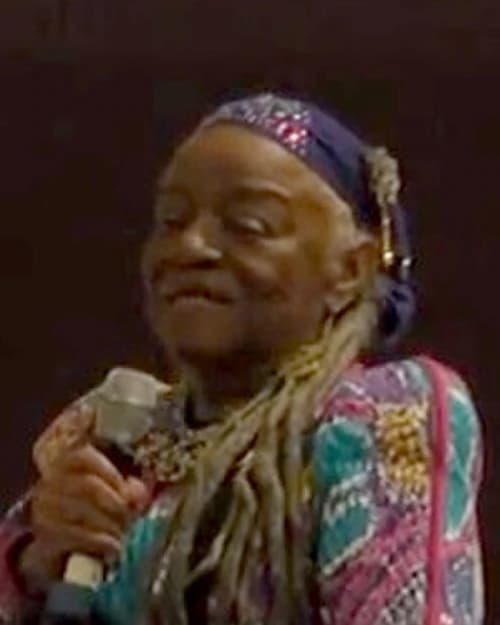
Biography
In 1983 Faith Ringgold began writing her stories straight onto quilts. Nobody would publish the autobiography she was working on at the time, and she reasoned that a text sewn into a quilt could be read at any exhibition and in any photograph in a book. The first such quilt was “Who’s Afraid of Aunt Jemima?”: she turned Aunt Jemima, the most worn-out stereotype of the Black woman, into the head of a family and the owner of a restaurant.
She was born on 8 October 1930 in Harlem and at birth was named Faith Willi Jones; she took the surname Ringgold when she married Burdette Ringgold in 1962. Her mother, Willi Posey, was a fashion designer and dressmaker, and her father was known as a storyteller. Duke Ellington and Langston Hughes lived in neighbouring buildings, and at family parties her childhood friend Sonny Rollins practised the saxophone. Her mother taught the girl to sew and to work with fabric. Quilting in the African American tradition she also learned from her grandmother, who had learned it from her own mother, Susie Shannon, who had been enslaved.
In 1948 she entered the City College of New York. Women were not allowed to study to become artists there, and she had to choose art education instead. Her teachers were Robert Gwathmey and Yasuo Kuniyoshi, and there she met the printmaker Robert Blackburn, with whom thirty years later she would produce a series of prints. She took her bachelor’s degree in 1955 and her master’s in 1959, teaching in the city’s schools all the while. In the summer of 1959 she went to Europe for the first time, to Paris, Florence and Rome, and the Louvre stayed with her for a long time.
Her early paintings are flat: the figures and shapes in them have no volume. A refusal from the gallery owner Ruth White, the work of Jacob Lawrence and the books of James Baldwin led her in 1963 to the “American People Series”: in those years, she said, it was impossible to paint landscapes, too much was going on around her. “For Members Only”, “Neighbors” and “The Civil Rights Triangle” show race relations through a woman’s eyes. Her first solo exhibition opened on 19 December 1967 at the Spectrum Gallery. It included three large murals, “The Flag is Bleeding”, “U.S. Postage Stamp Commemorating the Advent of Black Power” and “Die”, and more than five hundred people came, among them Romare Bearden and Norman Lewis. “Die” is now in the Museum of Modern Art in New York. Next came the “Black Light Series” (1967–1971), in which she gave up European chiaroscuro and built contrast out of dark colours. One work from it has a story attached: representatives of the Chase Manhattan Bank chose a flag painting and only at the artist’s prompting read the words hidden in its stars and stripes. In the end they bought a different work.
From the late 1960s Ringgold protested. In 1968, with Poppy Johnson and Lucy Lippard, she founded the Ad Hoc Women’s Art Committee and demanded that women make up half the participants in an exhibition at the Whitney Museum; on 13 November 1970, after yet another action, she was arrested. That same year, with her daughter Michele Wallace, she founded the group Women Students and Artists for Black Art Liberation (WSABAL). In 1972, on a commission from a public programme supporting artists, she painted the mural “For the Women’s House” for the women’s wing of the Rikers Island prison. It shows women in various professions and in public service, in other words a life that might take the place of prison; the images grew out of long conversations with the inmates, and the portraits are broken into triangles in the manner of Kuba textiles from the Congo. Around the same time, after the bloody uprising of 1971 at Attica prison, came the lithograph “United States of Attica”.
I think the turning point came in the summer of 1972 in Amsterdam. At the Rijksmuseum she saw Tibetan thangkas of the fourteenth and fifteenth centuries, paintings mounted on a fabric backing, and began to frame her canvases in fabric. This is how the “Feminist Series” and the “Slave Rape Series” were made. Her mother sewed with her, and in 1980 the two of them produced their first joint quilt, “Echoes of Harlem”. From 1973 Ringgold gave up school teaching and made masks and life-size soft sculptures, and in 1976 she staged a thirty-minute mime performance, “The Wake and Resurrection of the Bicentennial Negro”, in response to the celebrations of the American Bicentennial.
“The French Collection” (1991–1997) tells the story of a fictional Black artist, Willia Marie Simone, who comes to Paris. She poses for Picasso and Matisse, and in “Picnic at Giverny”, a parody of Manet’s “Luncheon on the Grass”, she herself paints a nude Picasso. The quilt “Tar Beach” (1988) became, in 1991, the first of her seventeen children’s books. For the 125th Street subway station she made “Flying Home: Harlem Heroes and Heroines” (1996).
From 1987 to 2002 she taught at the University of California, San Diego, and in 1995 she published her memoir “We Flew Over the Bridge”. From 1992 her studio was in Englewood, New Jersey. Her first exhibition at a European museum was mounted by the Serpentine Galleries in London in 2019, and the retrospective “American People” opened in 2022 at the New Museum in New York and travelled to the Musée Picasso in Paris.
Faith Ringgold died on 13 April 2024 at her home in Englewood, at the age of 93.
Profile notes
Profile and sources
Image
Artist image
Brooklyn Museum; Wikimedia Commons; CC BY 3.0.
