
15.12.1884–15.01.1926
Eugeniusz Zak
Eugene Zak was born in the Belarusian small town of Mogilno, grew up in Warsaw and built his career in Paris. In 1910 the French state bought one of his paintings for the Musée du Luxembourg, and in 1913 his work was shown at the Armory Show in New York. He drew elongated figures of harlequins, fishermen and musicians, and in 1923 opened his own gallery in Paris.
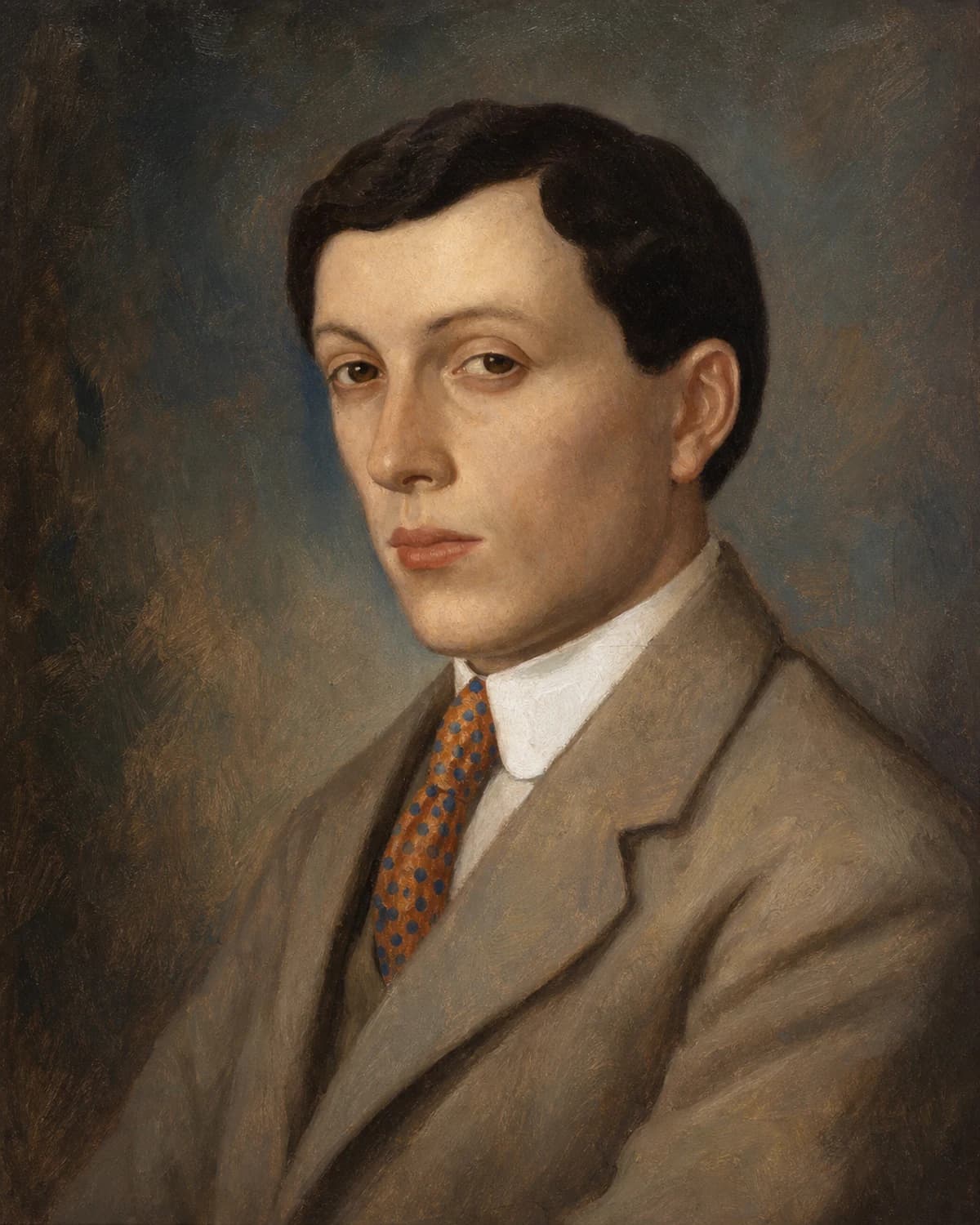
Biography
In 1910 the French government bought one of Zak’s paintings for the Musée du Luxembourg. He was twenty-five, and since his studies in Munich had lived in Paris for only six years.
He was born on 15 December 1884 into a Jewish family in the small town of Mogilno in the Minsk Governorate, now the Uzda District of the Minsk Region. While he was still a boy, the family moved to Warsaw, where he finished a non-classical secondary school. He went to Paris in 1901 or 1902 (the exact year is not known) and studied at the École des Beaux-Arts in the studio of Jean-Léon Gérôme, then at the Académie Colarossi under Albert Besnard. In 1903 he visited Italy, and by the end of the year was in Munich, at the private school of the Slovenian painter Anton Ažbe.
In 1904 he returned to Paris and in the same year made his debut at the Autumn Salon; two years later he was elected to the jury of the drawing section of that salon. He also took part in the Salon des Indépendants. In 1906–1908 he travelled to Brittany, to Pont-l’Abbé among other places. In Paris he belonged to the Society of Polish Artists and was friends with Roman Kramsztyk, Mela Muter, Elie Nadelman, Leopold Gottlieb and Zygmunt Menkes, and, among critics, with Adolf Basler and André Salmon. His solo exhibition at the Galerie Druet took place in 1911. From 1912 he taught at the Académie de La Palette. In 1913 he married the painter Jadwiga Kon, and his work was shown at the Armory Show: in New York, Chicago and Boston he was the only Pole besides Nadelman. In 1914 he took part in the Venice Biennale.
The First World War found him in Paris. He lived in the south of France (Nice, Saint-Paul-de-Vence, Vence) and visited Lausanne, where, according to some accounts, the war had forced him to move with Ilya Ehrenburg and Kramsztyk.
In 1916 Zak settled with his family in Częstochowa, his wife’s hometown. He grew close to the Formists, a Polish avant-garde group, visited Warsaw often and in 1921 helped to found the group Rytm (“Rhythm”), whose artists created a Polish version of Art Deco. His solo exhibition in Warsaw took place in 1917. In 1922 he left Poland for good: first for Germany, where he wrote articles on artists close to him for the magazine Deutsche Kunst und Dekoration, and then for Bonn. There, on commission from the architect Fritz August Breuhaus, he decorated the interior of a villa with paintings.
In 1923 Zak settled in Paris again, where he met Menkes and Marc Chagall, and opened his own gallery, the Galerie Zak. In 1925 his second solo exhibition was held in Paris. The Academy of Fine Arts in Cologne offered him the headship of its painting faculty.
Zak’s manner is easy to recognise. His early sanguine drawings of heads and busts recall Leonardo, Botticelli, Holbein and Dürer. Then came idyllic landscapes in the spirit of Puvis de Chavannes, peopled by figures of androgynous beauty with profiles like those on Greek vases. From about 1917 the fishermen and their families gave way to lonely habitués of taverns, harlequins and dancers with elongated proportions, posed like marionettes. They remind me of the young Picasso’s “Saltimbanques”, although Zak is thought to have painted more from imagination than from life. His last pictures have more light, and their colour is closer to the Impressionists, above all Renoir, whom he had earlier disdained.
Zak died on 15 January 1926 in Paris, in the 14th arrondissement, at the age of forty-one. He had not had time to decide on the Cologne offer. His widow took over the running of the gallery. In the 1930s it showed Kandinsky, and during the Occupation the gallery was looted and liquidated; Jadwiga Zak and their son were murdered at Auschwitz. Many works from the gallery have still not been found.
Related context
Associations
Works connected through artistic movements, cultural context and period. Priced works available in this market appear first.








Profile notes
Profile and sources
Image
Artist image
На основе открытого изображения: Eugeniusz Zak; Wikimedia Commons; Public domain.
