
02.10.1923–18.01.2014
Eugenio Cruz Vargas
Eugenio Cruz Vargas (1923–2014) worked for almost twenty years in banking and advertising before giving himself entirely to painting and poetry. He published three books of poems (1978, 1980, 2011), held four exhibitions between 1986 and 2008, and ended with abstraction: his last show was called “From Landscape to Abstraction”. In his final years he made sculptures from steel and copper.
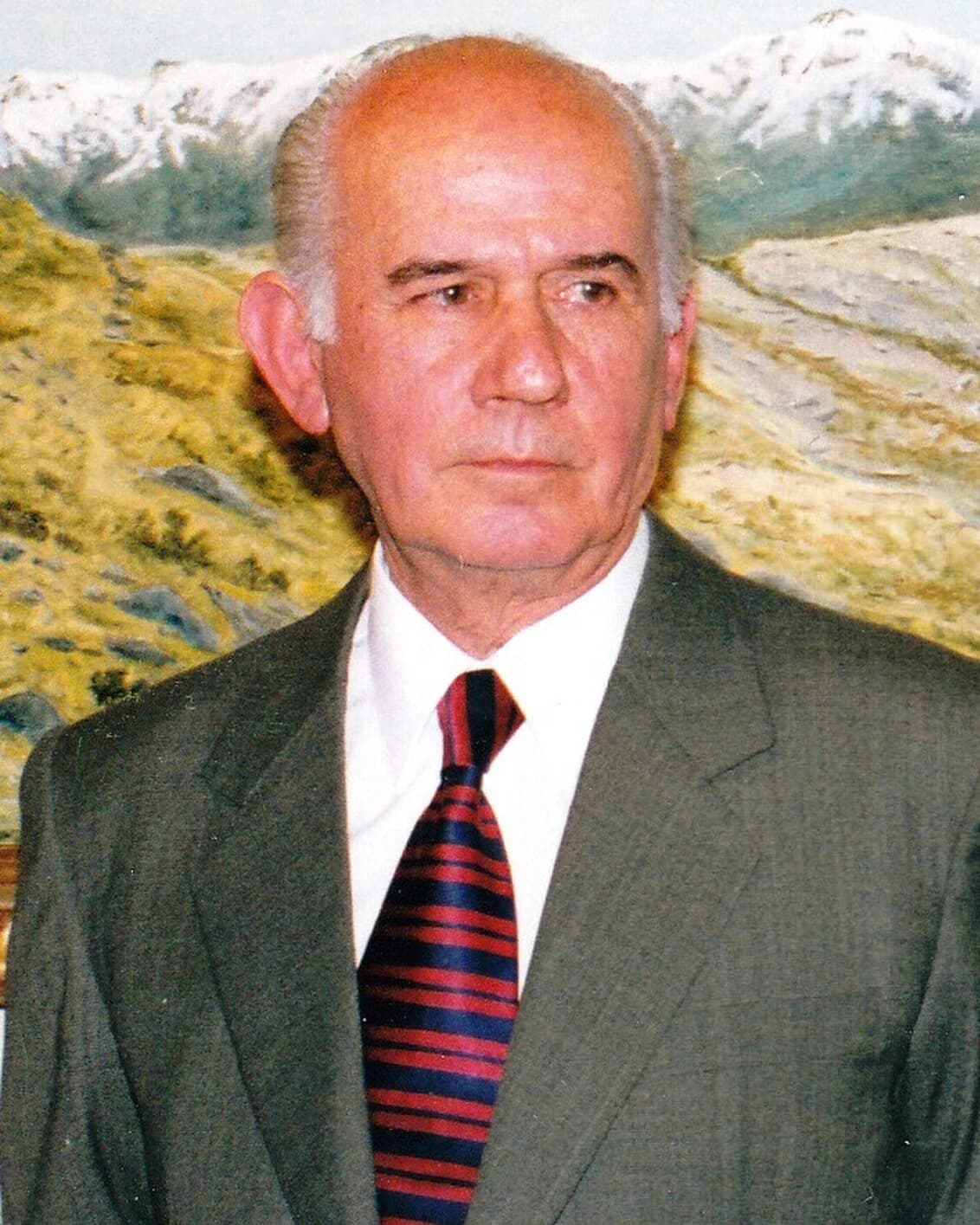
Biography
In 1970 advertising in Chile was in crisis, and Eugenio Cruz Vargas, the owner of several advertising agencies, left to look for new projects in Europe and Asia. In Paris he stayed for a long time and attended courses in art history at the École du Louvre.
He was born on 2 October 1923 in Santiago. His father, Pedro Nolasco Cruz Correa, was a winegrower; his paternal grandfather, Pedro Nolasco Cruz Vergara, is known as a literary critic. According to some accounts, the boy grew up on the Las Cabras farm in Viña San Pedro, the third of six children. He studied at the Colegio San Ignacio, a Jesuit school in Santiago. His artistic talent, it is generally held, showed itself already at school, but after his father’s death it became impossible to pursue art. He went to work at the Banco de Chile, in its advertising and property department. On 15 July 1950 he married Luz Vergara Errázuriz, and they had nine children.
In the early 1960s he became a partner in the advertising agency Cóndor, founded in 1942 by Ruperto Vergara Santa Cruz, and later its owner. Then came the agencies Cruz y del Solar, Vía Publicidad and Publicidad Siete.
After Paris, Cruz Vargas moved to the United States to raise funds for joint Chilean-American films. He managed to make two: the comedy “Antonio” (directed by Claudio Guzmán, filmed in Quintay, Santiago and Pirque) and the drama “Autorretrato” (directed by Maurice McEndree). No copies of either film, it is reported, survive in Chile.
Between 1978 and the mid-1980s he brought his last business ventures to a close and afterwards devoted himself only to painting and poetry. He settled in the south of the country and later lived in Olmué.
His first book of poems, “La única vez que miento” (“The Only Time I Lie”), appeared in 1978 from Editorial Universitaria; the second, “Cielo” (“Sky”), in 1980 from Nascimento, with drawings by Enrique Foos. Both are close to Surrealism: plain language, love, nature, the city and country life in the south of Chile. The third and last book, “De lo terrenal a lo espacial” (“From the Earthly to the Spatial”), came out in 2011 with a preface by the poet Emilio Antilef. The cover reproduces the author’s own painting “Paisaje en un color” (“Landscape in One Colour”). The book was presented on 8 April 2011 at the Cultural Institute of Providencia.
Two periods can be distinguished in his painting. First came a representational manner drawing on the masters of the nineteenth and twentieth centuries: oil on canvas in medium and large formats, rural life and the coast of central and southern Chile. Then came compositions with partial abstraction and, at the end, complete abstraction. The critic Víctor Carvacho Herrera, who wrote the preface to the catalogue of the 1986 exhibition, noted that the painter loved trees above all. Four exhibitions took place between 1986 and 2008; the last, “From Landscape to Abstraction”, was held in 2008 at the Cultural Institute of Providencia. In all he painted about three hundred oil paintings. Many are in private collections, and some belong to the family and the foundation that bears his name.
In his last years he turned to sculpture, making three large works from recycled steel and copper. They stand in the family’s private park in Olmué.
Cruz Vargas died there on 18 January 2014. A year later the foundation named after him printed a memorial notice in the newspaper El Mercurio, comparing the combination of painting and poetry in his work to that of William Blake.
Profile notes
Profile and sources
Image
Artist image
José Cruz; Wikimedia Commons; Public domain.
