
04.09.1875–13.09.1946
Eugene Lanceray
Eugene Lanceray (1875–1946) grew up in the Benois family and began in the World of Art group with historical scenes from the age of Peter the Great and Empress Elizabeth, book graphics and theatre work. After the revolution he stayed in the country: he lived in Dagestan and Tiflis, taught at the Academy of Arts of Georgia, and in Moscow painted the ceilings of the Kazansky station restaurant and the halls of the Hotel Moskva.
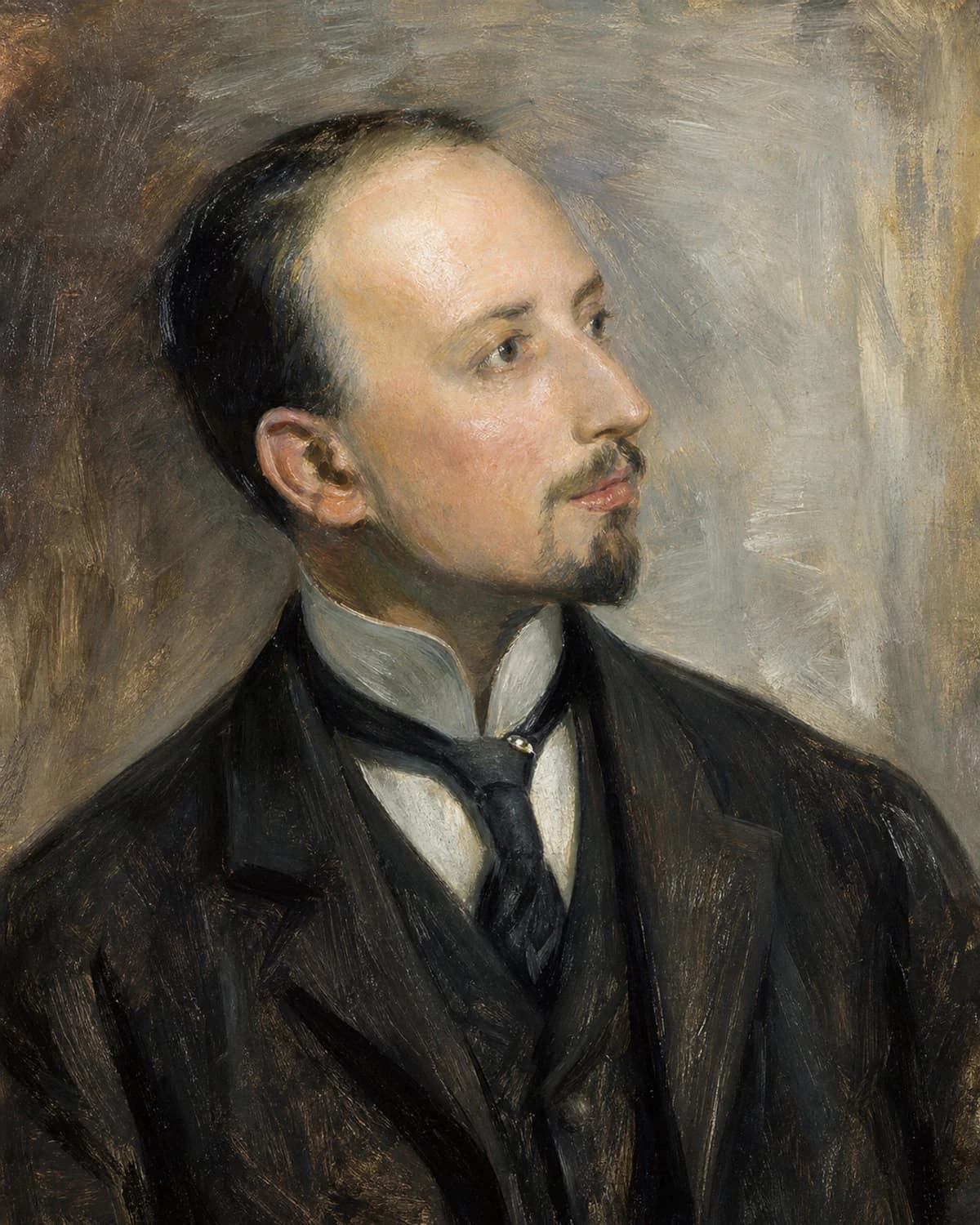
Biography
In January 1934 the first of Eugene Lanceray’s canvases, “Crimea”, was glued to the ceiling of the restaurant hall at Kazansky railway station in Moscow. The artist wrote in his diary that he was shaken: seen from below, the picture looked small, puny and not in the least monumental. Only now, he added, does one understand what the experience and mastery of Byzantium were worth.
He was fifty-eight. He had first been invited to work on this station back in 1916, together with Benois and Serebriakova, but the revolution cut that plan short.
He was born on 23 August (4 September) 1875 in Pavlovsk, near St Petersburg. His father, the animal sculptor Eugene Alexandrovich Lanceray, owned a small estate called Neskuchnoye, where the children grew up; after the father’s death their mother took them to St Petersburg, to the Benois house by St Nicholas Naval Cathedral. It was a family in which art was treated as an ordinary trade: his grandfather Nicholas Benois and his uncle Leon Benois were architects, another uncle, Alexandre Benois, a painter and critic. His sister Zinaida would become the painter Zinaida Serebriakova, his brother Nikolai an architect. Eugene finished the First St Petersburg Gymnasium, studied from 1892 at the Drawing School of the Society for the Encouragement of the Arts under Jan Ciągliński, Nikolai Samokish and Ernst Liphart, and in the second half of the 1890s travelled around Europe and worked at the Académie Colarossi and the Académie Julian in Paris.
On his return he joined the World of Art, where he was the youngest and at first behaved as Benois’s pupil. Like his elders, he was drawn to the eighteenth century, above all to the historical, architectural landscape. “Empress Elizabeth Petrovna at Tsarskoye Selo” (gouache, 1905) and “Ships of the Time of Peter the Great” (tempera, 1911) are in the Tretyakov Gallery, “St Petersburg in the Early Eighteenth Century” (1906) in the Russian Museum. He worked in book graphics from 1897, and in 1904 designed the address side of a postcard for the publishing house of the Community of St Eugenia, which stayed in print for ten years. In 1905 he travelled to the Far East. In 1906, with Zinovy Grzhebin, he published the anti-monarchist satirical magazine “Adskaya Pochta” (“Hell’s Post”), which managed three issues, then worked with the Shipovnik publishing house and drew its mark. In 1907–1908 he was one of the founders of the Ancient Theatre and returned to it in 1913–1914. From 1911 he headed the art department of the Imperial Porcelain Factory and the glass-engraving workshops in St Petersburg and Yekaterinburg. He received the title of academician in 1912 (according to other accounts, in 1913) and became a full member of the Academy of Arts in 1916. In the same years he was illustrating Tolstoy’s “Hadji Murat”, for example the watercolour “At the Alexander Column” (1912–1915).
In 1914–1915 Lanceray was a war artist and correspondent on the Caucasus front. In 1917 he left Petrograd for Dagestan and spent about three years there, becoming fascinated with the East. In 1919 he worked as an artist for OSVAG, the information and propaganda bureau of the Volunteer Army. Ivan Bilibin later recalled receiving a very high-flown letter from Lanceray about everyone’s duty to go to Rostov for this service, and going. What exactly he drew for OSVAG is hard to establish from the sources available to me.
From 1920 he lived in Tiflis. He worked as a draughtsman at the Museum of Ethnography, went on expeditions with the Caucasian Archaeological Institute, and from 1922 was a professor at the Academy of Arts of Georgia; Apollon Kutateladze is named among his students. With Iosif Sharleman he drew the coat of arms of the Georgian SSR, approved in 1921. In 1927 the academy sent him to Paris for six months. In 1931–1932 he painted two panels for the foyer of the Workers’ Palace in Kharkiv, “Partisans of the Caucasus” and “Meeting of Komsomol Members with the Peasants of Crimea”; they were restored in time for 2012.
In 1934 Lanceray moved to Moscow. At Kazansky station he was given the restaurant: on the ceiling each region received its own scene, Murmansk a ship with its crew, Crimea a smiling Tatar woman, southern trees and a carpenter at work. He painted in tempera, on canvases that were then fixed to the ceiling. The high vaults and uneven light got in his way, and the committee was unhappy too, though for a different reason: it found too many allegories in the sketches and no “deep socialist” idea. I think they noticed correctly: the lavish frames and solemnity of these paintings recall the ceilings of the seventeenth and eighteenth centuries and give away a man who grew up in the World of Art. In 1937 he painted the Hotel Moskva in tempera, made ceilings for the Tarasov house and the Memorial Hall in the Academy of Arts building; from 1934 to 1938, at Isaak Brodsky’s invitation, he taught at the All-Russian Academy of Arts in Leningrad. He also worked for the stage: “Julius Caesar” (1924), “Woe from Wit” at the Maly Theatre (1938). In 1936 he returned to Tolstoy and illustrated “The Cossacks”.
In 1942 he painted in gouache a series of five sheets, “Trophies of Russian Arms”, among them “The Victory at Poltava”. In 1943 he had a large exhibition at the Tretyakov Gallery and received the Stalin Prize, second class; in 1945 he became People’s Artist of the RSFSR.
After the war Lanceray worked at Kazansky station again, and in 1946 designed “The Squire’s Daughter” at the Bolshoi Theatre. He died on 13 September 1946 in Moscow and was buried in the Novodevichy Cemetery. The station ceilings were finished by other artists from his sketches. Lanceray’s diaries were published in three volumes in 2008–2009.
Related context
Associations
Works connected through artistic movements, cultural context and period. Priced works available in this market appear first.








Profile notes
Profile and sources
Image
Artist image
На основе открытого изображения: Boris Kustodiev; Wikimedia Commons; Public domain.
