
26.04.1798–13.08.1863
Eugène Delacroix
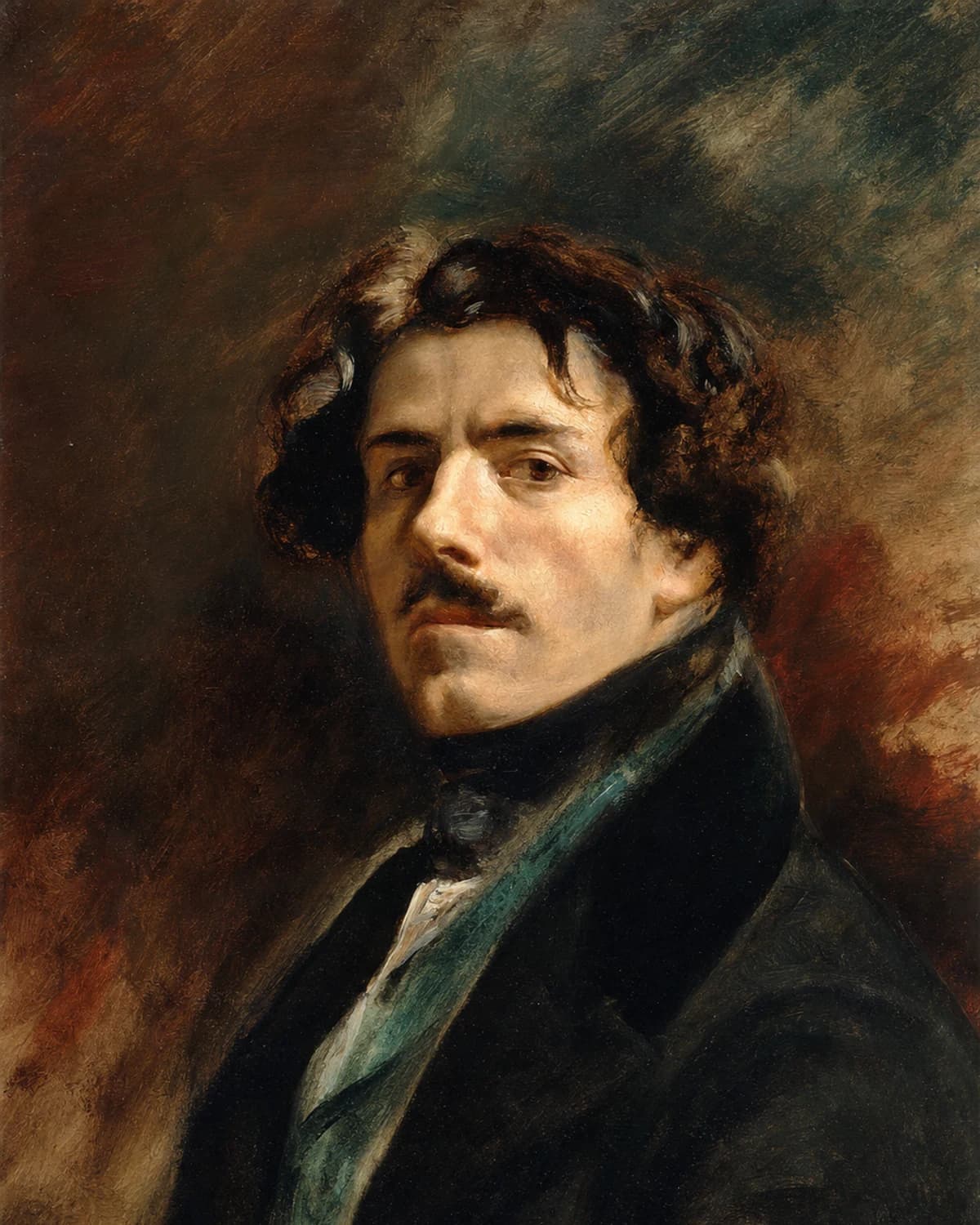
Eugène Delacroix (1798–1863) made his name at the Paris Salon of the 1820s with “The Massacre at Chios” and “The Death of Sardanapalus”, and in 1830 he painted “Liberty Leading the People”. A journey to Morocco gave him subjects for the rest of his life. His last decades went into murals for the Palais Bourbon, the Palais du Luxembourg, the Louvre and the church of Saint-Sulpice; his Journal is still read today.
Biography
When Eugène Delacroix’s studio was sold in 1864, 9,140 works were attributed to him: 853 paintings, 1,525 pastels and watercolours, 6,629 drawings, 109 lithographs and more than sixty sketchbooks. There were almost eight times as many drawings as paintings. He himself explained it this way: colour always occupied him, but drawing preoccupied him.
He was born on 26 April 1798 at Charenton-Saint-Maurice, near Paris. His legal father was Charles-François Delacroix, a former foreign minister; persistent rumour held that his real father was Talleyrand, who went on to protect the artist for many years. His mother, Victoire Oeben, was the daughter of the cabinetmaker Jean-François Oeben; the portrait painter Henri-François Riesener was also among his mother’s relatives, and in Normandy the boy would go out with his uncle to draw from nature. His father died in 1805, his mother in 1814, and at sixteen Eugène was an orphan.
Alexandre Dumas recalled that by the age of three Eugène had already hanged, burned, drowned and poisoned himself: he got tangled in a bag of oats, found himself under a mosquito net that caught fire, nearly drowned at Bordeaux and swallowed verdigris paint.
At the Lycée Louis-le-Grand he won prizes for drawing and for his knowledge of the classics. In 1815 he entered the studio of Pierre-Narcisse Guérin, and in 1816 the École des Beaux-Arts, where he drew plaster casts and models in the manner of David. His real schooling came from the Louvre, where he copied Rubens, Veronese, Titian and Velázquez, and from his friendship with Théodore Géricault. Delacroix posed for “The Raft of the Medusa” and, on seeing the finished picture, by his own account ran off like a madman and could not stop until he got home. Richard Bonington introduced him to English watercolour, to Shakespeare and to Byron. His first church commissions, “The Virgin of the Harvest” (1819) and “The Virgin of the Sacred Heart” (1821), still look towards Raphael. A year later he showed “The Barque of Dante” at the Salon.
The State bought “The Barque” for the Luxembourg gallery. In 1824 the Salon saw “The Massacre at Chios”: Greek civilians being rounded up by the Ottomans for slavery, and an infant reaching for its dead mother. There are no heroes or raised swords in it, only catastrophe, and many critics were outraged; Antoine-Jean Gros called the picture a massacre of painting. The State bought it too. After seeing works by Constable and watercolours by Bonington, Delacroix freely repainted the sky and the distant landscape on the canvas. It was followed by “Greece on the Ruins of Missolonghi”, the town where Byron had died shortly before.
In 1825 he travelled to England, to Thomas Lawrence and Bonington, and made lithographs for Shakespeare, then for Goethe’s “Faust”. “The Death of Sardanapalus” (1827–1828), after Byron’s play, shows the besieged king looking on impassively as his servants, on his orders, kill his concubines and horses. Some critics took it for a gruesome fantasy of death and lust.
“Liberty Leading the People” was painted after the July Revolution of 1830 against Charles X. The public at the Salon of 1831 received it with enthusiasm and the State bought it, but by 1832 officials found it too inflammatory and removed it from view; it was shown again only after the Revolution of 1848, and it is now in the Louvre. I think the picture holds together through contrast: the lit allegory in the smoke and the dead in the foreground. The boy with the pistols is sometimes seen as a model for Gavroche in “Les Misérables”.
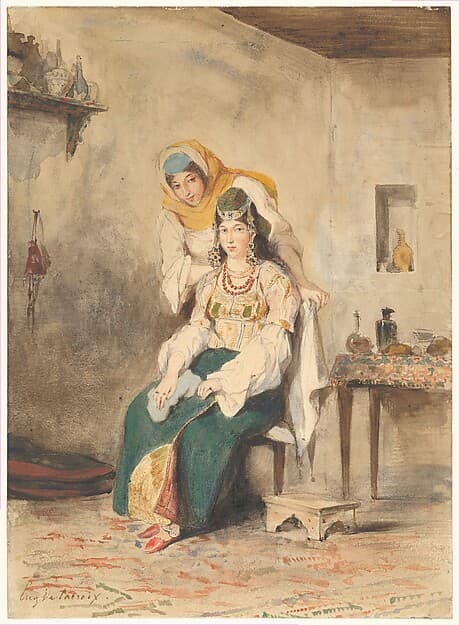
In 1832 Delacroix went to Spain and Morocco with the diplomatic mission of Charles-Edgar de Mornay. He went not to study but to escape Parisian civilisation, and North Africa turned out quieter and more patriarchal than he had imagined. “The Greeks and Romans are here at my door,” he wrote of the Arabs wrapped in white blankets. In Tangier he drew endlessly. Muslim women could hardly ever be persuaded to pose, and for “Women of Algiers in their Apartment” (1834) he made his sketches in secret; it was easier with “Jewish Wedding in Morocco” (1839). In all, more than a hundred paintings and drawings grew out of these impressions, down to the lion hunts of 1856–1861 and “Arabs Playing Chess”, painted some fifteen years after the journey.
From 1833 the state commissions came: the Salon du Roi in the Palais Bourbon, then the libraries of the Palais Bourbon and the Palais du Luxembourg, a “Pietà” for the church of Saint-Denys-du-Saint-Sacrement (1843), the ceiling of the Galerie d’Apollon in the Louvre around 1850. The last large commission was the Chapel of the Holy Angels at Saint-Sulpice, with “Jacob Wrestling with the Angel” and “The Expulsion of Heliodorus from the Temple”, completed in 1861. He confessed that his heart began to pound whenever he stood before a huge wall.
He was witty and elegant, and society waited for him to appear; he painted portraits of his friends, among them Chopin and George Sand on a single canvas that was cut up only after his death. Baudelaire wrote that Delacroix was passionately in love with passion, but coldly determined to express it as clearly as possible. Everything he saw and thought went into his Journal. In 1851 he was elected to the Paris municipal council, and in 1855 he was given a solo exhibition at the Exposition Universelle. What grieved him was something else: the public knew him through his old pictures, and it barely noticed the finished murals at Saint-Sulpice. In 1861 he became one of the founders of the Société Nationale des Beaux-Arts.
From 1844 he rested at a country house in Champrosay, and from 1834 his housekeeper, Jeanne-Marie Le Guillou, never left his side. In his will Delacroix left gifts to his friends and money to Jeanne, ordered his studio to be sold and expressly forbade any likeness of his features, whether a death mask, a drawing or a photograph. He died on 13 August 1863 in his Paris apartment on the rue de Furstenberg, where he had moved at the end of 1857, and was buried in Père Lachaise Cemetery. Since 1971 that apartment has housed the Musée National Eugène Delacroix.
Artist works
Works by the artist
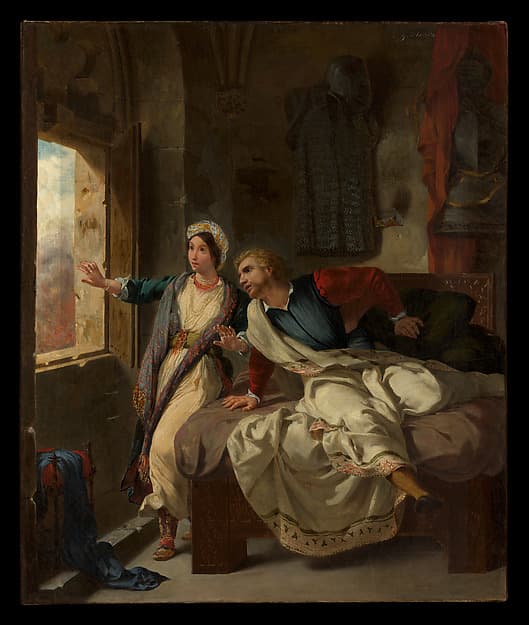
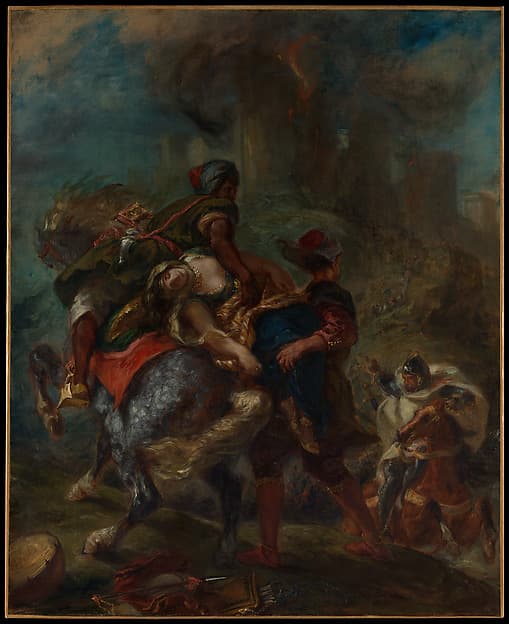
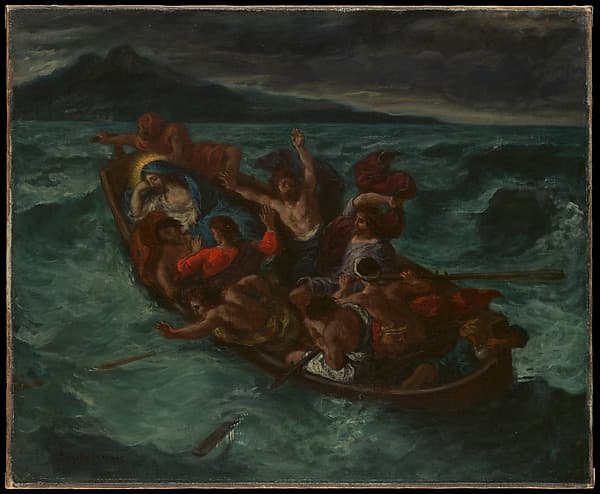
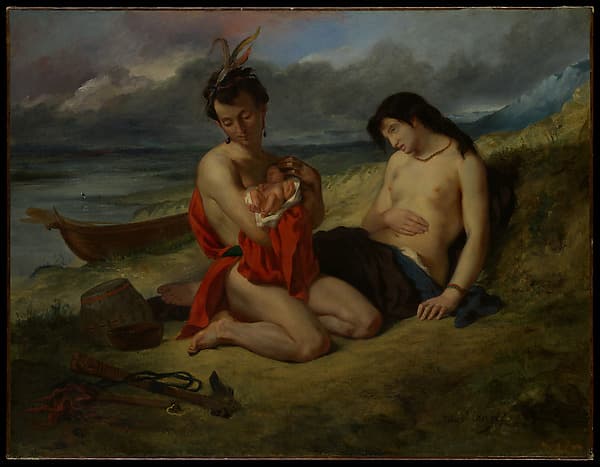
Works by Eugène Delacroix available in this edition of NEOARCA.
Related context
Associations
Works connected through artistic movements, cultural context and period. Priced works available in this market appear first.








Profile notes
Profile and sources
Image
Artist image
На основе открытого изображения: Eugène Delacroix; Wikimedia Commons; Public domain.
