
24.02.1925–14.11.2021
Etel Adnan
Etel Adnan (1925–2021) was born in Beirut, taught philosophy in California and wrote in French and English; her novel “Sitt Marie Rose” (1978) has been translated into Arabic. She painted for decades, but wide fame as an artist came to her at 87, after documenta 13 in Kassel: small canvases with pure planes of colour laid on with a palette knife.
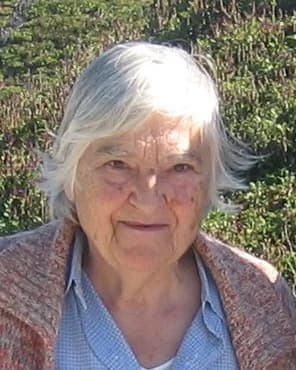
Biography
In the 1960s Etel Adnan would sit over an Arabic grammar book and copy out words from it for hours, without trying to grasp their meaning. Arabic had sounded around her since childhood, but she wrote in French and English, and Arabic letters entered her work as drawing. Out of these exercises grew her artist’s books, and then long folding concertina sheets modelled on Japanese leporellos: on them she drew landscapes which, in her words, could be unfolded in space like a free-standing drawing. She was strongly influenced by the hurufiyya artists, who joined calligraphy to modern art: the Iraqis Jawad Saleem and Shakir Hassan Al Said and the Palestinian Jabra Ibrahim Jabra.
She was born on 24 February 1925 in Beirut. Her mother, Rose Lacorte, was a Greek Orthodox woman from Smyrna; her father, Assaf Kadri, was a Muslim, an officer of the Ottoman army from Damascus. They had met in Smyrna during the First World War and moved to Beirut after the empire collapsed. At home the family spoke Greek and Arabic, and until about the age of five the girl spoke Turkish as well. Then she was sent to a French Catholic school, and French became her main language.
In 1945–1949 she studied French literature at the École Supérieure des Lettres in Beirut, then went to Paris on a scholarship and took a degree in philosophy at the Sorbonne. In 1955 Adnan left for the United States, for graduate study at the University of California, Berkeley, and at Harvard University. From the late 1950s she taught philosophy at Dominican College in San Rafael, north of San Francisco. Close by, in Sausalito, she had a house, and California remained her second life to the very end.
Her painting began with a knife. The early abstractions are done with a palette knife: oil paint, often squeezed straight from the tube, goes onto the canvas in dense, confident strokes. A red square often sits at the centre. What interested her, as she put it, was the immediate beauty of colour. Paul Klee was an important early model for her, and like Klee she loved small formats and a range of techniques.
Later Adnan returned to Beirut and became a journalist and the cultural editor of the French-language newspaper “Al Safa”. She filled the culture section herself, sometimes giving it cartoons and drawings, but what people remembered most were her front-page editorials, in which she wrote about the main political questions of the day.
For a long time the writer in her was more visible than the artist. The novel “Sitt Marie Rose”, centred on the civil war in Lebanon, came out in Paris in 1978 and won the France-Pays Arabes prize. “The Arab Apocalypse” appeared in French in 1980 and in English in 1989, “Journey to Mount Tamalpais” in 1985. From 1972 the artist Simone Fattal was at her side; in 1982 Fattal founded the Post-Apollo Press, where Adnan published her own books and translated. In 2003 an American academic journal devoted to the multi-ethnic literature of the United States called her very nearly the best-known Arab author writing today. For the story collection “Master of the Eclipse” she received the Arab American Book Award in 2010, for the poems of “Sea and Fog” the California Book Award in 2013, and in the same year a Lambda Literary Award. Since 2015 the University of Arkansas Press has given an annual poetry prize in her name for a first or second book of poems in English by an author of Arab heritage.
Then came 2012. At documenta 13 in Kassel a series of her bright abstractions was shown, and Adnan, already 87, suddenly found herself an artist in demand. I think it was the simplicity of these pictures that did it: a small canvas, a few planes of colour and nothing superfluous.
After that the exhibitions came one after another: the retrospective “Etel Adnan in All Her Dimensions” at Mathaf in Qatar (2014), with a 580-page catalogue, the Whitney Biennial (2014), the Sharjah Biennial (2015), “The Weight of the World” at the Serpentine Galleries in London (2016), the Massachusetts Museum of Contemporary Art and the San Francisco Museum of Modern Art (2018), “Light’s New Measure” at the Guggenheim Museum in New York (2021). The French government made her a Chevalier of the Order of Arts and Letters (2014), and in 2020 her book “Time”, translated by Sarah Riggs, won the Griffin Poetry Prize.
Etel Adnan died in Paris on 14 November 2021, at the age of 96. A year later the Van Gogh Museum in Amsterdam showed her work beside Van Gogh’s paintings in the exhibition “Colour as Language”.
Profile notes
Profile and sources
Image
Artist image
Nanwieser; Wikimedia Commons; CC BY-SA 3.0.
