
11.11.1935–present
Esther Mahlangu
Esther Mahlangu carried Ndebele wall painting, which her mother and grandmother taught her at the age of ten, from the walls of houses onto canvas, metal and fabric. International fame came with the Magiciens de la Terre exhibition in Paris in 1989, and in 1991 she became the first woman and the first non-Western artist to paint a car for the BMW Art Car series. She works in Mpumalanga province, South Africa.
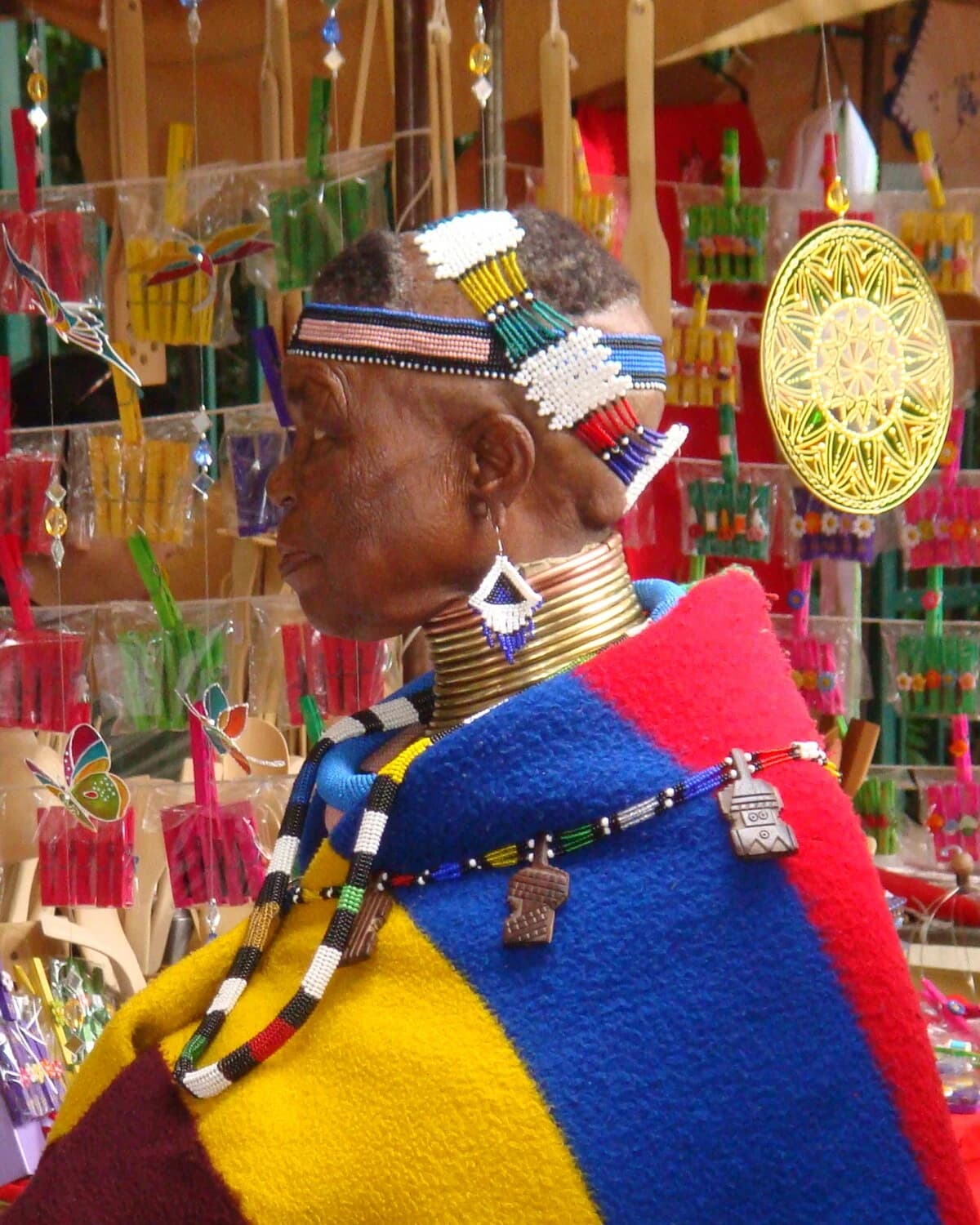
Biography
When Esther Mahlangu arrived in Paris in 1989 for the Magiciens de la Terre exhibition, she found that the organisers had built a house for her. It was a full-size replica of her own home, and she was to paint its walls in public, in front of thousands of visitors. The exhibition, held at the Centre Pompidou and the Grande Halle de la Villette, was conceived as an argument with Eurocentrism: alongside Western artists it showed contemporary art from non-Western countries. For Mahlangu it brought her first international recognition.
The invitation grew out of a single trip. In 1986 researchers from the French embassy, among them the curator André Magnin, were travelling through South Africa and saw the paintings on the walls of her house. During her two months in France she also found time to paint a mural in the Museum of Fine Arts in Angoulême. By 1990 she had invitations to paint walls and exhibit in more than twelve countries.
She was born on 11 November 1935 on a farm near Middelburg, in what is now Mpumalanga province, and belongs to the Southern Ndebele people. She began painting at ten. Her mother and grandmother taught her, as was customary: adolescent girls were being prepared for the day when they would decorate the outer walls of their own homes. This painting is done only by women, and only on special occasions. As a teenager Mahlangu had already mastered the craft completely and was being asked to paint houses, yet critics began to write about her only at the end of the 1980s.
From 1980 to 1991 she lived and worked at Botshabelo, a historical open-air village where visitors are shown Ndebele culture. Her designs are built from lines outlined in white, which run diagonally or fold into chevrons, and the coloured fields between them are dense and clean. She takes her motifs from traditional Ndebele dress and beadwork, and turns ordinary household objects into abstract signs. She paints freehand, without sketches or guidelines. Her brush is made of chicken feathers. When she works in beads, she lays out her signature in beads too, as her initials. I think this free hand, keeping the geometry even without a ruler, is the real secret of her style. Over time Mahlangu moved her patterns more and more from walls onto canvas, metal and fabric, and in this way a traditional art tied to the clay wall reached a wide public.
In 1991 BMW commissioned her to paint a car for its Art Car series, in which Andy Warhol, David Hockney and Frank Stella had worked before her. Mahlangu became the first woman and the first non-Western artist in the series. The project was timed to the end of apartheid: five years had passed since BMW opened its plant in Rosslyn, and a year since Nelson Mandela's release. The Ndebele patterns went onto the body of a BMW 525i, and this was her first work on something other than a wall. The car was later shown at the National Museum of Women in the Arts in Washington (1994) and at the British Museum in the exhibition South Africa: The Art of a Nation (2016–2017).
In 1992 she painted a five-storey wall of the Johannesburg Civic Theatre and that same year took part in Documenta 9.
In August 1994 Mahlangu travelled to the United States for the first time. For the opening of her first solo exhibition at the National Museum of Women in the Arts she painted an empty building that was to become the museum's new wing. The work went on from 25 August to 15 September, and every day passers-by and drivers stopped to watch. The exhibition ran until 13 November: canvases, photographs of her wall paintings and that same car.
After that the commissions came one after another. In 1997 she painted the tail fins of several British Airways aircraft, and in 2007 a small Fiat 500 for the exhibition Why Africa? in Turin. In 2016 she made trainers with Ndebele patterns for a Swedish footwear brand, and embroidery entered her work for the first time; the same year she painted the interior of a BMW 7 Series for display at the Frieze fair in London. In 2020 she became the first South African artist commissioned to design the interior of a Rolls-Royce Phantom, with a “gallery” in the dashboard, and in 2024 she made a concept car with BMW whose body changes colour by means of electronic ink. There were museum projects as well: an exhibition at the Musée national des Arts d'Afrique et d'Océanie in Paris (1998), and a month-long residency at the Virginia Museum of Fine Arts with two murals (2014). Her works belong to Jean Pigozzi's collection of contemporary African art.
In 2006 the South African government awarded her the Order of Ikhamanga in Silver. Honorary doctorates followed: from the University of Johannesburg and the Durban University of Technology (2018), and from the Tshwane University of Technology (2022). In 2024 the University of South Africa conferred on her an honorary doctorate of philosophy in mathematics, citing her “mathematical prowess”. I would not take this as a mere polite gesture: her patterns really are built on a precise calculation of rhythm and proportion. In April of that year she received the lifetime achievement award at the first South African Creative Arts Awards, and in July she was made an Officer of the French Ordre des Arts et des Lettres.
In 2024 her first retrospective opened, Then I Knew I Was Good at Painting, covering fifty years of work; it was curated by Nontobeko Ntombela, and its first venue was the Iziko South African National Gallery in Cape Town. The same year Mahlangu took part in the Venice Biennale. She has long supported, at her own expense, a school where young artists learn Ndebele painting, and in 2024 a studio devoted to her work opened in Mpumalanga. In 2025 her exhibition When Heart and Mind Agree was held at the Jenkins Johnson Gallery in San Francisco.
Profile notes
Profile and sources
Image
Artist image
Claudia_midori; Wikimedia Commons; CC BY 2.0.
