
05.09.1933–09.11.2025
Erik Bulatov
For almost thirty years Erik Bulatov (1933–2025) earned his living by illustrating children’s books, which he made together with Oleg Vasiliev, and gave the rest of his time to painting. His large canvases with slogans and inscriptions written over sky and landscape, beginning with “Horizon” (1972), were shown in 1988 by the Kunsthalle Zürich and the Centre Pompidou. From 1992 he lived in Paris.
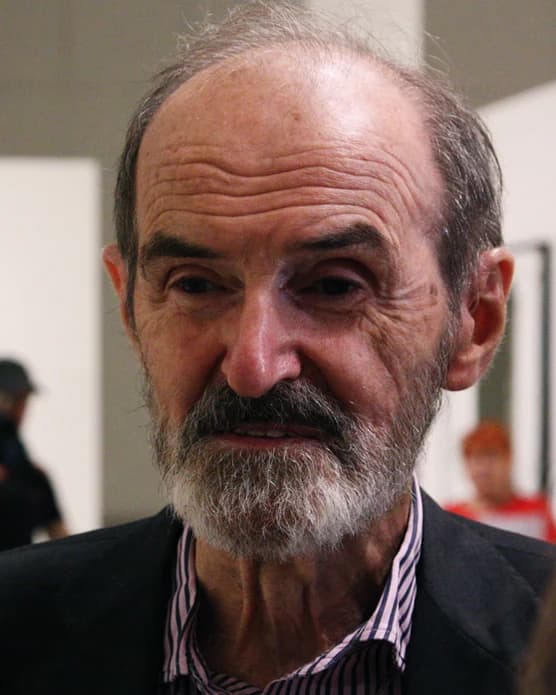
Biography
In 1968 Erik Bulatov’s solo exhibition in Moscow lasted one day and was held in the Blue Bird café. Three years earlier his paintings, together with works by Vyacheslav Kalinin, had hung briefly at the Kurchatov Institute. He had no other shows in his own country in the Soviet years: the censors would not allow it.
Abroad he was exhibited from 1973, while the first exhibition of his graphic work at the Tretyakov Gallery did not open until 2003.
He was born on 5 September 1933 in Sverdlovsk, where his father, Vladimir Borisovich Bulatov, a Communist Party official from Saratov, had been sent on assignment. When the boy was three, the family returned to Moscow. His mother, Raisa Pavlovna Shvarts, had come to the USSR from Białystok at fifteen, without knowing Russian, and became a stenographer. In 1941 mother and son were evacuated to Saratov, then to Sverdlovsk, and in February 1943 they returned to Moscow. His father was killed at the front in 1944. According to Bulatov, his father for some reason firmly believed that his son would become an artist.
In 1958 Bulatov graduated from the Surikov Art Institute. From 1959 he worked for the children’s publishers Detgiz and Malysh, most often in partnership with Oleg Vasiliev; among their joint books is the Ukrainian folk tale “The Mitten” (1979). For almost three decades illustration kept him, and he divided the year by the rule “half a year for books, half a year for painting”. Both artists were deeply absorbed by Robert Falk and Vladimir Favorsky. In the 1960s Bulatov, together with Ilya Kabakov, Eduard Steinberg, Vasiliev, Vladimir Yankilevsky and Viktor Pivovarov, belonged to the circle that the Czech critic Jindřich Chalupecký named, after the block where they lived, the “Sretensky Boulevard Group”. They could not show their work officially and gathered at Kabakov’s to look at and discuss what they had made. It was more a fellowship of like-minded artists than a school with a shared style, and Moscow Conceptualism grew out of it.
From 1963 to the end of the 1960s he tried out various modernist manners and worked out how space, light and colour function in a picture. It was then that his theory took shape: a picture consists of two mutually exclusive parts, the real plane of the canvas and an imaginary space that can be built on one side of it. Tradition reconciled these parts; Bulatov set them against each other. It seems to me that everything he did afterwards rests on this: the inscription lies on the plane, while the landscape behind it recedes into depth.
In the early 1970s came large canvases in which slogans, signs and words from posters are written over the sky, fields or a city street. In 1972 he painted “Horizon”; in the perestroika years the picture was taken for a parody and filed under Sots Art. Bulatov himself did not count himself part of Sots Art and said there was no irony in his work. Pop Art and Sots Art, he explained, set out to prove that social reality was the only reality, whereas he wanted to show that social space has a boundary and that freedom always lies beyond it.
Recognition came all at once. In 1988 there were solo exhibitions at the Kunsthalle Zürich and the Centre Pompidou, he took part in the Venice Biennale, and he came to be called “the artist of perestroika”. In 1989 he was shown at the Institute of Contemporary Arts in London and in New York, where he moved that same year; in 1992 he settled in Paris and lived there to the end. His works entered the Tretyakov Gallery, the Russian Museum, the Centre Pompidou, the Museum Ludwig in Cologne, the Albertina in Vienna and the Guggenheim Museum in New York.
The first retrospective of his paintings in Russia opened at the Tretyakov Gallery in 2006. Then came the Innovation Prize (2013), the exhibition “I Live, I See” at the Manege (2014), large canvases for the opening of the Garage Museum’s new building and the painting “Freedom” for the Boris Yeltsin museum (both in 2015), and the mural “Stop, Go. A Barn in Normandy” at the Art-Ovrag festival in Vyksa (2020). He was a corresponding member of the Saxon Academy of Arts (1997), an honorary member of the Russian Academy of Arts (2008) and a Chevalier of the French Order of Arts and Letters (2015).
Erik Bulatov died on 9 November 2025 in Paris at the age of ninety-two. In 2026 the ROSIZO centre in Moscow showed his exhibition “Selected Pages”.
Profile notes
Profile and sources
Image
Artist image
Valerij Ledenev; Wikimedia Commons; CC BY-SA 2.0.
