
1953–present
Enrique Chagoya
Enrique Chagoya was born in Mexico City in 1953, studied economics, and received his art training only in California. His prints and drawings combine Aztec manuscripts, comics and Disney characters. He is known for the Codex series on amate paper and for his reworkings of Goya's prints, and he teaches at Stanford University.
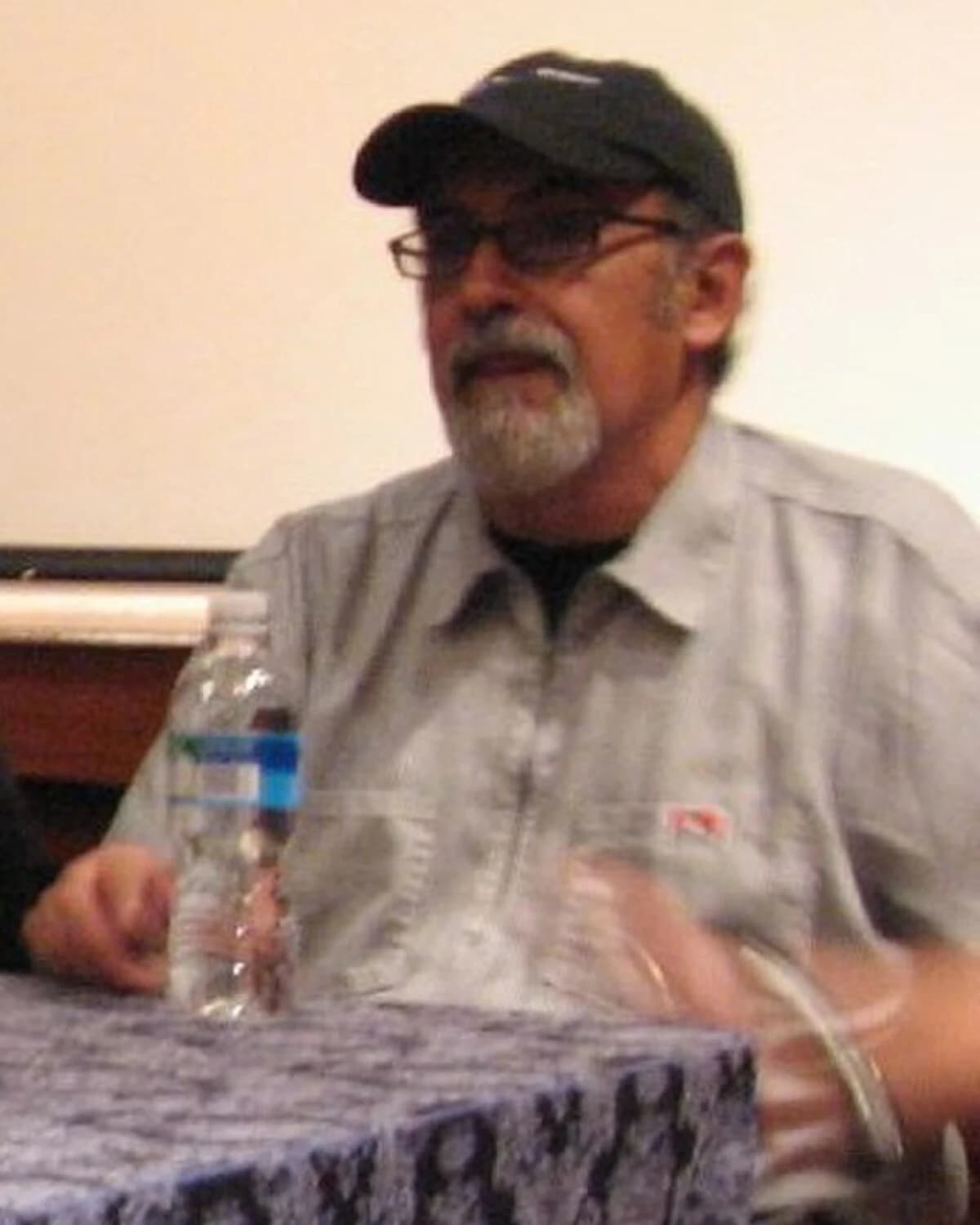
Biography
On 10 June 1971 a student demonstration in Mexico City was broken up by a paramilitary group called Los Halcones (“the Hawks”). Enrique Chagoya, then an eighteen-year-old schoolboy, escaped by leaping over a shop's closing gate.
He later said that the day taught him how dangerous it can be to have a critical mind and to use the freedom of expression guaranteed by the constitution.
He was born on 23 September 1953 in Mexico City. His father worked at the Banco de México and taught his son to draw; his office held forged banknotes and printing plates, almost a museum of forgery, and this, the artist says, was his first encounter with the idea of appropriation. He was raised in part by a nurse from an Amerindian family, from whom he learned respect for the indigenous peoples of his country and their history. He read comics, Mexican and American, and watched “The Lone Ranger” and “I Love Lucy” dubbed into Spanish. From 1971 to 1974 Chagoya studied economics at the National Autonomous University of Mexico, where the teachers included political refugees from other Latin American countries. At the same time he drew political cartoons for trade-union newsletters, and as a student he took part in rural development projects. In 1978 he spent some time helping to organise farmworkers in the Rio Grande Valley in Texas, and in 1979 he moved to Berkeley. Of this he said: “I did not emigrate, I was imported.” He worked as a freelance illustrator and graphic designer. In 1984 he received a BFA from the San Francisco Art Institute, and in 1987 an MFA from the University of California, Berkeley. From 1987 to 1990 he directed the Galería de la Raza in San Francisco, and since 1990 he has taught. He became a United States citizen in 2000.
A large pastel, “Their Freedom of Expression. The Recovery of Their Economy”, became a milestone; it was shown in New York in 1984 at the “Artists Call Against US Intervention in Central America”. Before that, in Mexico, he had worked in abstraction; he considered the sheet a political statement rather than an artwork, but his career as a political artist began with it. Ronald Reagan's head is set on a huge Mickey Mouse and Henry Kissinger's on a small one, and together they paint slogans on a wall. The format of 80 by 80 inches and the black-and-red palette became a template for the drawings in his MFA exhibition at Berkeley and for many later works. Among his other large pastels are “Double Agent” (1989), with the elder George Bush as a superman, which refers to the Iran-Contra affair; “Nose Job” (1989), with Reagan as Pinocchio; and a sheet on the Iraq war (2004) in which the younger George Bush appears as Dopey from “Snow White”.
Around 1992, the quincentenary of Columbus's landing, he began the Codex series, based on Mesoamerican manuscripts. These come in two forms: accordion-fold books with lithographs, and large sheets on amate paper, which was used before the Spanish arrived. In “Uprising of the Spirit” (1994, Los Angeles County Museum of Art), Superman, shedding his pilgrim disguise, faces Nezahualcoyotl, the poet and ruler of Texcoco. The artist's point is that the Pilgrims and the conquistadors were the first “illegal aliens” of North America, and that today's immigrants should be treated humanely. He calls this method “Reverse Anthropology”. “The Governor's Nightmare” (1994) refers to the anti-immigrant policies of California governor Pete Wilson, and its model is taken from the Codex Magliabechiano.
One work proved controversial: the accordion-fold lithograph “The Misadventures of the Romantic Cannibals”, a female figure with a Christ-like head in a sexually suggestive setting. In 2010, at a city-run museum in Loveland, Colorado, a visitor who had travelled from Montana smashed its case and tore it; a court ordered her to pay $2,991 in restitution. The artist has said that the work concerns the cases of sexual abuse in the Catholic Church. Later the pastor of a church in Loveland wrote to him, and Chagoya gave the congregation a painting of Christ he made for it, with the word “love” on a banner; the congregation received it with applause.
Another strand of his work is prints in which he reworks Goya's plates, more than thirty of them. The first, “Contra el bien general” (“Against the common good”), appeared in 1983: he replaced the head of a scribe with Reagan's. In “Goya Meets Posada”, two artists who never met shake hands, while the artist himself, as a boy, skates by in the corner.
In 2021 Chagoya received a Guggenheim Fellowship and was elected to the National Academy of Design in New York; he is also a Tiffany Fellow. In 2019–2022 his series “Detention at the Border of Language” was shown at Stanford, Santa Clara and Madison, and in 2024 he took part in an exhibition at the Pérez Art Museum Miami. He lives in San Francisco and teaches at Stanford.
Profile notes
Profile and sources
Image
Artist image
Libby Rosof; Wikimedia Commons; CC BY 2.0.
