
19.01.1824–11.01.1884
Emmanuil Dmitriev-Mamonov
At fifteen, before he had studied painting, Emmanuil Dmitriev-Mamonov sketched Gogol reading “Dead Souls”, and many consider this drawing the best of his works. He later portrayed the Moscow Slavophiles, studied at the Moscow School of Painting and Sculpture, lived in Italy and published articles on art and on the fate of Slavophilism.
Biography
The drawing was made in pen or pencil (sources differ) in the autumn of 1839, at the Nashchokin house, where Gogol was reading the first chapters of “Dead Souls”. Its author was fifteen. He caught the reader’s sly smile, his pose and gesture, and the long hair that Gogol would grow from 1840 is not yet on the sheet.
Emmanuil Dmitriev-Mamonov was born on 19 January 1824 (7 January, Old Style) in Moscow. His father, Alexander Ivanovich, a veteran of the war of 1812 and later a major general, drew battle scenes and was one of the founders of the Society for the Encouragement of Artists in Saint Petersburg; he died when his son was twelve. The boy had his first drawing lessons from him. In 1840 he entered the law faculty of Moscow University and, between lectures, attended classes at the Imperial Academy of Arts in Saint Petersburg. At the university he became close to Vasily Yelagin, son of Avdotya Petrovna Yelagina, in whose salon the future Slavophiles gathered (the Slavophiles were a circle of Russian thinkers who defended a distinct Russian path of cultural development).
For this circle he became the house portraitist. His drawings of the 1840s made up the “Yelagin Album”: Khomyakov, the Kireevsky brothers, Aksakov, many of them in several versions. Later 101 photographs were made from the album. In the 1850s Dmitriev-Mamonov studied at the Moscow School of Painting and Sculpture, and in 1858 the Academy of Arts awarded him the title of portrait painter. He portrayed Yazykov, Pavlov, Konstantin Aksakov, Nashchokin (an oil portrait of the late 1840s or early 1850s is in the State Historical Museum), Pyotr Kireevsky, and in 1859 he showed a portrait of General Yermolov in Saint Petersburg. The critic Mikhail Mikhailov of the journal “Sovremennik” singled it out from the whole exhibition for its lack of routine and its “living, almost speaking face”. At about that time, apparently, the formal portrait of Shamil was made. In 1852 the Moscow governor-general Zakrevsky put him on the list of Slavophiles placed under police surveillance.
He drew Gogol many times: at least seven graphic portraits are known. In 1848 Vera Aksakova wrote to her father that Mamonov had drawn the writer “astonishingly like”, but in his absence, from memory. In 1852 a lithograph appeared dated 5 March, and it is still disputed. Some hold that the date should be read as 5 February, two weeks before Gogol’s death, and that the drawing was made from life. Others think the lithograph was redrawn from an earlier portrait. According to Viskovatov, the artist himself called the date a mistake. Contemporaries judged it differently: Bessonov found the portrait poor, Smirnova-Rosset thought it unsuccessful, and Gogol’s mother found it a good likeness. The print run was fifty copies at one rouble each, and engravings were later made from the lithograph in Leipzig by Brockhaus and by Bachmann. A lithograph of Gogol in his coffin was wrongly attributed to him: its author was Vladimir Rachinsky.
What interests me most about the 1839 drawing is that he was not yet a professional. Some critics still call him an amateur, pointing to the abundance of profiles. But by the end of his studies at the School, profiles almost disappear, and the portraits of Kireevsky, Nashchokin and Yermolov are painted full-face and in three-quarter view.
He also wrote about painting. In 1856–1859 three of his articles appeared in “Russkaya beseda” (“Russian Conversation”), among them “On Flemish Painting”, in which he set the Flemish against the Italians and reproached them for abandoning the ideal. The article was challenged by the journal’s censor von Kruse and by Sergey Aksakov, who was offended by the comparison of Gogol with Teniers; in “Sovremennik” Vladimir Stasov argued against him. In 1858 he signed a collective letter from 48 writers and scholars protesting against antisemitic articles in the journal “Illustratsiya”.
In 1860 the Academy sent him abroad as a pensioner. He settled in Italy for a long time, visited Paris and Dresden, and in Rome met the Russian artists Mikhail Botkin and Fyodor Bronnikov. He grew close to Mikhail Bakunin, painted his portrait, and took an interest in Marx. A family genealogy says of him: “First a Slavophile, then a Bakuninist.” He followed the peasant reform, and in 1863, during the Polish uprising, he broke with the Slavophiles by calling for Poland to be given freedom. By the early 1870s he had moved away from Pan-Slavism.
In 1873 “Russkii arkhiv” (“Russian Archive”) published his article “The Slavophiles”, a reply to Alexander Pypin’s essays. He argued that Khomyakov’s followers, Ivan Aksakov and Yury Samarin, had lost the free spirit of the first Slavophiles. The editor Pyotr Bartenev refused to print the second, religious part. Aksakov, having read the proofs, answered with a letter to the publisher containing sharp attacks, and it appeared in the same issue. Dmitriev-Mamonov himself was abroad, and was not allowed to reply. In 1869 he had already written the pamphlet “The Gentleman and the Cook”, not intended for print; Mikhail Gershenzon published it in 1923.
In 1874 the artist returned to Russia and stayed in Dorpat (now Tartu), with Yelagin’s family. After Yelagin’s death in 1879 he moved to Saint Petersburg, where he associated mainly with Konstantin Kavelin.
He died on 30 December 1883. His works are held in the Tretyakov Gallery, the Russian Museum, the State Historical Museum, the Pushkin House and other collections; there have been no solo exhibitions of his work.
Related context
Associations
Works connected through artistic movements, cultural context and period. Priced works available in this market appear first.








Profile notes
Profile and sources
Image
Artist image
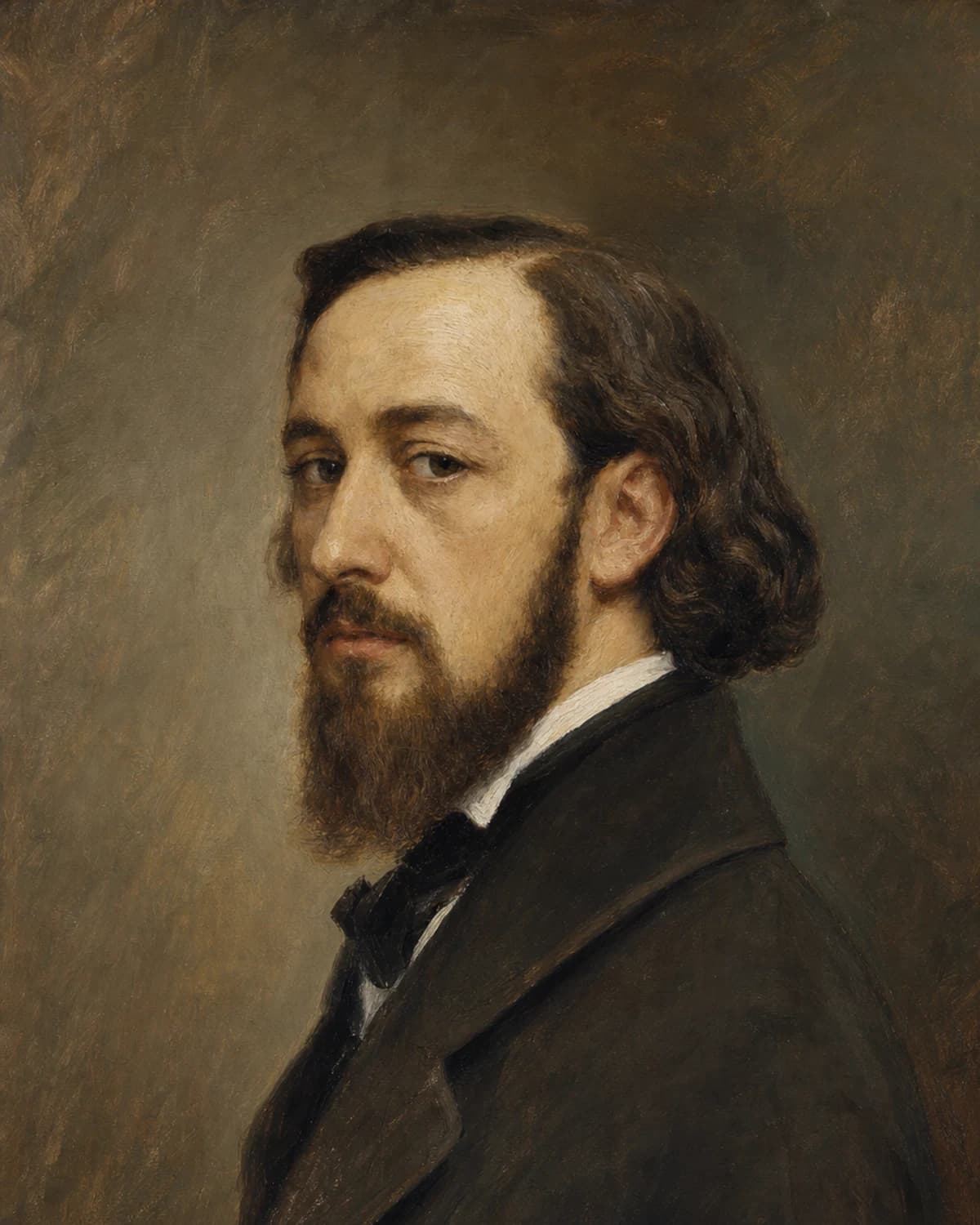
На основе открытого изображения: Emmanuil Dmitriev-Mamonov; Wikimedia Commons; Public domain.
