
01.08.1857–13.01.1936
Emily Shanks
Emily Shanks (1857–1936), the daughter of an English merchant in Moscow, studied under Polenov, Vladimir Makovsky and Pryanishnikov, and in 1894 became the first woman member of the Society of Travelling Art Exhibitions. Children appear in almost all her genre paintings; “New Girl at School” was bought by Pavel Tretyakov for his gallery. In 1913 she moved to London, where she spent the last twenty-odd years of her life.
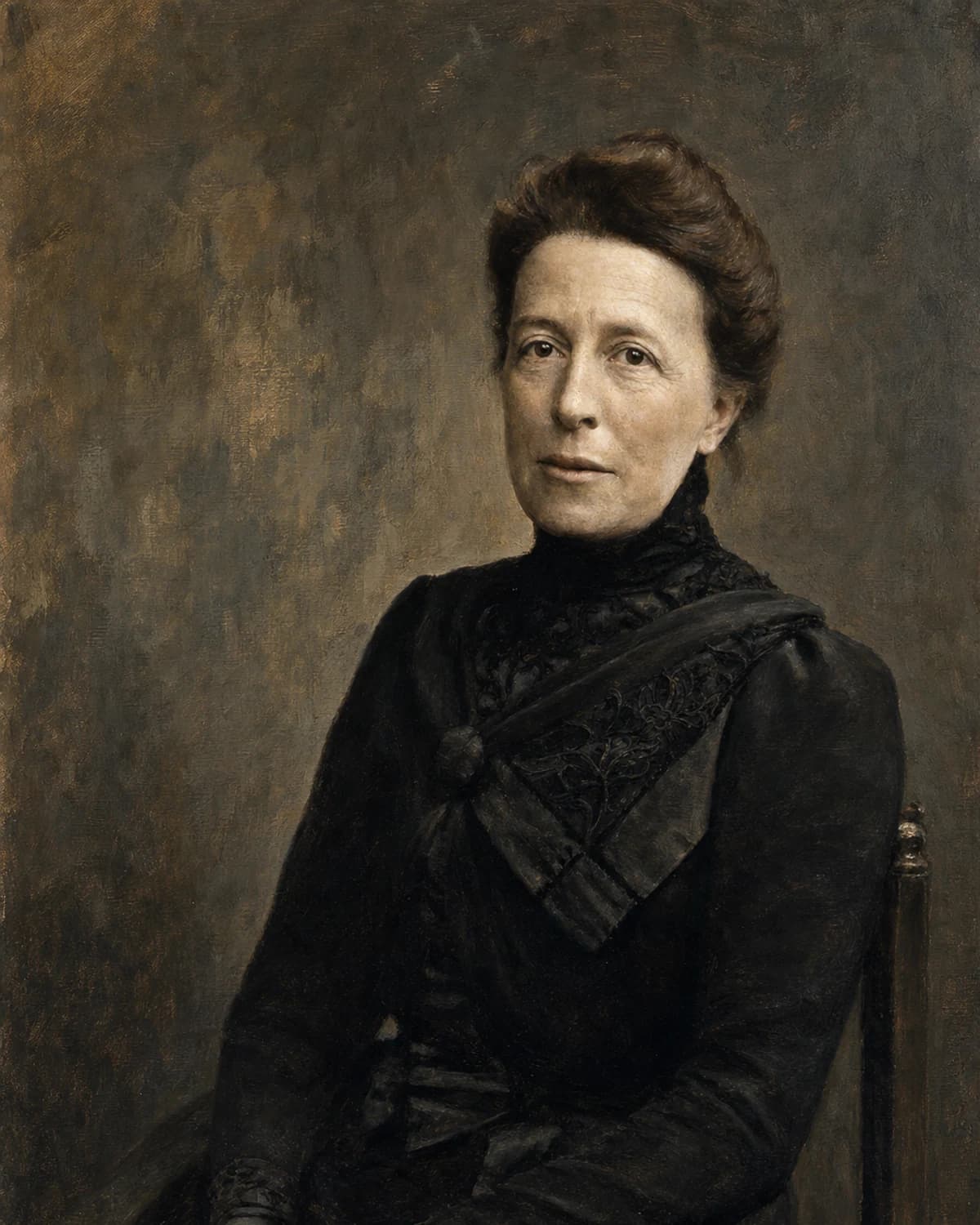
Biography
In 1892 the Peredvizhniki accepted Emily Shanks’s painting “New Girl at School” for their exhibition: a girl on her first day in class. Ilya Repin praised the canvas, Vladimir Stasov wrote of its grace and truthful expression, and Pavel Tretyakov bought it from the artist for his gallery, where it has remained.
Two years later, in 1894, Shanks was elected a member of the Society of Travelling Art Exhibitions for her painting “The Ink Spot”. Before her, there had been no women among the Society’s members.
She was born in Moscow on 1 August 1857, the second daughter of James Steuart Shanks and Mary Louisa Schilling. Her father had come to Moscow in 1852 and, with the Swede Henrik Conrad Bolin, founded the trading house Shanks & Bolin, Magasin Anglais, on Kuznetsky Most, one of the most fashionable shops in the city. There were eight children in the family; they lived in comfort, and the daughters had the time and means to make friends among the Moscow intelligentsia. The eldest sister, Louise, married Aylmer Maude and translated Tolstoy into English. The youngest, Mary, illustrated Tolstoy’s works and was a friend of his eldest daughter, Tatyana; both sisters, Emily and Mary, are recorded in the visitors’ book of the Tolstoy home. Her patronymic, Yakovlevna, is formed from her father’s name, James.
From 1882 Shanks attended the Moscow School of Painting, Sculpture and Architecture as an auditing student. Her teachers were Vasily Polenov, Vladimir Makovsky, Illarion Pryanishnikov, Yevgraf Sorokin, Sergei Korovin and Nikolai Nevrev, and she was taught anatomy by Alexander Gubarev, a professor of medicine at Moscow University. In 1888 she won two minor silver medals, for painting and for drawing, and in 1890 she graduated with the rank of class artist and a major silver medal for the painting “Nanny’s Letter”. She was a friend of Polenov and of his sister Yelena Polenova: in the winter of 1891–1892 the Shanks sisters regularly painted with them, as the Polenovs’ letters show clearly. In 1894 she painted the artist’s wife, Natalya Vasilyevna Polenova (the portrait is in the Polenov Museum-Reserve), and in the picture “Among the Flowers”, the Polenovs’ daughter.
Children are present on almost every one of her canvases. In “The Older Brother” (1891), with which she first appeared at the Peredvizhniki, three teenagers carry out “scientific experiments” at home. In “A Difficult Task” (1893), later called “Hiring a Governess”, a seated lady questions a young governess while two children and a nanny look on; the picture is now in Tyumen, at the Slovtsov Museum Complex. In “The Ink Spot” three girls try to wash the ink off a visitor’s dress. The collector Ekaterina Stanitskaya bought it, and where it is now is unknown, so I can judge the picture only from descriptions. “A Guest at the Institute” (about 1896), in which schoolgirls greet a former pupil, ended up in the Czech Republic, at the Gallery of Fine Arts in Náchod; “Soap Bubbles” (about 1897) in the Syzran Museum of Local History; and “Ear Inspection”, a scene in a Russian hospital, in the Chelmsford Museum in England. Around 1909 she painted children building a toy aeroplane. Critics readily praised her pictures of children, although one of them found “The Ink Spot” less spontaneous than her earlier work.
She exhibited with the Peredvizhniki until 1915, and in 1894 was a delegate to the First Congress of Russian Artists and Art Lovers. Her work was also shown at the All-Russian Industrial and Art Exhibition in Nizhny Novgorod in 1896, at the Moscow Society of Art Lovers, where she was listed as an amateur member in 1890 and as an artist from 1899, at the Lemercier Gallery (1909–1913), in Kazan (1909), at the International Art Exhibition in Rome (1911) and at the 11th International Exhibition in Munich (1913).
Her father died in 1911, relatives and friends were leaving Russia one after another, and in 1913, after holding a solo exhibition of more than fifty paintings in Moscow, Shanks moved to London. The family lost its business and its house in Moscow in the revolution. In 1916 and 1918 she showed two Moscow pictures at the Royal Academy summer exhibitions, “A Bit of Moscow” and “Peaceful Moscow”. In England she painted portraits of her relatives and landscapes of London, the Swiss mountains, the Pyrenees and France, and she signed her later works in English. Emily Shanks died in London, in Kensington, on 13 January 1936, in her seventy-ninth year.
Related context
Associations
Works connected through artistic movements, cultural context and period. Priced works available in this market appear first.








Profile notes
Profile and sources
Image
Artist image
На основе открытого изображения: Emily Shanks; Wikimedia Commons; Public domain.
