
06.09.1897–26.10.1976
Emiliano Di Cavalcanti
Emiliano Di Cavalcanti (1897–1976) conceived and designed the Week of Modern Art of 1922 in São Paulo, and after two years in Montparnasse began painting mulatto women, carnival and the back streets of Rio in dense colour. “Five Girls from Guaratinguetá” of 1926 is his best-known picture. He was jailed twice for his communist views, and in 1951 helped set up the first São Paulo Biennial.
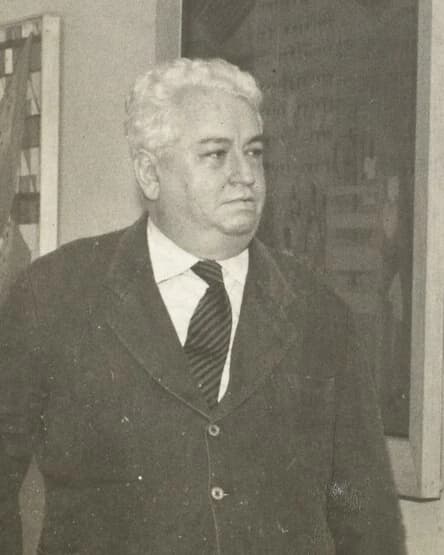
Biography
From 11 to 18 February 1922 the Week of Modern Art ran at the Municipal Theatre of São Paulo: music, poetry, lectures, an exhibition. Di Cavalcanti conceived it and put it together, and he drew the catalogue and the programme. His own paintings in that exhibition were still symbolist, with a touch of expressionism.
He was born on 6 September 1897 in Rio de Janeiro and bore the name Emiliano Augusto Cavalcanti de Albuquerque Melo. He grew up in the house of his maternal uncle, frequented by abolitionists, and published his first drawings in the magazine “Fon-Fon”. In 1916 he entered the law faculty in São Paulo and never finished the course; in 1917 the bookshop O Livro held his first exhibition, caricatures only.
In 1918 he fell in with the circle of Mário and Oswald de Andrade and Guilherme de Almeida, out of which the Week grew. From 1923 to 1925 he lived in Paris as correspondent of the newspaper “Correio da Manhã”, attended the Académie Ranson, met Picasso, Matisse, Braque, Léger, Satie and Cocteau, and exhibited in London, Berlin, Brussels and Amsterdam. Back in Rio, he joined the Brazilian Communist Party and resolved to paint something of his own, something Brazilian: hence “Five Girls from Guaratinguetá” of 1926, five women in hats by a peeling wall, one in a blue dress, two with parasols, the fifth looking out of a window somewhere past the viewer. In 1929 he made panels for the João Caetano Theatre in Rio, in 1930 he took part in an exhibition of Brazilian art at the Roerich Museum in New York, and in 1932, with Flávio de Carvalho, Antonio Gomide and Carlos Prado, he founded the Club of Modern Artists in São Paulo and published an album of twelve drawings, “Brazilian Reality”, mocking the military. In that same year, 1932, during the Constitutionalist Revolution, he was arrested for the first time. On his release he married the painter Noêmia Mourão; in 1936 they were both arrested, hid on the island of Paquetá, and friends got them out and helped them leave for Paris. There, at the International Exposition of 1937, he won a gold medal for his murals in the pavilion of the Franco-Brazilian coffee company, and he worked in radio. In 1940, ahead of the German invasion, they fled to Brazil, leaving behind some forty paintings; these were found in 1966 in the basement of the Brazilian embassy in Paris. By one account the pictures were shipped from Europe and lost on the way, by another they were left in Paris; the second seems to me the more likely, since it was in the embassy that they turned up.
From 1940 he lived in São Paulo and fought abstraction in articles and lectures, among them one at the Museu de Arte de São Paulo in 1948. To the first São Paulo Biennial of 1951 he personally invited Diego Rivera and David Siqueiros, and both came; to the Museu de Arte Moderna de São Paulo he gave more than five hundred drawings, now 564 sheets in the university’s Museu de Arte Contemporânea. At the second Biennial of 1953 he shared the prize for best national painter with Alfredo Volpi. In 1954 the Museu de Arte Moderna in Rio showed a retrospective of his work; in 1956 he took part in the Venice Biennale, and at Oscar Niemeyer’s suggestion he designed a tapestry for the Alvorada Palace and painted the Stations of the Cross for the cathedral in Brasília. In 1964 President João Goulart appointed him cultural attaché in France; he left for Paris but, after the coup, never took up the post. A retrospective in 1971 at the Museu de Arte Moderna de São Paulo, an honorary doctorate from the University of Bahia, a stamp with the “Five Girls” and the Portuguese Order of Prince Henry in 1975 fell in his last years.
After 1940 his canvases carry almost nothing but Brazilian subjects: mulatto women, Black Brazilians, carnival, empty alleys, the tropical shore. In manner he is compared with the Mexican muralists, but without their politics.
Di Cavalcanti died on 26 October 1976 in Rio de Janeiro. He lay in state in the lobby of the Museu de Arte Moderna and was buried in the São João Batista Cemetery. In 1977 Glauber Rocha made a short film about him, “Di”, and for the centenary in 1997 three museums in Rio and São Paulo held commemorative exhibitions.
Related context
Associations
Works connected through artistic movements, cultural context and period. Priced works available in this market appear first.








Profile notes
Profile and sources
Image
Artist image
Unknown Unknown; Wikimedia Commons; Public domain.