
31.05.1923–27.12.2015
Ellsworth Kelly
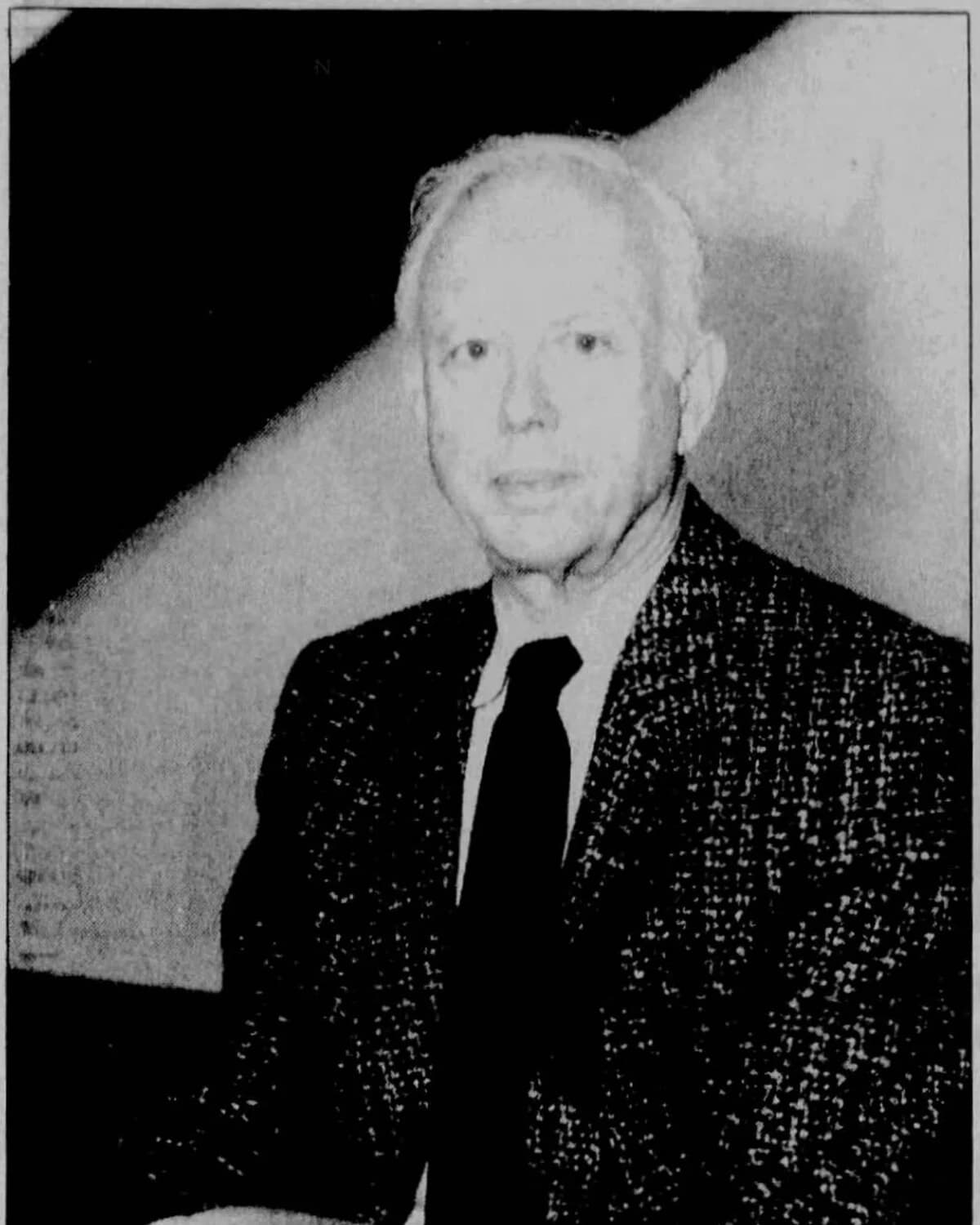
Ellsworth Kelly (1923–2015) painted canvases of a single flat colour and cut them at slanting angles, taking his shapes from things seen: light on the Seine, the outline of a leaf, a shadow. Six years in Paris after the war, a first New York show at Betty Parsons’s in 1956, a studio in Spencertown from 1970; his only building, “Austin”, opened in Texas two years after his death.
Biography
In 1959 Ellsworth Kelly, chatting with Agnes Martin, his downstairs neighbour on Coenties Slip, was fiddling with the paper lid of a coffee cup. He cut into the circle, folded it, set it on the table, and the lid rocked. Soon came his first sculpture in the round, “Pony”, named after a child’s rocking horse, and after it the “Rocker” series.
That was how he worked all his life: he did not compose pictures but found them. “I wanted to find them,” he said later.
Kelly was born on 31 May 1923 in Newburgh on the Hudson, the second of three sons of an insurance executive and a former schoolteacher. The family moved to Oradell in New Jersey, near the reservoir, where at eight or nine his grandmother got him into birdwatching; Audubon stayed with him for a long time. His parents agreed to pay only for technical training, and from 1941 he studied at the Pratt Institute in Brooklyn until, on 1 January 1943, he was inducted into the army. He asked to be assigned to the 603rd Engineers Camouflage Battalion, where many artists served: Fort Dix, Camp Hale in Colorado with the mountain ski troops, Fort Meade. The battalion belonged to the “Ghost Army”, a unit that used inflatable tanks and trucks to mislead the enemy about the disposition of the Allies; in Europe Kelly spent most of his time at the wheel of a truck, drawing in his free hours. On the G.I. Bill he studied in 1946–1947 at the School of the Museum of Fine Arts in Boston, and in 1948, after hearing Max Beckmann lecture on Cézanne, he left for Paris. He hardly attended the École des Beaux-Arts, but he met John Cage and Merce Cunningham, Jean Arp and Brâncuși. By May 1949 he had painted his first abstractions; “Seine” (1950) is made of black and white rectangles placed by lot, and the eight collages “Spectrum Colors Arranged by Chance” (1951) were made from numbers drawn on slips of paper: eighteen hues on a grid forty inches by forty. His first solo exhibition was at the Galerie Arnaud in 1951. In six years in France he sold one painting, spoke French badly, was evicted from his studio in 1953 and in 1954 returned to America.
New York struck him as “very tough”: his work was thought too European. In May 1956 Betty Parsons gave him his first New York exhibition; in 1957 the Whitney Museum took “Atlantic”, “Bar” and “Painting in Three Panels” for “Young America” and bought “Atlantic”, two white arcs on black, his first museum purchase; the critics were troubled that a painting should consist of three canvases. In 1958 “Concorde Relief I” was cut from elm, the first of his thirty wood sculptures. In 1959 he was included in the Museum of Modern Art’s “Sixteen Americans”, in 1961 he was shown at the São Paulo Biennial, in 1963 the relief “Blue Tablet” hung in “Toward a New Abstraction” at the Jewish Museum, and in 1966 “Blue Disc” went into “Primary Structures” alongside artists much younger than he. “Yellow Piece” (1966) became the first shaped canvas: rounded corners and a single colour turn the wall behind the picture into its ground. In “Green White” (1968) the triangle appeared for the first time: a green inverted trapezoid above a white triangle. For the Empire State Plaza in Albany he made “Yellow Blue” in 1968, his first steel sculpture, nine feet high and almost sixteen wide, the only one in painted steel.
In 1970 Kelly left New York for Spencertown and rented a former theatre in nearby Chatham, the most spacious of his studios; a year later the fourteen paintings of the “Chatham Series” began, each in the form of an inverted letter L made of two joined single-colour canvases. The twelve “Gray” paintings (1972–1983) were conceived as a statement against war and are therefore drained of colour. From 1973 he regularly made large outdoor sculptures in unpainted steel, aluminium and bronze, often in the form of totems, like “Curve XXIII” (1981); in the 1980s sculpture took as much of his energy as painting, and in that decade more than sixty per cent of his 140 sculptures were made. He took up lithography in earnest in 1964–1966 with Maeght in Paris, and from 1970 worked with Gemini G.E.L.; the “Suite of Plant Lithographs” grew to 72 sheets, and “Purple/Red/Gray/Orange” (1988), eighteen feet long, is called the largest single-sheet lithograph. His first retrospective was at the Museum of Modern Art in 1973, and the Guggenheim retrospective of 1996 travelled to Los Angeles, the Tate and the Haus der Kunst in Munich; in 2008 the Musée d’Orsay hung him beside Cézanne. There were many commissions: the “Houston Triptych” (1986), the “Dallas Panels” (1989), a memorial at the Holocaust Memorial Museum in Washington (1993), panels for the Bundestag (1998), “White Curve” for the Art Institute of Chicago (2009), the curtain “Spectrum VIII” (2014) for the auditorium of the Fondation Louis Vuitton. In 2000 he received Japan’s Praemium Imperiale, in 2013 the National Medal of Arts.
In a 1996 interview he said: “Canvas rots. Paint changes color. But you keep trying to freeze the world.”
From 2001 he worked in Spencertown in a 20,000-square-foot studio rebuilt by Richard Gluckman. In 2015 he gave the Blanton Museum of the University of Texas the design for a stone building for contemplation, conceived back in 1986 for a private collector and never built: coloured glass, a wooden totem, fourteen black-and-white marble panels. Kelly died in Spencertown on 27 December 2015, at ninety-two. “Austin”, his only building, opened on 18 February 2018; in 2019 the United States Postal Service issued ten stamps with his works, and in 2024 the Ghost Army received the Congressional Gold Medal.
Profile notes
Profile and sources
Image
Artist image
Walter McCardell for The Baltimore Sun; Wikimedia Commons; Public domain.
