
31.01.1865–21.07.1941
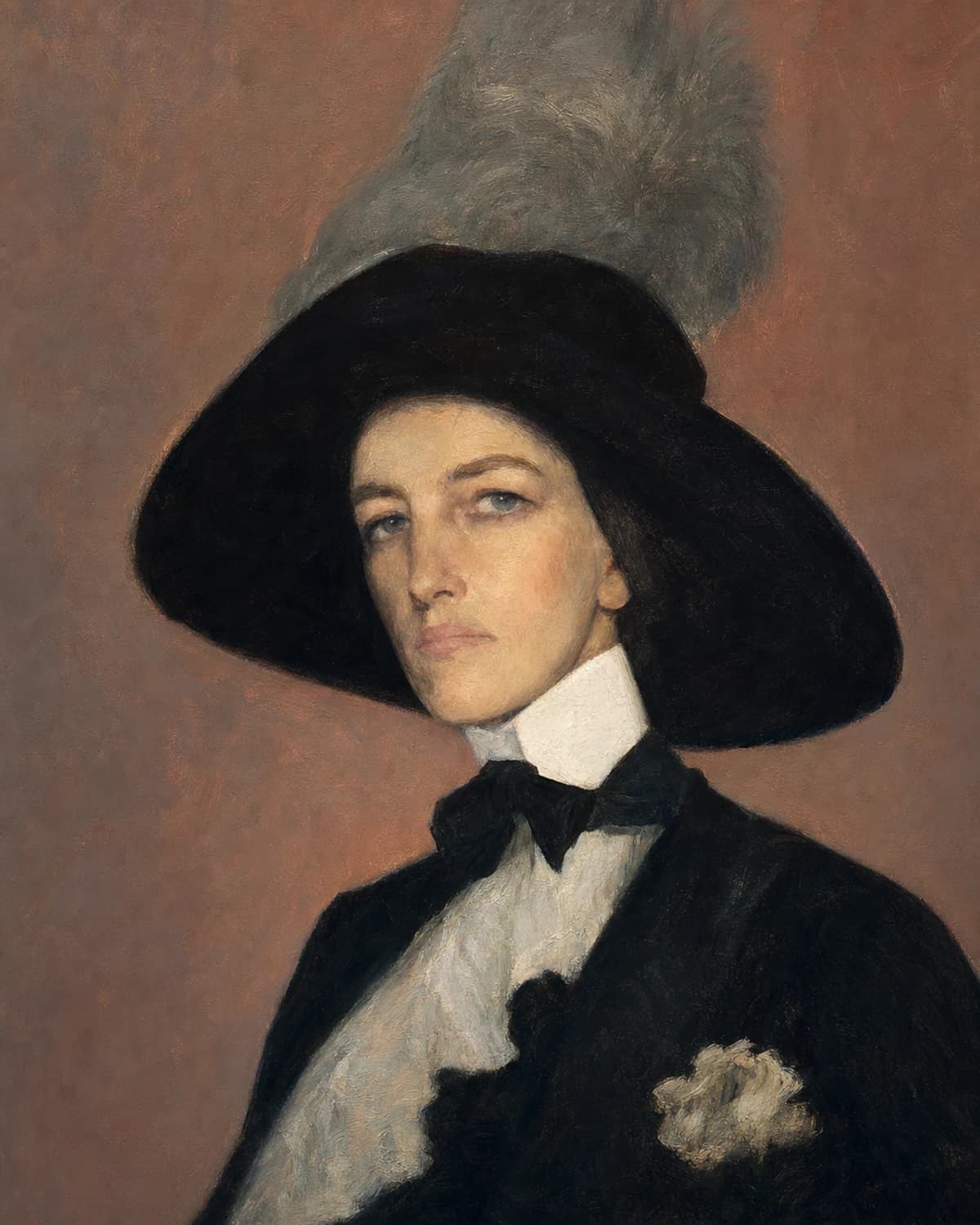
Elizaveta Kruglikova
Elizaveta Kruglikova (1865–1941) lived in Paris for almost twenty years, where she studied etching, taught it at the Académie de La Palette and kept a studio in Montparnasse where the Russian Artistic Circle met. Her main techniques were monotype and silhouette. After returning in 1914 she published the book “Paris on the Eve of the War”, taught in Leningrad and made silhouette portraits of her contemporaries.
Biography
The queens in this pack hold a rake and a sickle, the king stands with a hammer, and the jacks are a Young Pioneer, a sailor and a peasant. Elizaveta Kruglikova came up with her silhouette playing cards in the mid-1920s. They do not form a single series; three different approaches can be seen in them, and only some of the cards are openly propagandist.
The silhouette was almost a hereditary pastime in her family.
She was born on 19 (31) January 1865 in St Petersburg, to Sergei Nikolaevich Kruglikov and Olga Yulievna Neiman. Her father was a military man who painted for his own pleasure, while her grandfather, Nikolai Alexandrovich Kruglikov, was regarded as a notable draughtsman and cut silhouettes as an amateur. Her elder brother Nikolai became a railway engineer and assistant chief of works on the construction of the Ussuri Railway; in 1910 his sister painted his portrait on the porch of his country house, a book in his hands. In 1880 Elizaveta lived with her father in Poltava, met artists from the circle of the Peredvizhniki there and decided that she would devote herself to art. From 1890 to 1895 she attended the Moscow School of Painting, Sculpture and Architecture as an auditing student, studying with Illarion Pryanishnikov, Sergei Korovin and Abram Arkhipov.
In 1895 Kruglikova left for Paris and lived there until 1914. She studied at the Académie Vitti and the Académie Colarossi, set up her own studio in 1900 and from 1902 studied etching with Joseph-Victor Roux-Champion. She brought old engraving and printing techniques back into use, mezzotint and aquatint. But she became best known for monotype, in which each impression exists as a single copy. From 1909 she herself taught etching at the Académie de La Palette. Her studio in Montparnasse, at 17 rue Boissonade, became the meeting place of the Russian Artistic Circle, which, after its address, was simply called “Montparnasse”. Russian and French artists, writers and poets came there.
When the First World War began she returned to St Petersburg and drew close to the World of Art. An exhibition of her own impressions of prints and monotypes had already been held there in 1913. In 1916 the album “Paris on the Eve of the War in Monotypes by E. S. Kruglikova” came out, with texts by Balmont, Benois, Voloshin, Vyacheslav Ivanov, Remizov, Roerich, Sologub and Alexei Tolstoy. She gave the proceeds to Russian artists stranded in France.
After the revolution she took up puppet theatre: in 1919 she became one of the founders of the State Puppet Theatre and made puppets for it herself. In 1922–1929 she taught at the Leningrad VKhUTEMAS and VKhUTEIN, which occupied the building of the Academy of Arts. In 1922 her “Silhouettes of Contemporaries” came out, in 1923 an agitational poster on literacy and illustrations to Conan Doyle’s novel “The Refugees”, and then children’s books, among them Leo Tolstoy’s “The Fire” (1928). In July 1924 she signed a contract with the Academy of Arts publishing house and by early 1925 had cut eighteen silhouette portraits, “Leaders of the October Revolution”, for a poster. The poster was never printed, and the series was published only in 2022. In 1925 her prints and silhouettes of 1902–1925 were shown in Kazan, and in 1928 her work was at the Venice Biennale.
It seems to me that her last years are best told through portraits. In 1933 Pyotr Neradovsky drew her in pencil. In 1938 Mikhail Nesterov painted her portrait, which the Tretyakov Gallery acquired at once; the second, of 1939, was bought by the Russian Museum. It was painted in Moscow, where Kruglikova was staying with the artist N. A. Severtsova in the flat of her late father, Alexei Severtsov, and the sketch for it was made in Koltushi. In that same year, 1939, she came to Moscow to help with an exhibition of former members of the World of Art.
Elizaveta Kruglikova died in Leningrad on 21 July 1941, a month after the war began, and was buried at the Literatorskie Mostki.
Related context
Associations
Works connected through artistic movements, cultural context and period. Priced works available in this market appear first.








Profile notes
Profile and sources
Image
Artist image
На основе открытого изображения: Elizaveta Kruglikova; Wikimedia Commons; Public domain.
